Clear Sky Science · en
Ion–electron synergy-enhanced flexible highly sensitive wireless sensing system with wide strain range
Smart Bandages That Feel Every Move
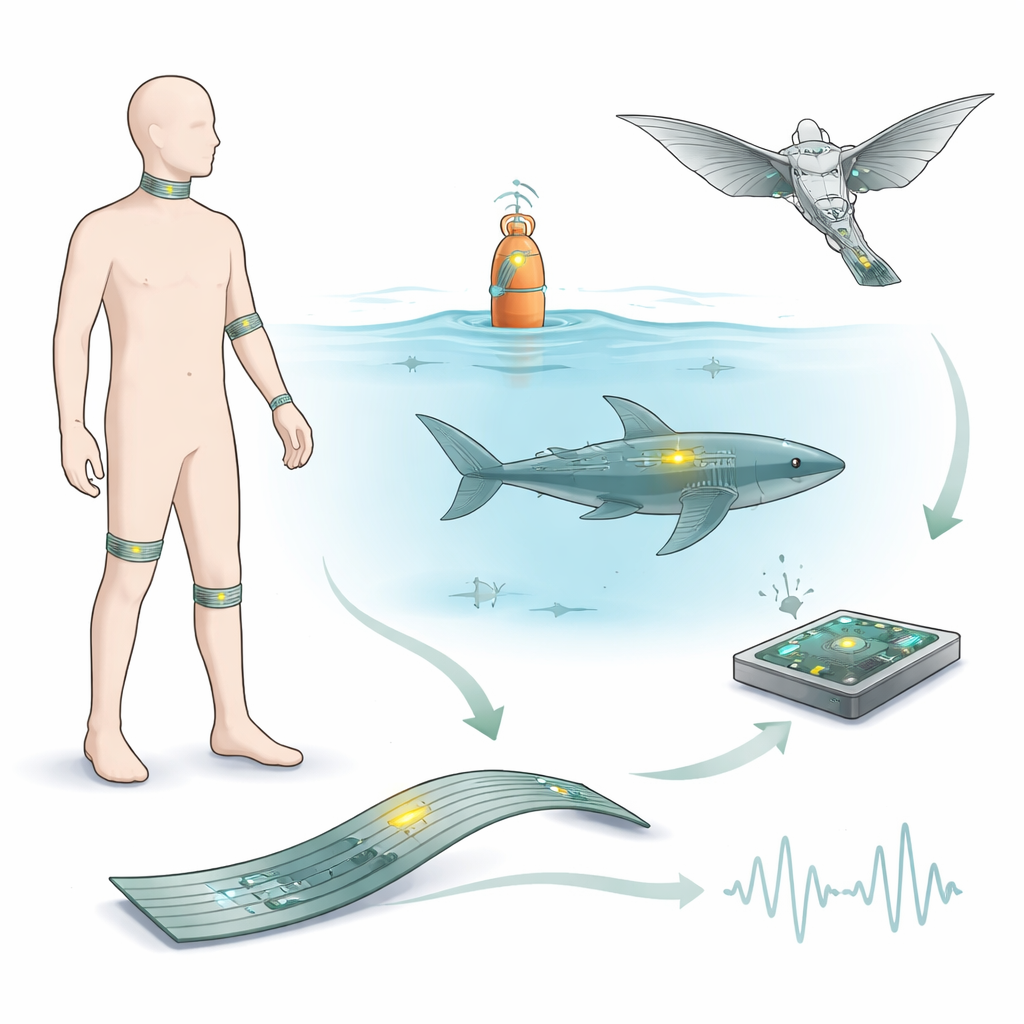
Imagine a thin, flexible patch on your throat that can "hear" you speak without a microphone, or a soft band on a robotic fish that senses how it swims through the ocean. This study introduces a new kind of stretchy, wireless sensor that can feel tiny motions as well as big stretches, all while working reliably on the human body and underwater robots. It points toward future wearables and bioinspired machines that monitor health, movement, and the environment with the sensitivity of living skin.
Why Stretchy Sensing Is So Hard
Many modern gadgets already rely on flexible strain sensors to track bending and stretching in joints, soft robots, or wearable devices. But there has been a stubborn trade-off: sensors that stretch a lot usually lose sensitivity, while very sensitive ones tend to break or give unreliable readings at large strains. Traditional designs mostly use electronic conductors—materials where electrons carry current—laid out in thin films that develop tiny cracks as they stretch. Those cracks can boost sensitivity, but once the film is pulled too far, the paths for electrons simply snap, and the device stops giving useful information.
A Dual-Path Sensor: Ions Plus Electrons
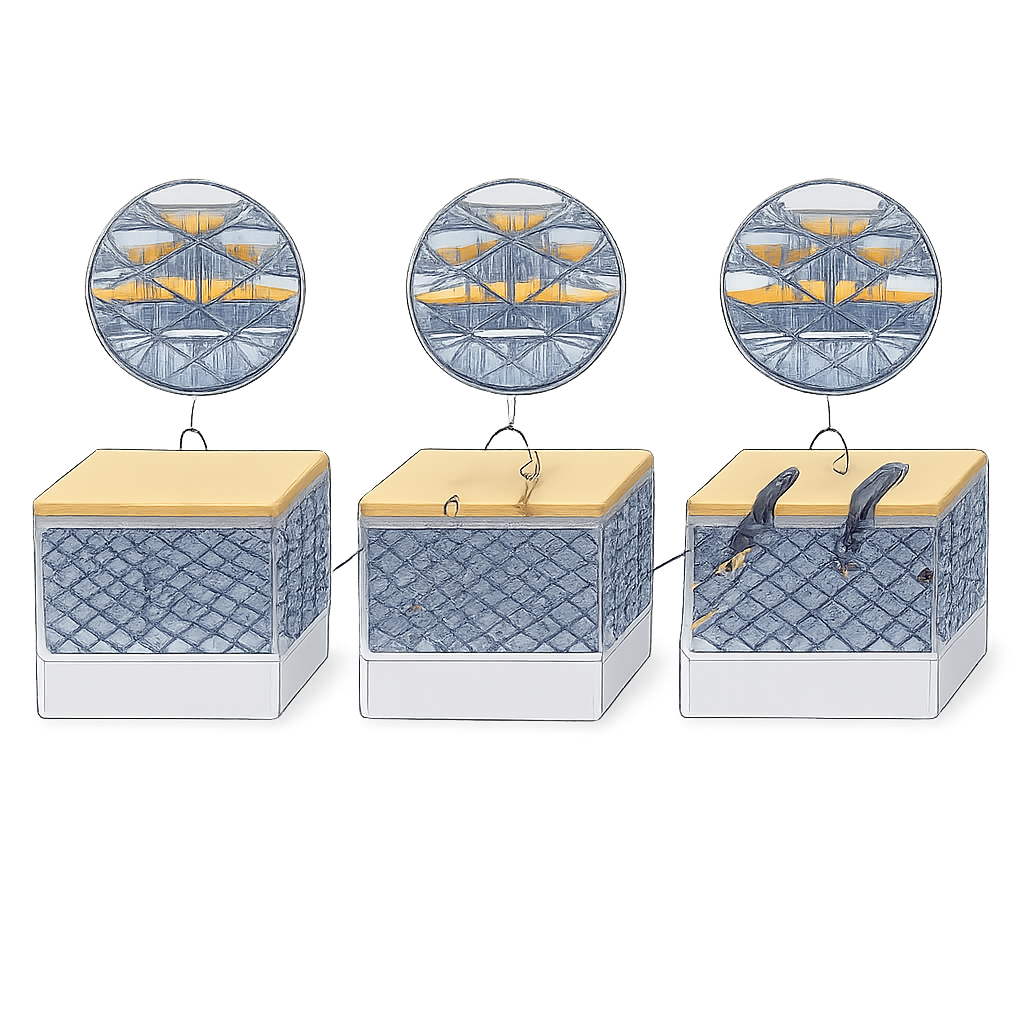
To break out of this limitation, the researchers built a hybrid material that combines two kinds of charge carriers. Inside their sensor, called the ion–electron synergy-enhanced sensing system (IESS), a porous, rubbery layer holds both carbon nanotubes, which conduct electrons, and an ionic liquid, where charged molecules carry current. On top of this sits a very thin gold film that forms controlled microcracks when stretched. When the device is pulled, the gold layer and nanotube network develop and widen cracks that interrupt some electron paths. At the same time, the ionic liquid rearranges into new channels that can bridge gaps between broken regions. Because electrons and ions respond differently to stretching, their combined effect produces a much larger, more tunable change in electrical resistance than either alone.
Breaking and Bridging at the Microscale
The team carefully tuned the structure so that this cracking-and-bridging behavior works in their favor. By adjusting the thickness of the gold layer and the amount of nanotubes, they found a configuration where the sensor stays responsive from essentially no stretch up to 100 percent elongation—doubling its length. Microscopy shows a sponge-like interior that can deform easily, while surface images reveal a network of cracks that evolve from small, scattered lines at low strain to wide, open gaps at high strain. Electrical tests confirm that the ionic liquid dramatically reduces the barriers for charge to move through the nanotube network and across cracks, yielding an enormous change in resistance when the device is bent or stretched. The sensor can detect strains as small as 0.08 percent, responds in under a tenth of a second, and survives thousands of stretch cycles with only minor drift.
From Human Throats to Robotic Sharks
The authors then turn this material into a full wireless system with a tiny microcontroller, high-precision electronics, a battery, and Bluetooth communication, all built into a compact module. Worn on the neck, the patch records subtle throat motions during speech. Using machine-learning algorithms, the system can distinguish nine different simple vocal sounds with over 90 percent accuracy. Placed on wrists, fingers, knees, and other joints, it tracks everyday movements and their frequencies in real time. When encapsulated for underwater use and mounted on a robotic shark, the sensor cleanly separates patterns for diving, rising, and forward swimming. Similar patches on a buoy and a flapping-wing robot capture wave-induced strain and flapping frequency, demonstrating that the same core device can monitor both human health and complex motions in water and air.
What This Means for Everyday Technology
By letting ions and electrons work together inside a carefully engineered soft structure, this study shows that it is possible to build strain sensors that are both extremely sensitive and highly stretchable, without relying on bulky wires. The integrated system can feel everything from tiny throat vibrations to large joint bends, transmit the data wirelessly, and work even in demanding environments like the ocean. For non-specialists, the key message is that future wearable patches, soft robots, and smart infrastructure could gain a much more skin-like sense of touch, enabling more natural speech interfaces, better health monitoring, safer marine systems, and more responsive bioinspired machines.
Citation: Chai, J., Wu, G., Huang, Z. et al. Ion–electron synergy-enhanced flexible highly sensitive wireless sensing system with wide strain range. Microsyst Nanoeng 12, 149 (2026). https://doi.org/10.1038/s41378-026-01261-w
Keywords: flexible strain sensors, wearable health monitoring, soft robotics, underwater sensing, wireless biosensing