Clear Sky Science · en
Triboelectric horology: escapement-inspired design strategy for prolonged energy harvesting under irregular mechanical inputs
Turning Everyday Motion into Lasting Power
Everyday movements—from gusts of wind and distant traffic vibrations to the swing of your arm—carry tiny amounts of mechanical energy that usually go to waste. This paper describes a watch‑like device that can store those small, irregular jolts of motion and slowly release them as a smooth stream of electricity. The technology, called a triboelectric nanogenerator, could one day help power sensors, wearables, and air‑quality devices without needing batteries or a wall socket.
Why Unsteady Motion Is Hard to Harvest
Many proposed “energy harvesting” devices try to pull power from the world around us. Triboelectric nanogenerators are especially attractive because they can be made cheaply from common materials and generate high voltages when two surfaces move against each other. But there is a catch: the motion sources we want to tap—like wind, footsteps, or building sway—are irregular and often slow. That means the electrical output from typical devices surges and dies away instead of providing steady power, which limits their usefulness for running real‑world electronics.
A Clockmaker’s Trick for Smoothing Energy
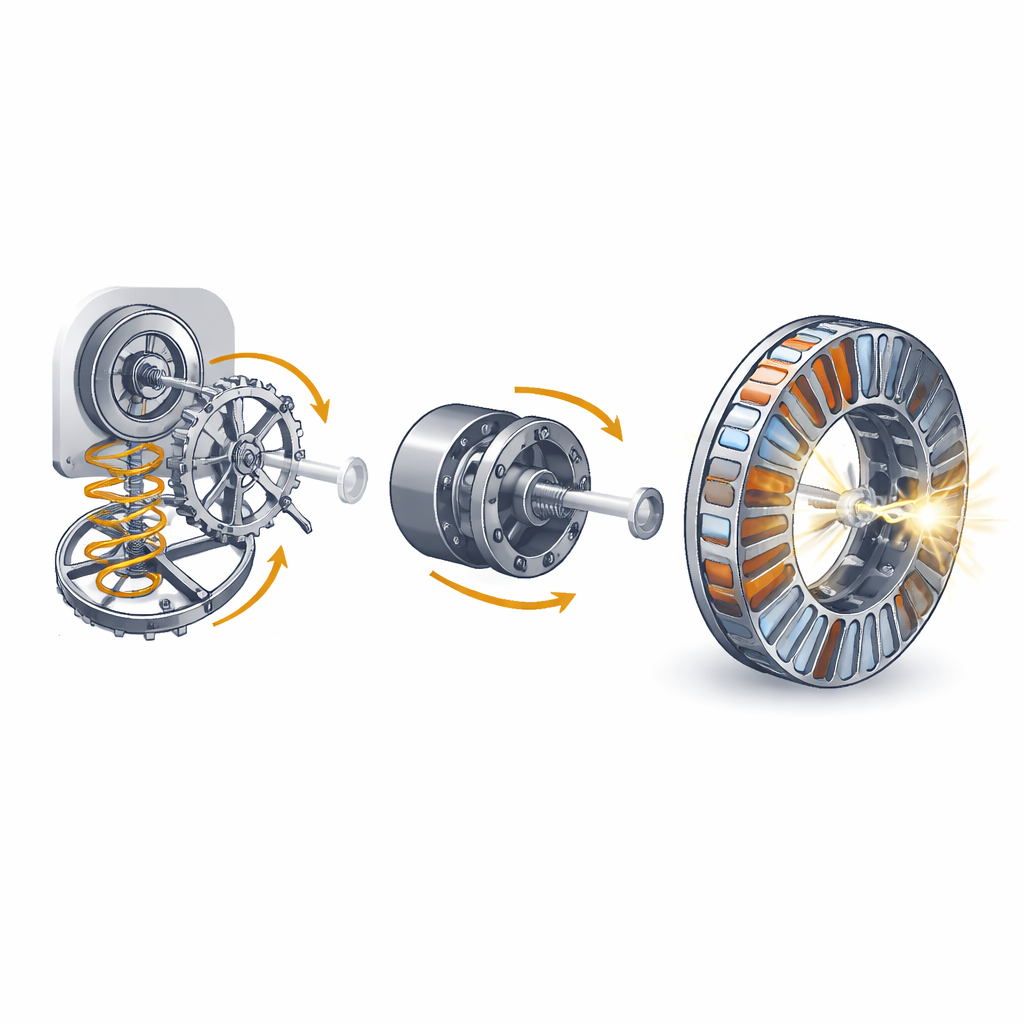
To solve this, the authors borrow a clever idea from mechanical watches. They build a system called LONG (long‑lasting operable triboelectric nanogenerator) that uses an “escapement” mechanism—the same kind of part that regulates the ticking of a clock. First, a spiral spring is wound by a brief mechanical input, such as a pull on a wire. This spring stores energy and then feeds it into a train of gears and an escapement wheel controlled by a rocking balance wheel and thin metal spring. The escapement repeatedly locks and releases the wheel, turning the stored energy into a series of tiny, regularly timed pushes instead of one quick burst.

From Smooth Rotation to Electric Current
In a real watch, that regulated motion simply turns the hands. In LONG, it drives a rotating electrical generator. A one‑way clutch is added between the escapement and the generator so that rotation continues smoothly even while the escapement periodically stops and starts. The generator itself uses the triboelectric effect: a disc covered with special charged plastic pieces spins above fixed metal electrodes. As the charged areas sweep past the electrodes, electrons flow back and forth through an external circuit, creating an alternating current. To boost performance even when the torque is low, the team uses “electrets”—plastics that hold a long‑lived electric charge implanted by a controlled corona discharge process.
Fine‑Tuning the Mechanical and Electrical Design
The researchers systematically adjust the key parts of the system to find the best compromise between strong voltage and long running time. They vary the force of the spring, the ratios of the input and output gears, the mass attached to the escapement wheel, and the electric potential stored in the electret film. They show how each factor affects the size and regularity of the electrical output, choosing settings that keep the rotation stable while minimizing wasted energy. They also examine the tiny details of the rectifier circuit—the diodes that turn the alternating output into one‑way current—demonstrating that diode capacitance can quietly flatten and weaken the high‑voltage signal if chosen poorly.
What This Device Can Actually Do Today
With all parts optimized, the LONG system produces peak voltages around 300 volts and currents of about 19 microamperes, and it can run continuously for over three minutes after a single winding. That is enough to light 125 connected light‑emitting diodes and to charge small capacitors that then briefly power a digital thermometer‑humidity meter. By adding a simple circuit that multiplies voltage, the authors push the output into the kilovolt range and drive a corona discharge between a needle and a plate, using it to remove smoke particles from a small chamber. These demonstrations show that the device can both run low‑power electronics and enable high‑voltage tasks such as dust collection.
A Step Toward Self‑Powered Small Devices
For non‑experts, the key message is that the team has found a practical way to turn irregular, one‑time motions into a longer‑lasting, more stable flow of electricity by combining clockwork‑style mechanics with advanced materials. Instead of relying on batteries or steady power lines, future sensors and wearable gadgets could be driven by this kind of self‑regulated generator, quietly harvesting energy from the movements and vibrations that already surround us.
Citation: Lee, D., Ju, S., Park, D.Y. et al. Triboelectric horology: escapement-inspired design strategy for prolonged energy harvesting under irregular mechanical inputs. Microsyst Nanoeng 12, 131 (2026). https://doi.org/10.1038/s41378-026-01259-4
Keywords: triboelectric nanogenerator, energy harvesting, mechanical watches, wearable sensors, self-powered devices