Clear Sky Science · en
A synthetic method for preparing double channelling materials, and an operational mechanism for selective p- and n-type channels for gas sensing
One Tiny Device, Two Kinds of Dangerous Gas
Industrial plants, tunnels, and even our cities need compact sensors that can warn us when harmful gases build up. Today, different gases usually demand different sensor materials, which complicates design and raises cost. This study introduces a single, smart material that can detect two important toxic gases—one that steals electrons and one that donates them—by automatically choosing which internal pathway to use, much like a road network that reroutes traffic on its own.
Building a New Kind of Sensing Material
The researchers focused on two well-known metal oxides used in gas sensors. Tin oxide usually behaves as an n-type semiconductor, where electrons carry current and it is especially responsive to an oxidizing gas called nitrogen dioxide (NO2). Copper oxide, in contrast, is typically p-type, where positive “holes” carry current, and it is especially good at detecting the reducing gas hydrogen sulfide (H2S). Instead of making two separate sensors, the team set out to blend these two behaviors into one continuous material, so that both gases could be read reliably by the same tiny device.
To achieve this, they first grew long, thin tin-oxide nanowires on a ceramic base and then coated them with a very thin layer of copper. Next came a brief but intense treatment called flame chemical vapor deposition, lasting only about five seconds. During this step, the heat and reactive environment partially oxidized the copper and partially altered the tin oxide, scrambling them into a mixed layer of non‑equilibrium tin and copper oxides. Electron microscopy and diffraction studies confirmed that instead of a simple “core–shell” coating, the final structure was a solid solution: intertwined regions of tin‑rich and copper‑rich oxides distributed throughout each nanowire, with a rough, highly textured surface ideal for gas interactions. 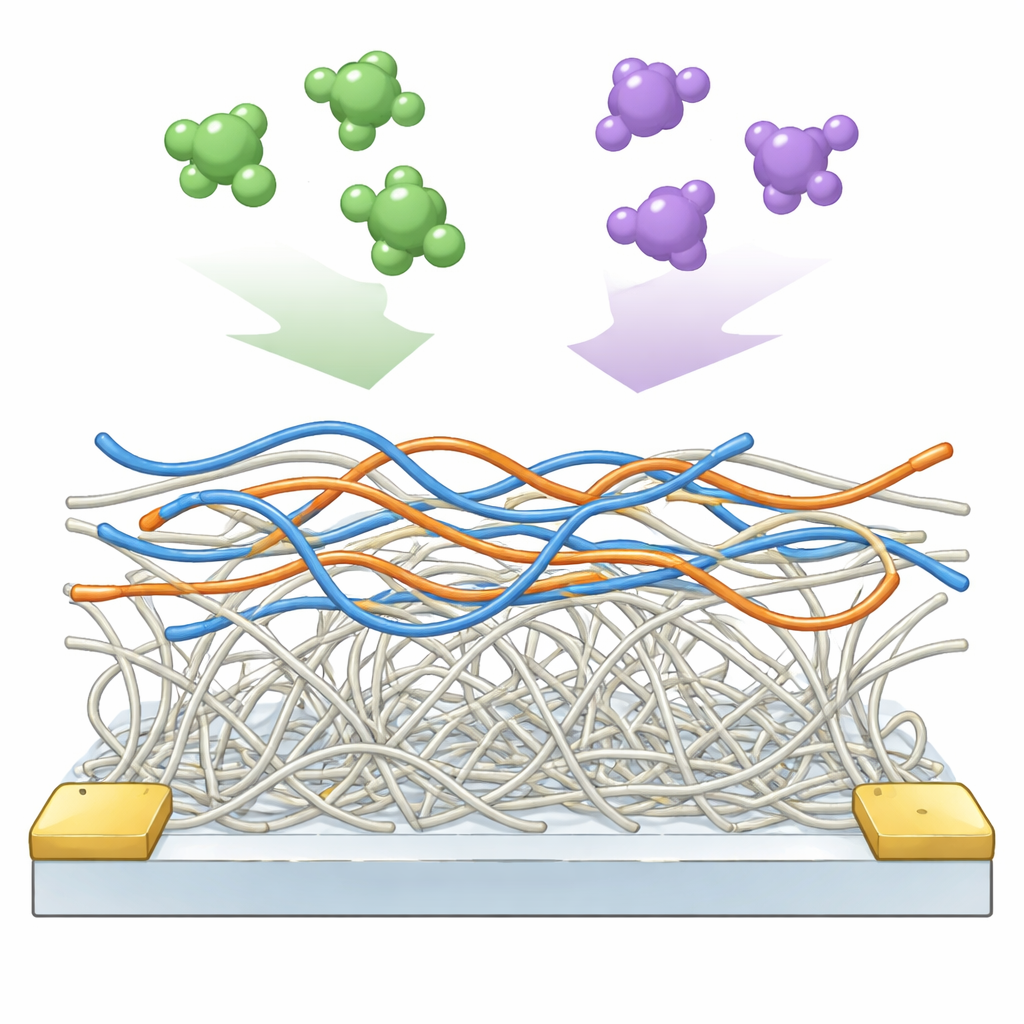
How the Double Pathway Responds to Gases
Inside this mixed network, regions that act like n-type and p-type semiconductors coexist and interconnect in three dimensions. At the microscopic level, that means there are many tiny junctions where electron‑rich and hole‑rich zones meet, alongside chains of similar zones linked together. When the sensor is heated to a modest 100 °C and exposed to NO2, the gas tends to pull electrons from tin‑rich regions. This widens internal barriers along electron paths and effectively narrows the “electron highways,” so the material’s electrical resistance rises sharply. Measurements showed that at 10 parts per million of NO2, the response was stronger and faster than that of conventional tin‑oxide sensors operating under similar conditions.
When the same mixed material encounters H2S at 100 °C, a different part of the network takes over. H2S donates electrons and strongly interacts with copper‑rich regions, which normally conduct via holes. By filling some of these holes, the gas shrinks the effective width of the hole‑carrying paths and again raises the overall resistance. The response to H2S is smaller than to NO2 but still competitive with dedicated copper‑oxide sensors. Crucially, both gases produce an increase in resistance even though one is oxidizing and the other is reducing; the internal network automatically chooses whether electron‑dominated or hole‑dominated pathways govern the signal. 
Why Low Temperatures and Selectivity Matter
The sensor’s sweet spot is at relatively low temperatures—around 100 °C—where it behaves as a genuine semiconductor with few mobile charges until a gas arrives. At room temperature, NO2 can still be detected, though more weakly, while H2S is harder to sense. At higher temperatures near 300 °C, the mixed oxides start to behave more like metals, and the gas response drops or even changes character. Impressively, at 100 °C the device shows strong selectivity: it responds clearly to NO2 and H2S but barely reacts to other test gases such as acetone, ammonia, and carbon monoxide. This means the dual‑channel design provides not just flexibility, but also a built‑in way of avoiding false alarms from many common background vapors.
A Step Toward Smarter, Simpler Gas Alarms
In everyday terms, the authors have created a single “nose” that can listen to two very different “voices” and still give one clear electrical answer. By blending tin and copper oxides into a carefully disordered, mixed network with both n-type and p-type regions, they show that one material can automatically select the right internal pathway depending on whether NO2 or H2S is present. This approach could simplify gas sensor design, reduce the number of separate components needed, and open the door to compact devices that track multiple hazardous gases at once, especially in situations where lower operating temperatures and energy savings are essential.
Citation: Choi, M.S., Na, H.G., Hwang, J.Y. et al. A synthetic method for preparing double channelling materials, and an operational mechanism for selective p- and n-type channels for gas sensing. Microsyst Nanoeng 12, 160 (2026). https://doi.org/10.1038/s41378-026-01253-w
Keywords: gas sensing, metal oxide sensors, nitrogen dioxide, hydrogen sulfide, semiconductor nanowires