Clear Sky Science · en
Systematic investigation of the LSPR characteristics in plasmonic nanoarrays
Why tiny metal patterns matter
Imagine using patterns of metal dots smaller than a virus to sense the chemistry of a drop of liquid, or to boost the faint glow and Raman signals from just a few molecules. This paper explores how to build such patterns repeatably over large areas and, crucially, how to “tune” their color-like optical response with precision. By understanding this tuning, engineers can design better sensors and optical chips for medicine, chemistry, and environmental monitoring. 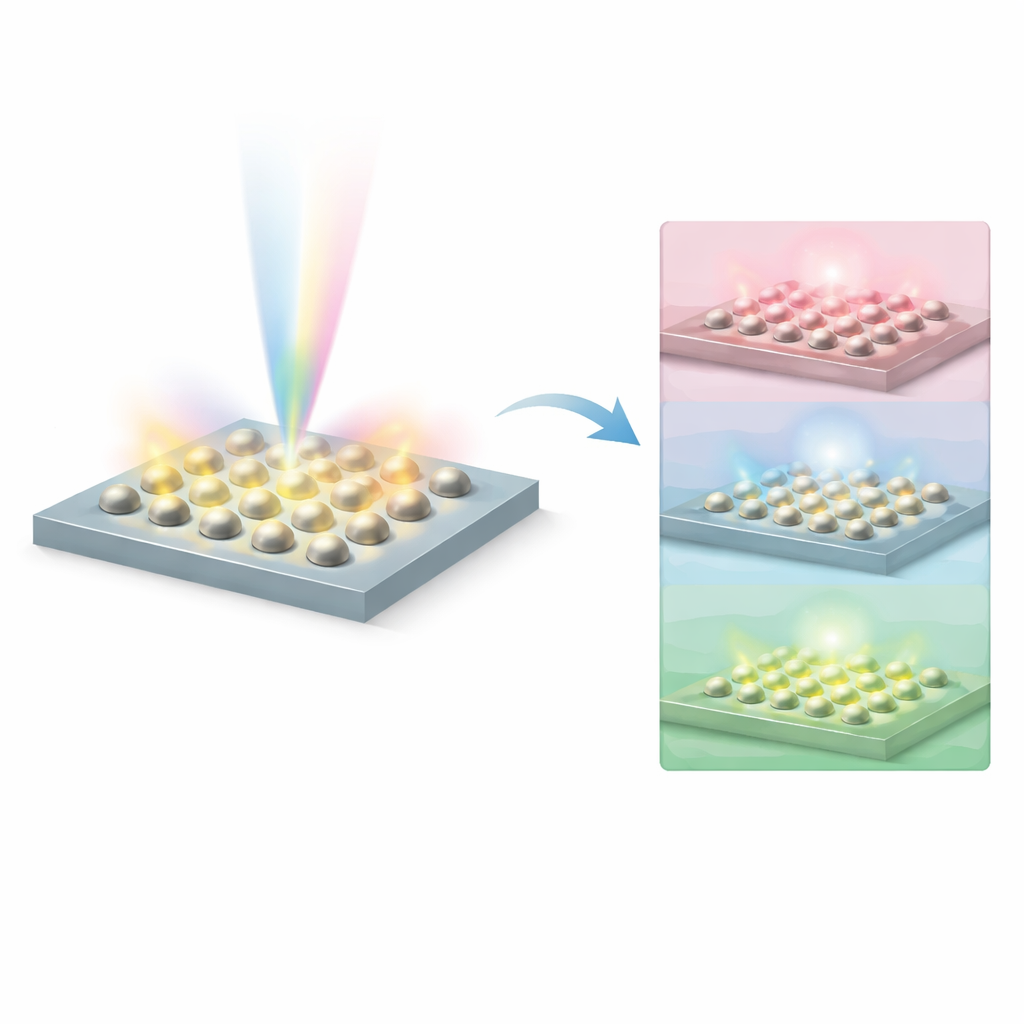
Rattling electrons on a nanoscale stage
When light hits a tiny metal particle, its electrons can collectively slosh back and forth, like water in a shaken bowl. This motion, called a localized surface plasmon resonance, concentrates light into intense nanoscale hotspots. The color at which this resonance occurs depends sensitively on the particle’s size, shape, material, and surroundings. While chemists have long studied individual metal nanoparticles floating in liquids, this work focuses on ordered carpets of nanoparticles—nanoarrays—grown directly on solid supports, where their geometry and environment differ in important ways from idealized spheres.
Building ordered carpets of nanoparticles
The researchers create their nanoarrays using a porous anodic aluminum oxide (AAO) membrane as a reusable stencil. This film contains a regular honeycomb of holes whose size and spacing can be finely controlled by the anodizing conditions. By placing the membrane on glass or silicon and evaporating gold or silver through the holes, they form hexagonally arranged nanoparticles stuck to the surface. Removing the membrane leaves behind a clean, periodic pattern that can extend over centimeter scales. Microscopy reveals that these particles are not perfect spheres: they resemble little crowns or domes with a broad base, a shape that strongly affects how electrons move when light arrives.
How size, thickness, and smoothness shift the color
Systematic measurements show how different design choices steer the plasmon color. Increasing the particle diameter at fixed thickness produces a red shift, meaning the resonance moves to longer wavelengths, largely because larger particles and smaller gaps enhance coupling between neighbors. In contrast, thickening the deposited metal—turning flat disks into taller crown-like domes—triggers an unexpected blue shift to shorter wavelengths and a narrowing of the spectral peak. This behavior goes against simple “bigger means redder” rules and arises from the out-of-plane geometry: as the vertical shape changes, the restoring forces on the electrons change, raising the resonance energy. Heating the arrays further smooths the particles, reduces surface roughness and tiny side clusters, and pushes the resonance even more to the blue while sharpening the peak, showing that crystal quality and shape uniformity also matter.
Mixing metals, stretching shapes, and sensing liquids
The team then explores more advanced knobs for control. By stacking thin layers of gold and silver within each nanoparticle in different orders, they shift the resonance across a broad spectral range and adjust how sharp or broad the peak is, because each metal has its own optical losses and sees a different local environment at the substrate or surface. Using angled evaporation through the same AAO stencil, they grow ellipsoidal particles whose long and short axes differ, creating two distinct plasmon modes that respond differently to the polarization of incoming light. Finally, they demonstrate sensing: immersing the nanoarrays in liquids of increasing refractive index leads to a clear red shift of the plasmon color, with larger particles showing higher sensitivity. The effect is nearly linear over the tested range, a desirable feature for quantitative sensors. 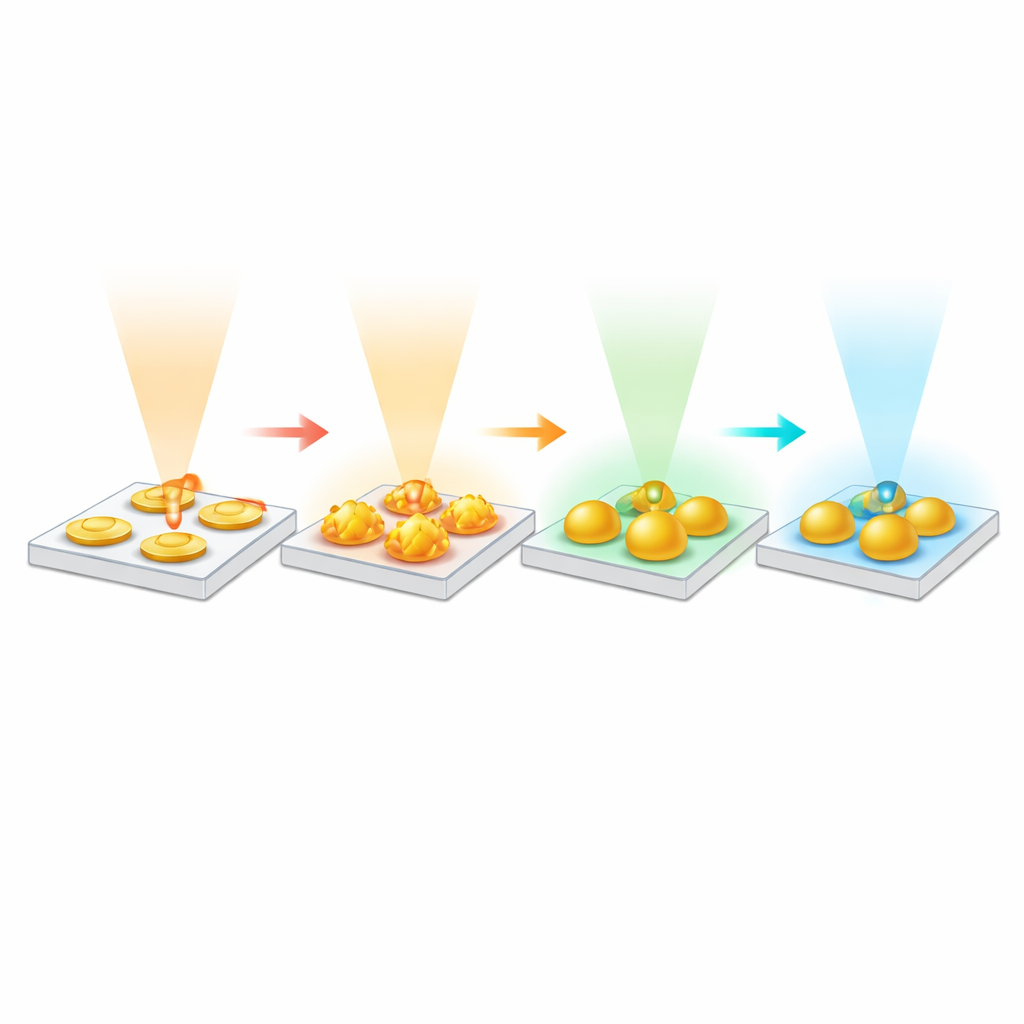
From fundamental insight to practical sensors
In plain terms, this study maps out how to “dial in” the optical behavior of dense nanoparticle carpets by controlling their size, height, material mix, smoothness, and surrounding medium. It shows that real, template-made particles behave differently from ideal spheres, and that thickness and environment can be used as powerful extra levers to move the plasmon color in both directions. Because the AAO-based process is scalable and reproducible, these insights directly support the design of robust plasmonic sensors and devices that can detect subtle changes in nearby molecules with high precision.
Citation: Zhao, X., Zhu, X., Chen, D. et al. Systematic investigation of the LSPR characteristics in plasmonic nanoarrays. Microsyst Nanoeng 12, 137 (2026). https://doi.org/10.1038/s41378-026-01248-7
Keywords: plasmonic nanoarrays, localized surface plasmons, refractive index sensing, nanoparticle fabrication, optical nanodevices