Clear Sky Science · en
A novel bioinspired integrated system for simultaneous fog harvesting and energy supply
Turning Fog Into a Helpful Resource
In many dry regions, people face two problems at once: not enough clean water and not enough reliable electricity. This study explores a new device that tackles both challenges by pulling water out of fog while also turning the falling droplets into small bursts of power. Inspired by desert plants and insects, the system is designed to work in remote, off‑grid places, where even modest amounts of water and electricity can make a big difference for growing food.
Learning From Desert Life
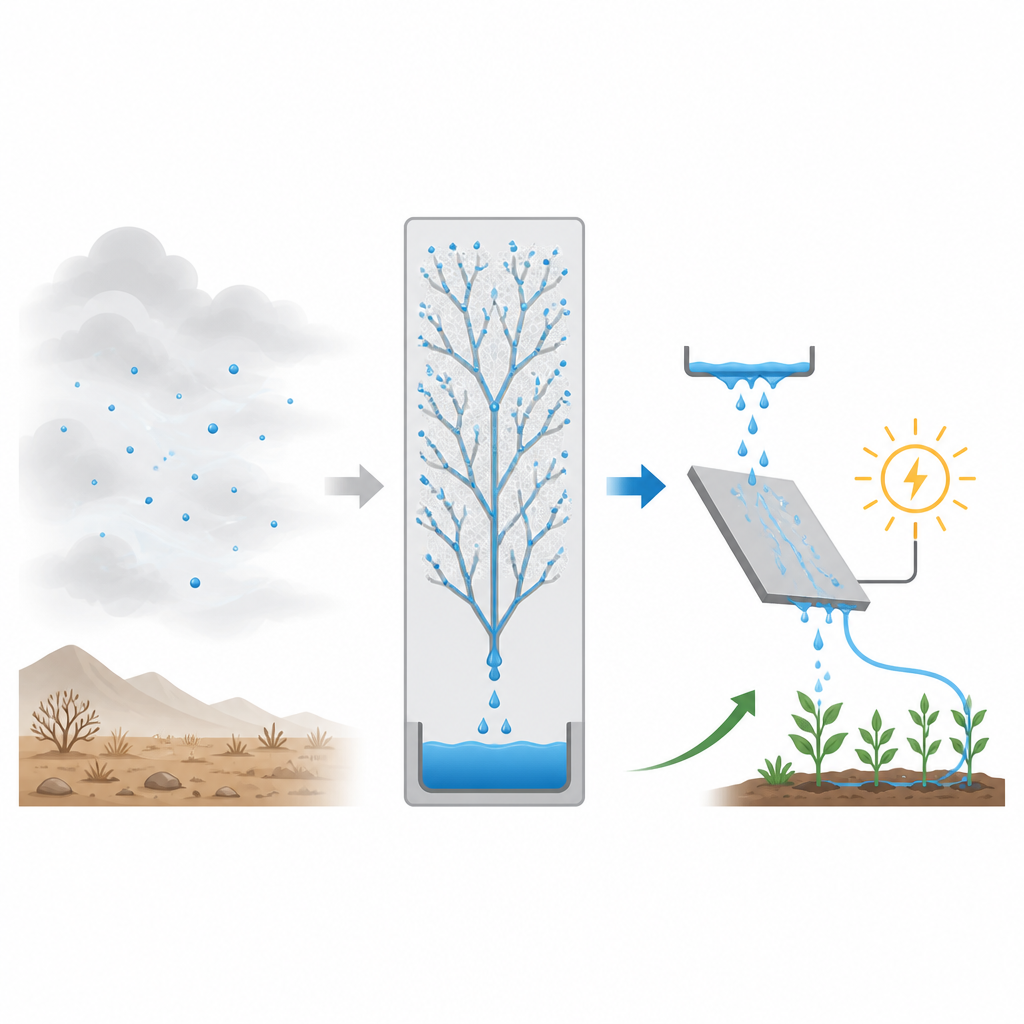
Nature has already solved the problem of catching water from thin air. The Namib Desert beetle, cactus spines, and the rim of pitcher plants all collect and guide tiny droplets with great efficiency. The research team copied key features from these organisms to create a metal surface covered with branching grooves. These grooves are carefully tuned so that some areas like water and others repel it. As fog drifts past, microdroplets land, merge, and are pulled along these paths without getting stuck, much like water moving down the veins of a leaf.
How the Fog Collector Surface Works
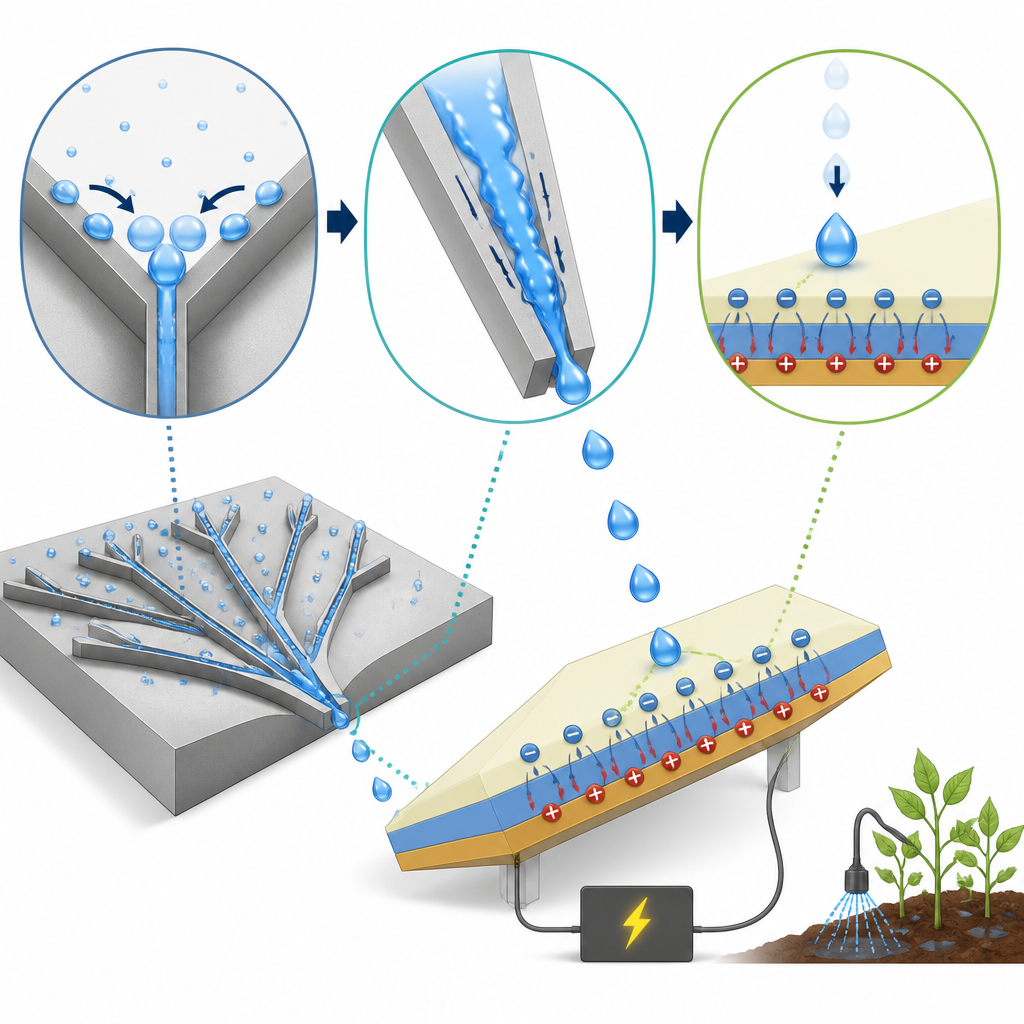
The heart of the water‑harvesting part is a patterned titanium sheet called a synergistic biomimetic dendritic structured surface. It is made by laser etching and light treatment to create tiny ridges and a gentle change in how much different regions attract water. When fog hits this surface, droplets first form on super‑thirsty side branches, then are drawn toward a main trunk and down to a collection point. The shape of the grooves, the slope of the branches, and the gradual change in wetness all combine to push droplets in one direction. Tests showed that the best design harvested nearly ten grams of water per square centimeter per hour, over four times more than a plain titanium sheet.
Turning Falling Drops Into Electricity
The second key part of the system is a droplet‑based triboelectric nanogenerator, a device that turns the motion of water drops into electrical signals. After fog water gathers and drips off the collector, it lands on a tilted plate made of a soft rubbery material mixed with a conductive compound called MXene. When each droplet hits and spreads across this coated plate, electrical charges are rearranged at the surface, and a tiny pulse of current flows between hidden metal layers. By choosing the right droplet size, fall height, and tilt angle, the team boosted both the current and the voltage while keeping the surface so water‑repellent that drops roll away instead of forming a sticky film.
Putting Water and Power to Work for Plants
To show that the combined fog harvester and generator can do real work, the researchers built a small chamber lined with twenty‑five of the patterned metal units. Under fog‑like conditions, this module collected about 1.6 liters of water overnight per one‑third of a square meter of area, enough to meet most of one person’s daily drinking needs in a dry climate. The stored water then flowed by gravity through a drip line onto the power‑producing plate and finally into soil holding barley seeds. The tiny power bursts were used to light small lamps that stand in for plant‑growth lighting, while the harvested water irrigated the seeds. Over several days, the barley watered by fog grew taller and healthier than unwatered controls.
A New Tool for Dry but Humid Places
The finished system shows that fog can be used as both a water source and a gentle energy source at the same time. The special surface captures and guides droplets very efficiently, and the droplet‑powered plate reliably produces low‑level electricity suitable for things like sensors or small lights. Because the approach relies only on local humidity and gravity, it is well suited to coastal deserts and other areas where air is moist but liquid water and power lines are scarce. While more work is needed to add full water purification and long‑term protection of the metal parts, this bioinspired design offers a practical path toward small, self‑reliant units that support farming and daily life in water‑stressed regions.
Citation: Gao, H., Li, L., Hu, Y. et al. A novel bioinspired integrated system for simultaneous fog harvesting and energy supply. Microsyst Nanoeng 12, 174 (2026). https://doi.org/10.1038/s41378-026-01240-1
Keywords: fog harvesting, water and energy, bioinspired surfaces, triboelectric nanogenerator, off-grid agriculture