Clear Sky Science · en
Dual-target magnetic anomaly detection and recognition based on a board-level micro fully integrated fluxgate tensor for unexploded ordnance (UXO) mission
Finding Hidden Dangers Underground
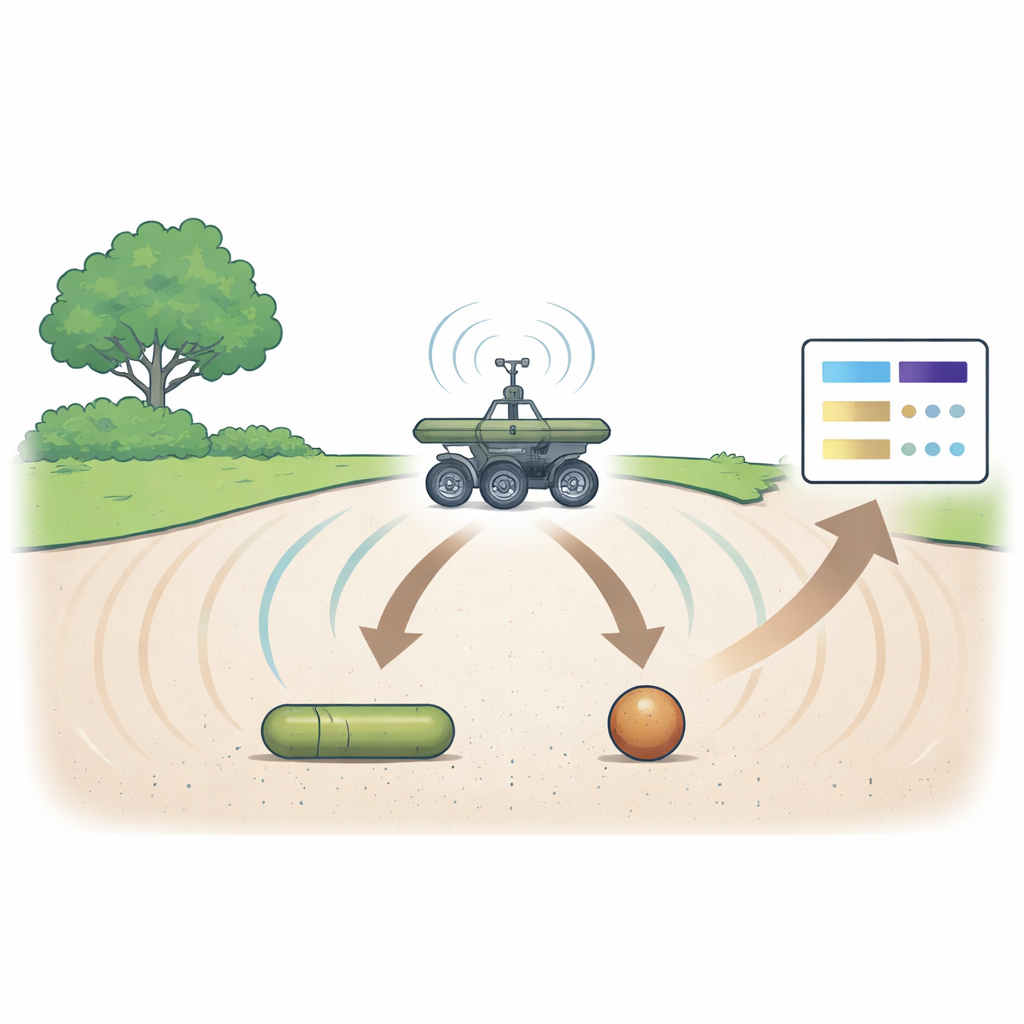
Across former battlefields and test ranges, unexploded shells and bombs can lie hidden for decades, threatening civilians, construction workers, and the environment. Many of these objects are made of steel and subtly disturb Earth’s magnetic field. This paper describes a new, pocket‑sized magnetic sensor array that can spot and tell apart multiple buried metal targets at once, paving the way for safer, more efficient removal of unexploded ordnance (UXO) using portable and unmanned systems.
A New Kind of Magnetic "Eyes"
The authors build on a sensing principle called magnetic anomaly detection: ferromagnetic objects slightly bend Earth’s magnetic field, and sensitive instruments can pick up those distortions. Traditional instruments are either bulky, delicate, power‑hungry, or easily disturbed by background noise. The team uses a technology known as a fluxgate sensor, which offers a practical balance of high sensitivity, ruggedness, and the ability to operate at room temperature. They shrink this technology using micro‑fabrication methods similar to those used for computer chips, so that many tiny sensors can be packed closely together into a single, compact module that still measures the full three‑dimensional magnetic field.
Building a Compact Sensor Grid
At the heart of the system is a millimeter‑scale magnetic sensor built on a glass chip. Each chip contains a special metal core wrapped by miniature coils that both excite and read out the magnetic response. Using thick photoresist, multi‑layer electroplating, and insulating polymer films, the researchers form tightly controlled three‑dimensional coil structures with excellent uniformity from chip to chip. Three of these one‑direction sensors are then bonded together at right angles in a U‑shaped frame to create a triaxial sensor that senses the magnetic field along all three axes. Four such triaxial units are mounted in a cross shape on a small circuit board, with only 20 millimeters between neighboring units. The final device—a full “magnetic tensor” array—measures just 86 by 80 by 16 millimeters and consumes less than a tenth of a watt.
Seeing Shape Through Magnetic Shadows
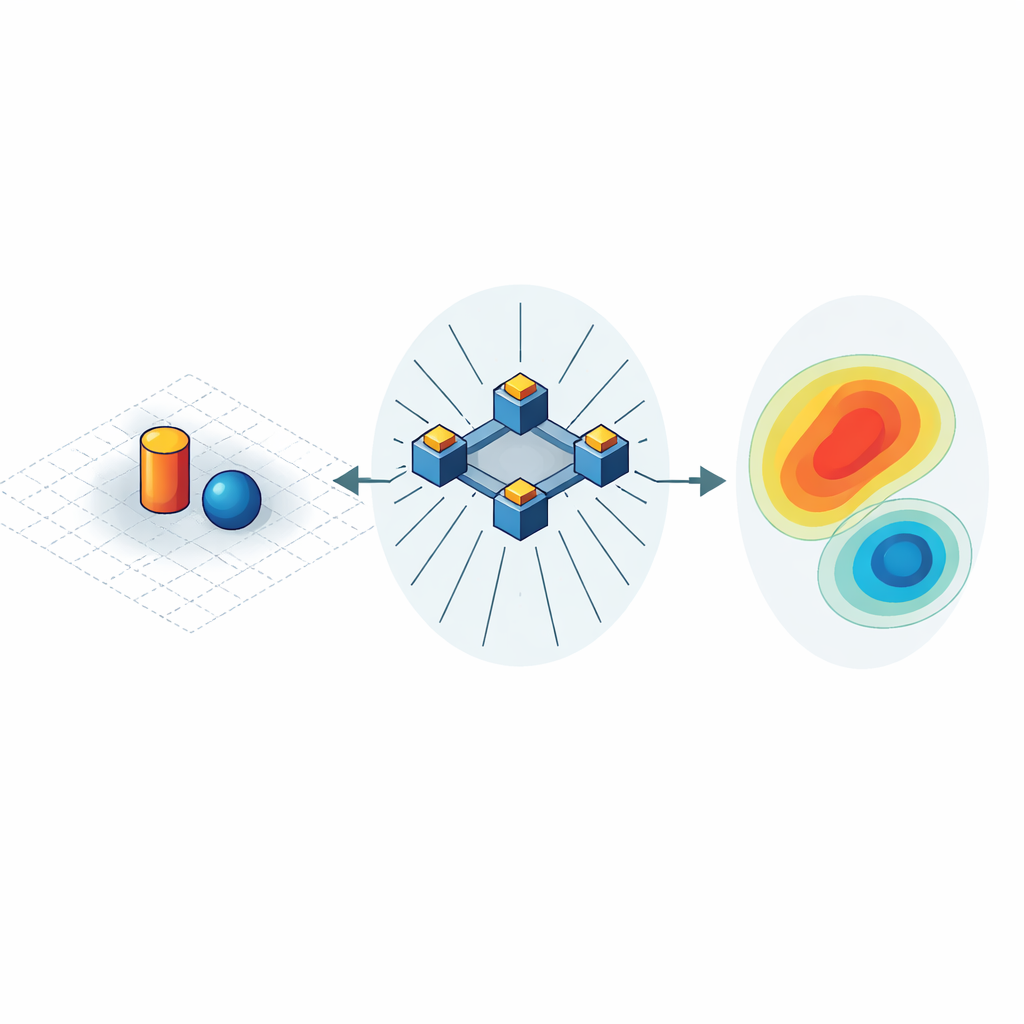
Because the four triaxial sensors are arranged in a precise pattern, the device can measure not only the local magnetic field but also how it changes from point to point—the magnetic gradient “tensor.” This richer information acts like a shadow that encodes the size and shape of buried objects and helps cancel out background interference. The team first validates the basic performance of twelve individual chips, finding high sensitivity and extremely low noise. They then move outdoors to a 1.2‑meter square test area, where they place different magnets at the center and scan the area at dozens of points with the array raised 10 centimeters above the ground. From these measurements they reconstruct colorful maps of the magnetic gradients and analyze the outlines of the anomaly patterns.
Telling Two Hidden Objects Apart
In single‑target tests, the researchers compare an olive‑shaped magnet and a spherical magnet. Both can be located within about 15 centimeters of their true center positions, but their magnetic “footprints” look different: the elongated magnet produces a stretched pattern, while the sphere appears nearly round. The team quantifies this by an aspect ratio, effectively comparing the long and short dimensions of the anomaly map; the olive‑shaped magnet yields a higher aspect ratio than the near‑circular sphere. Next, they test two hollow magnets at once—one cylindrical and one spherical—placed side by side. Even though these magnets are relatively weak, the tensor maps still reveal two distinct peaks and clearly different outline shapes. Again, the elongated target produces a more stretched pattern than the spherical one, allowing the system to recognize that two different kinds of objects are present in the same area.
What This Means for Safer Land Clearance
For a layperson, the key message is that this miniaturized sensor board can both find and distinguish multiple buried metal objects by reading subtle distortions in Earth’s magnetic field, all while being small, lightweight, and energy‑efficient. That makes it far easier to mount on drones, small robots, or hand‑held tools than older magnetic systems. As the authors refine the electronics to collect data faster and in higher resolution, this technology could significantly improve the speed, accuracy, and reliability of UXO surveys, helping clear former conflict zones more safely and at lower cost.
Citation: Pu, Z., Fang, D., Dai, Y. et al. Dual-target magnetic anomaly detection and recognition based on a board-level micro fully integrated fluxgate tensor for unexploded ordnance (UXO) mission. Microsyst Nanoeng 12, 119 (2026). https://doi.org/10.1038/s41378-026-01227-y
Keywords: unexploded ordnance detection, magnetic anomaly sensing, fluxgate sensor array, MEMS magnetometer, portable UXO survey