Clear Sky Science · en
Vertical-flow tearable paper-tape rolls for scalable multiplexed point-of-care nucleic acid testing
Faster Lab Tests Anywhere
Getting an accurate lab test for infections like HIV or hepatitis usually means sending a blood sample to a well-equipped hospital and waiting days for results. This paper describes a low-cost, pocket-sized system that can turn that kind of testing into a simple, near–one-step procedure done on the spot, using something that looks and behaves a bit like a roll of tape. The goal is to bring precise DNA and RNA testing to clinics, ambulances, and remote villages without reliable electricity or advanced laboratories.
A New Kind of Test Strip
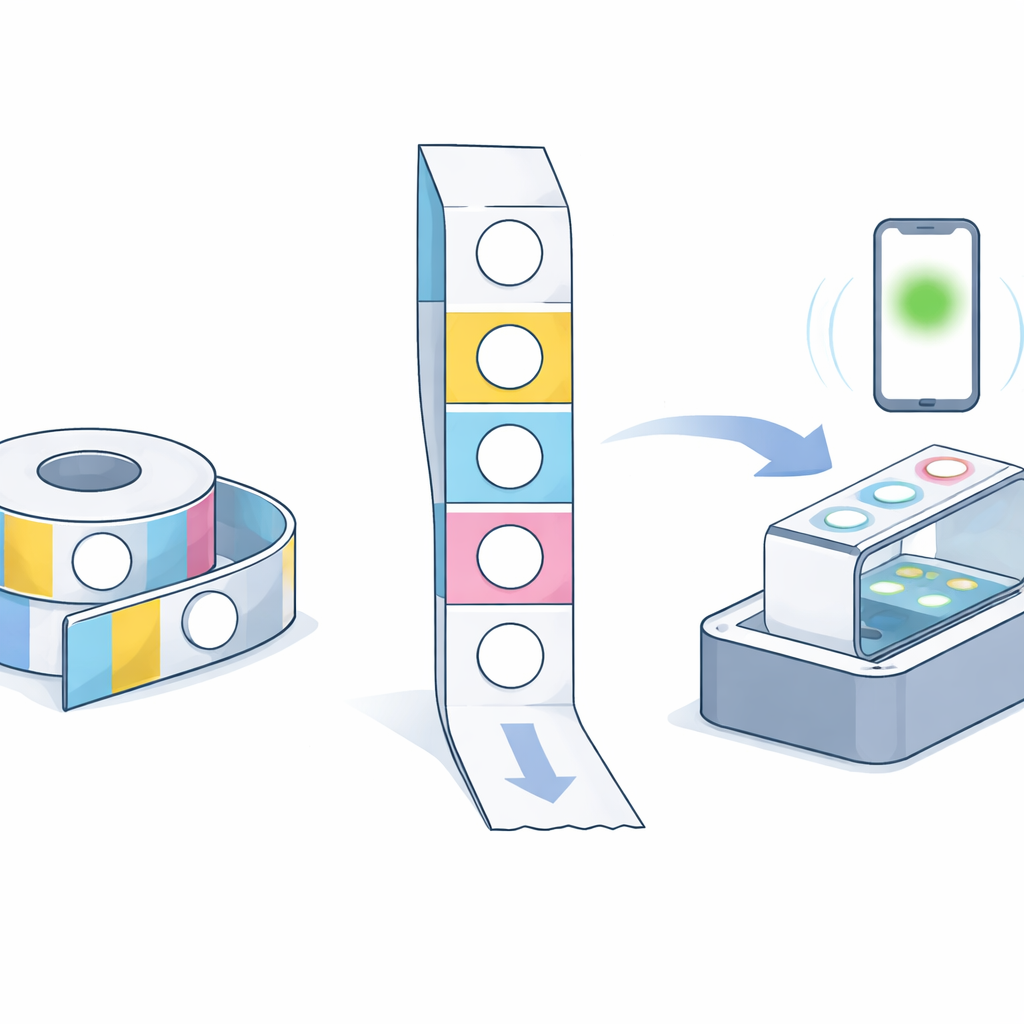
The heart of the invention is a "vertical-flow paper-tape" (VFPT) device. Instead of the familiar test strip where liquid creeps sideways along a printed path, this design stacks small circular pads of paper and film in layers, then rolls many of these units into a tape-like roll. Each test contains four key pads: one that traps unwanted blood cells and debris, one that captures genetic material like viral DNA or RNA, several pads that act as reaction chambers, and one to soak up waste liquid. A caregiver simply tears off a short section from the roll, folds it along pre-set lines, and has a complete disposable test for a single patient.
Letting Gravity Do the Work
Traditional paper tests rely on sideways, or lateral, flow. That sideways motion tends to smear molecules, cause clumping at edges, and limit how many different things can be checked at once. The VFPT instead uses vertical flow: the sample is dropped on top, and gravity pulls it straight down through layered pads. The authors show, both by mathematical modeling and experiments, that this vertical approach moves liquids several times faster and carries molecules farther and more evenly than sideways flow. It cuts down on random sticking to the paper, avoids ring-like deposits, and nearly doubles how far different types of molecules can travel through stacked layers, all of which boosts sensitivity and reliability.
From Blood Drop to Genetic Answer
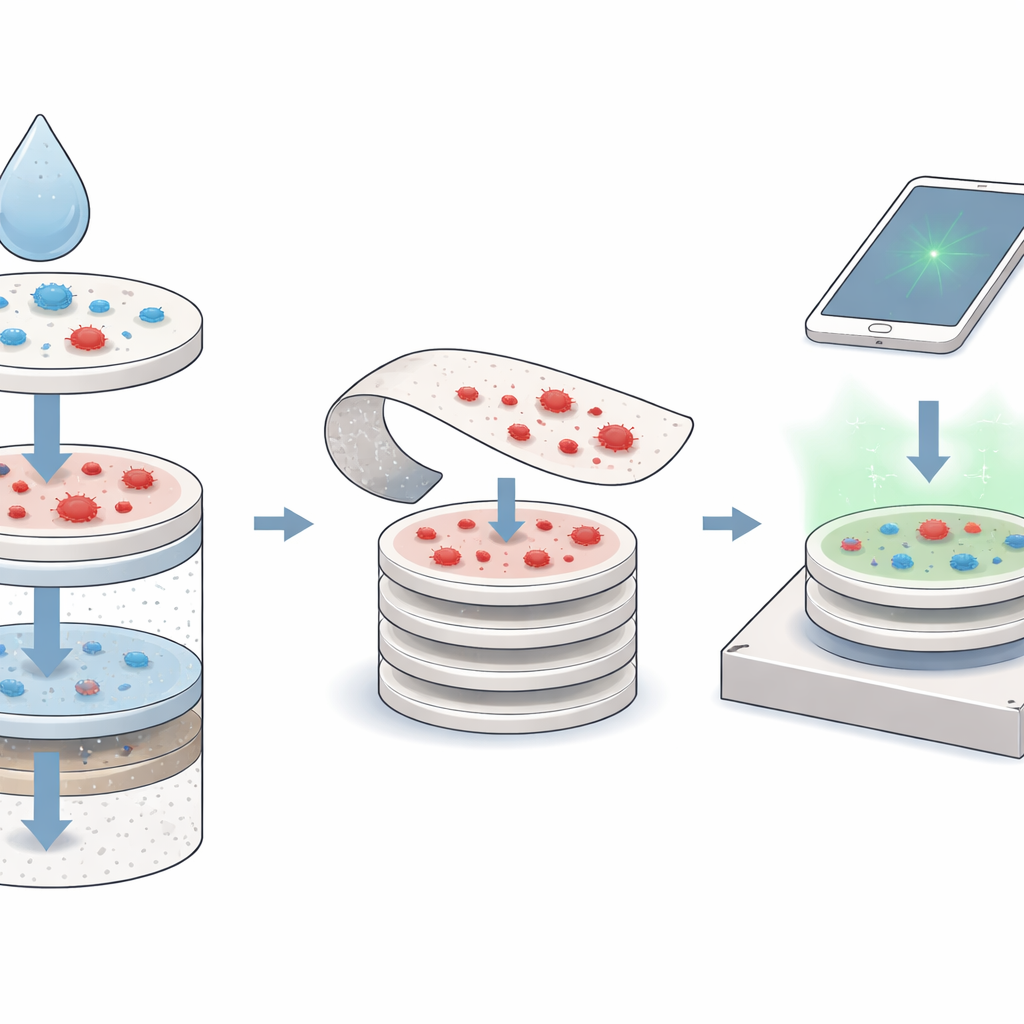
To turn the tape into a full testing system, the team combines it with a small, battery-powered box and a smartphone. First, blood mixed with a simple chemical solution is added to the folded VFPT. The top filter pad holds back cells and debris, while the capture pad below holds on to the released genetic material. Waste liquid continues down to the bottom pad. After a brief wash step, the capture pad is flipped so that the stored DNA or RNA is rinsed into multiple detection pads, each tailored to a different target—such as HIV, hepatitis B, hepatitis C, and an internal control. These pads are then pressed onto the portable box, which gently heats them and shines ultraviolet light to drive a DNA-copying reaction that works at a constant temperature.
Reading the Result With Light
The DNA-copying method used, known as isothermal amplification, produces large amounts of double-stranded genetic material wherever a target is present. A fluorescent dye in the reaction glows brighter as more DNA is made. Instead of using an expensive lab instrument to read this glow, the system relies on a smartphone camera paired with a simple app. The phone photographs the glowing spots through an optical filter, and the app converts brightness into a number that reflects how much virus was in the original sample. Across a wide range of concentrations, this brightness tracks closely with values from standard laboratory PCR tests.
Real-World Performance and Promise
In tests with more than 200 real patient plasma samples covering HIV, hepatitis B, and hepatitis C, the VFPT platform detected as few as a few hundred viral copies per milliliter—on par with many clinical methods and clearly better than common paper-strip tests. Sensitivity and specificity for all three infections exceeded about 90 percent when compared head-to-head with hospital PCR results. Because the tape-based devices cost around ten cents each, can be mass-produced by roll-to-roll manufacturing, and run on a small rechargeable battery and smartphone, the system is well-suited to clinics with tight budgets, mobile screening programs, and outbreak settings where quick, reliable answers can guide life-saving treatment.
Citation: Shi, S., Wang, Z., Yao, Y. et al. Vertical-flow tearable paper-tape rolls for scalable multiplexed point-of-care nucleic acid testing. Microsyst Nanoeng 12, 120 (2026). https://doi.org/10.1038/s41378-026-01172-w
Keywords: point-of-care diagnostics, paper microfluidics, vertical-flow assay, nucleic acid testing, HIV HBV HCV detection