Clear Sky Science · en
Porous material engineering through synthesis for smart sensor systems
Why Tiny Holes Matter in Everyday Sensors
From air-quality trackers and fitness wearables to smart food packaging, modern life quietly depends on sensors. This article explains how a special class of “hole‑rich” materials—called porous materials—can make those sensors far more sensitive, faster, and more reliable. By carefully engineering the size, shape, and arrangement of countless microscopic pores, researchers are building smarter sensor systems that can better detect gases, body chemicals, pressure, and more in real time.
Building Blocks Full of Invisible Pathways
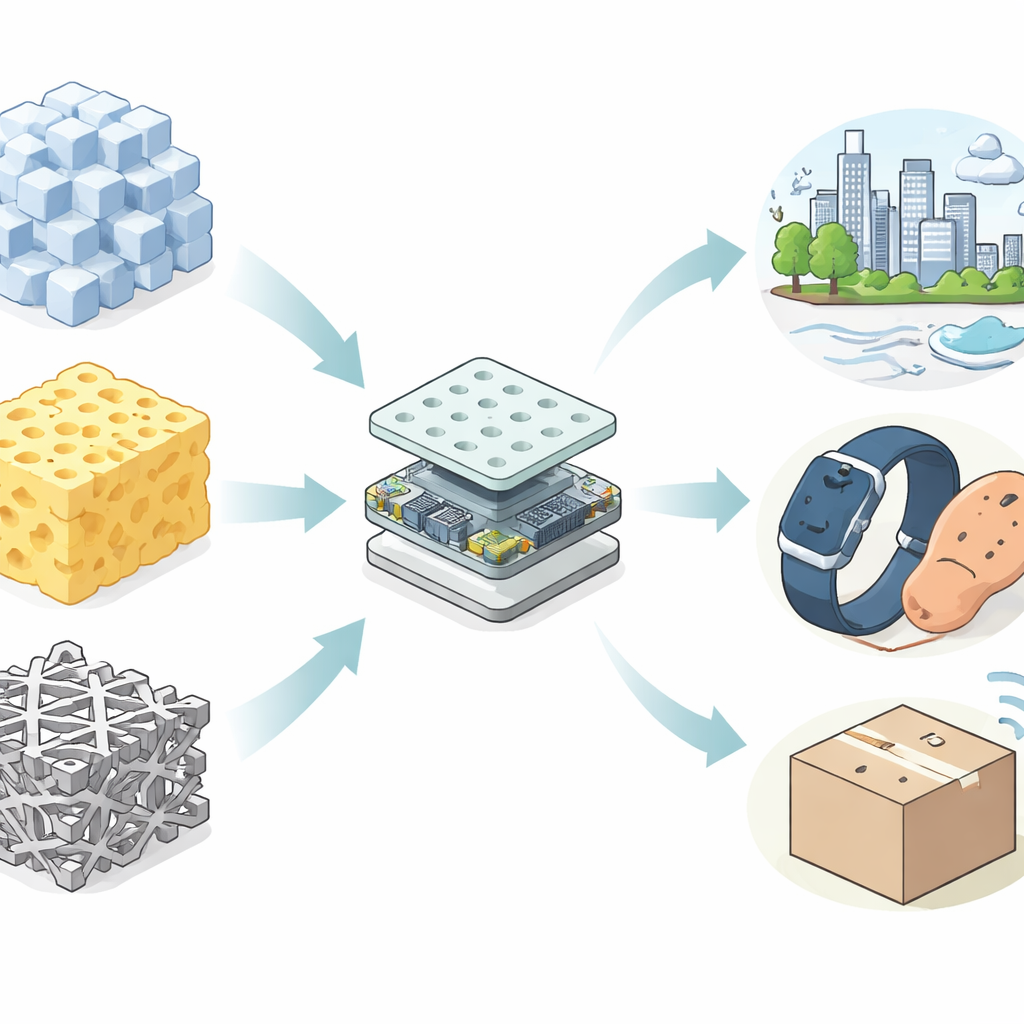
Porous materials are solids laced with a maze of tiny voids, from holes smaller than a nanometer to channels wide enough to see under a microscope. Because of these internal passageways, a small piece of porous material can have an enormous internal surface area—sometimes hundreds or thousands of square meters per gram. The review describes three major families. Metal oxides, like titanium dioxide and zinc oxide, provide robust and chemically stable scaffolds for gas and environmental sensors. Polymers, which are soft and flexible, can be formed into foams and sponges that bend, stretch, or compress, ideal for wearable pressure and strain sensors. Carbon-based structures, such as porous graphene and aerogels, offer excellent electrical conductivity in ultralight, springy 3D networks.
Crafting Pores with Modern Manufacturing Tools
Creating the right pores in the right places is crucial. The article surveys several manufacturing routes that give scientists fine control over pore size and architecture. Sol–gel methods start from liquid precursors that turn into solid networks with built‑in pores. Template-assisted approaches use removable “skeletons”—from salt crystals to sugar particles—to imprint ordered channels into ceramics, polymers, or carbons. Three-dimensional printing adds another level, allowing designers to draw both the outer device shape and its internal porosity directly from a digital file. Finally, intense light sources such as lasers and flash lamps can carve porous graphene and other carbon frameworks in milliseconds, directly on flexible substrates. Together, these techniques balance precision, scalability, and cost, moving porous sensors closer to mass production.
How Pores Turn Interactions into Signals
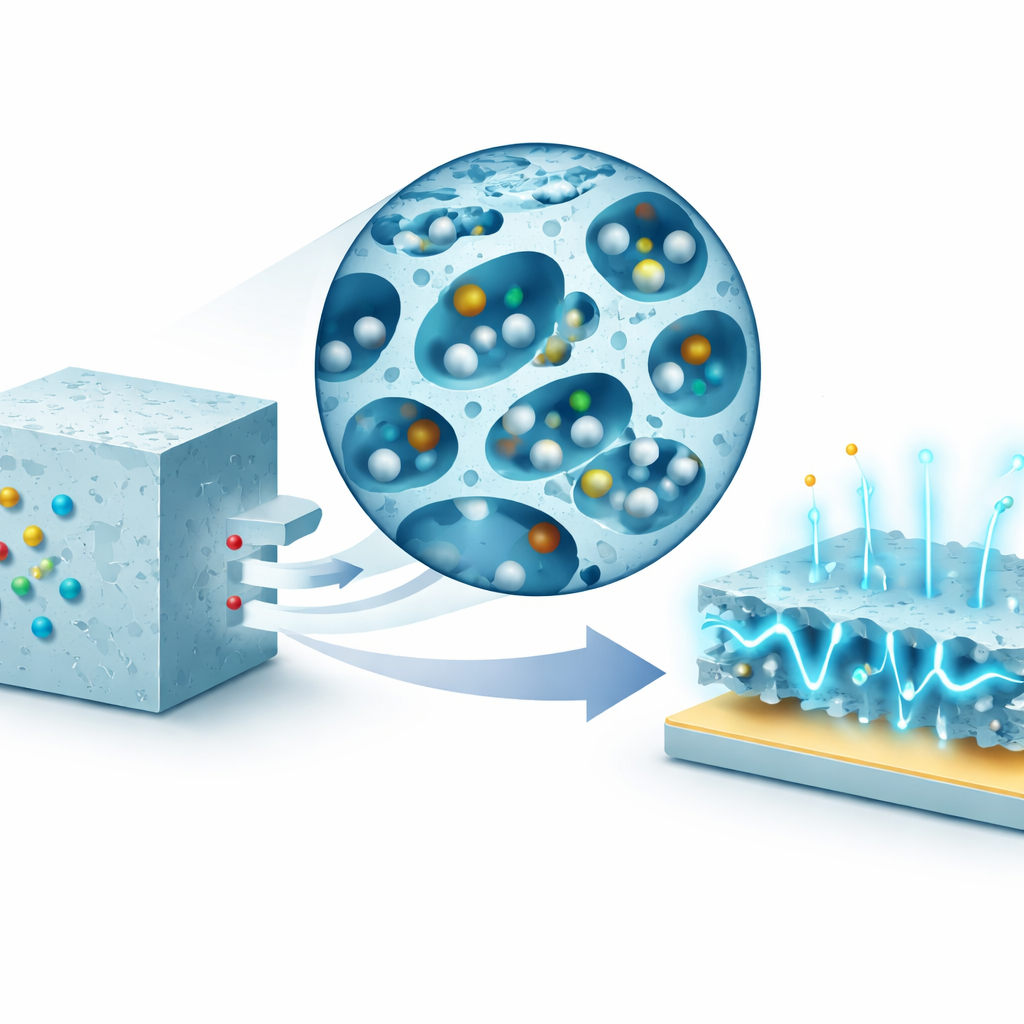
Porous architectures change how materials respond electrically, electrochemically, and optically when something from the outside world—like a gas molecule or a drop of sweat—comes in. In electrical pressure sensors, for example, compressing a porous polymer collapses its air pockets, changing both the distance between electrodes and the effective insulating properties; this amplifies capacitance changes and yields higher sensitivity than solid films. Nanoporous metal electrodes expose much more active surface to liquids, speeding up electron transfer and sharpening signals in chemical and biological tests. In optical devices, porous silicon and other light‑guiding frameworks trap and scatter light within their pores, so even subtle shifts in refractive index from an entering vapor or biomolecule produce measurable color or brightness changes.
Real-World Uses: From Clean Air to Wearable Health
The review highlights how these engineered pores translate into practical sensor systems. In environmental monitoring, porous metal oxides and covalent organic frameworks can rapidly capture and sense pollutants such as nitrogen dioxide or heavy metals at low concentrations, thanks to fast diffusion through interconnected channels and abundant binding sites. For health and fitness, porous carbon and polymer composites form comfortable, breathable patches and bands that track ions, metabolites, and mechanical signals in sweat or skin motion while surviving thousands of bending and washing cycles. Similar concepts are used to make highly stretchable strain sensors that respond not only to stretching, but also to twisting and complex body movements, enabling electronic “skins” and soft robotics to feel their surroundings.
Where This Research Is Heading Next
While porous materials already deliver impressive sensor performance, the article notes persistent hurdles: keeping pore structures uniform at industrial scale, preventing mechanical weakening as porosity rises, and integrating many sensing functions without electrical cross-talk. Light-based fabrication and advanced 3D printing show promise in addressing these challenges by offering faster, cleaner, and more repeatable control of pore structure. Looking ahead, the authors envision porous sensors tightly linked to artificial intelligence and Internet of Things platforms, providing dense streams of high‑quality data for smarter cities, cleaner environments, and more personalized healthcare. In simple terms, by learning to sculpt matter full of carefully designed empty space, engineers are making sensors that see, feel, and respond with unprecedented precision.
Citation: Choi, S.J., Park, S.Y., Kim, K.H. et al. Porous material engineering through synthesis for smart sensor systems. Microsyst Nanoeng 12, 123 (2026). https://doi.org/10.1038/s41378-025-01156-2
Keywords: porous materials, smart sensors, wearable electronics, environmental monitoring, graphene