Clear Sky Science · en
Robust single-mode laser via merging bound state in the continuum
Why tiny, steady lasers matter
Lasers are everywhere, from phone networks to sensors and medical tools. Many of these systems need very small light sources that shine at a single, pure color and stay stable even when driven hard. But shrinking lasers usually makes them more fragile and more likely to split into several colors. This study shows a new way to build chip-scale lasers that are both tiny and stubbornly single-minded in how they shine.
Trapping light in a surprising way
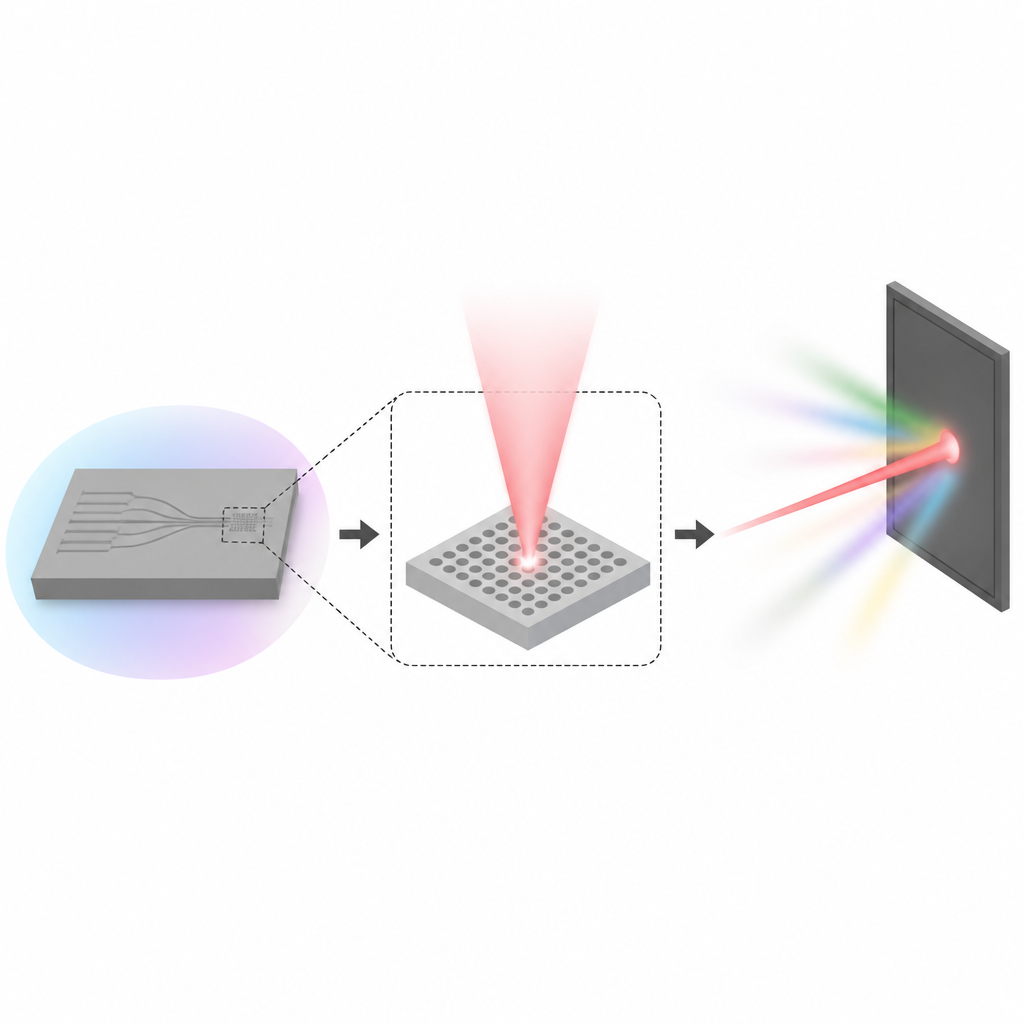
The work centers on a curious type of light trap called a bound state in the continuum. In simple terms, it is a pattern that lets light stay confined even though it has every chance to escape. The researchers create this trap in a flat semiconductor sheet drilled with a regular grid of tiny air holes. When arranged just right, this pattern allows one special light pattern to linger with very little loss, making it ideal for lasing. The challenge is to keep that one pattern dominant while real devices remain small and imperfect.
Making many traps act as one
Instead of relying on a single light trap, the team tunes the hole sizes so that several of these special states in the light pattern merge together. On paper, this merging greatly boosts how well the device holds light in, cutting the power needed to start lasing. Experiments on chips with a grid of 20 by 20 holes confirm that the lasing threshold drops when the merged condition is approached. Measurements of how light leaves the surface and how it interferes with itself show the telltale doughnut-shaped beam and vortex structure expected from this family of light traps.
Finding the sweet spot for one-color output
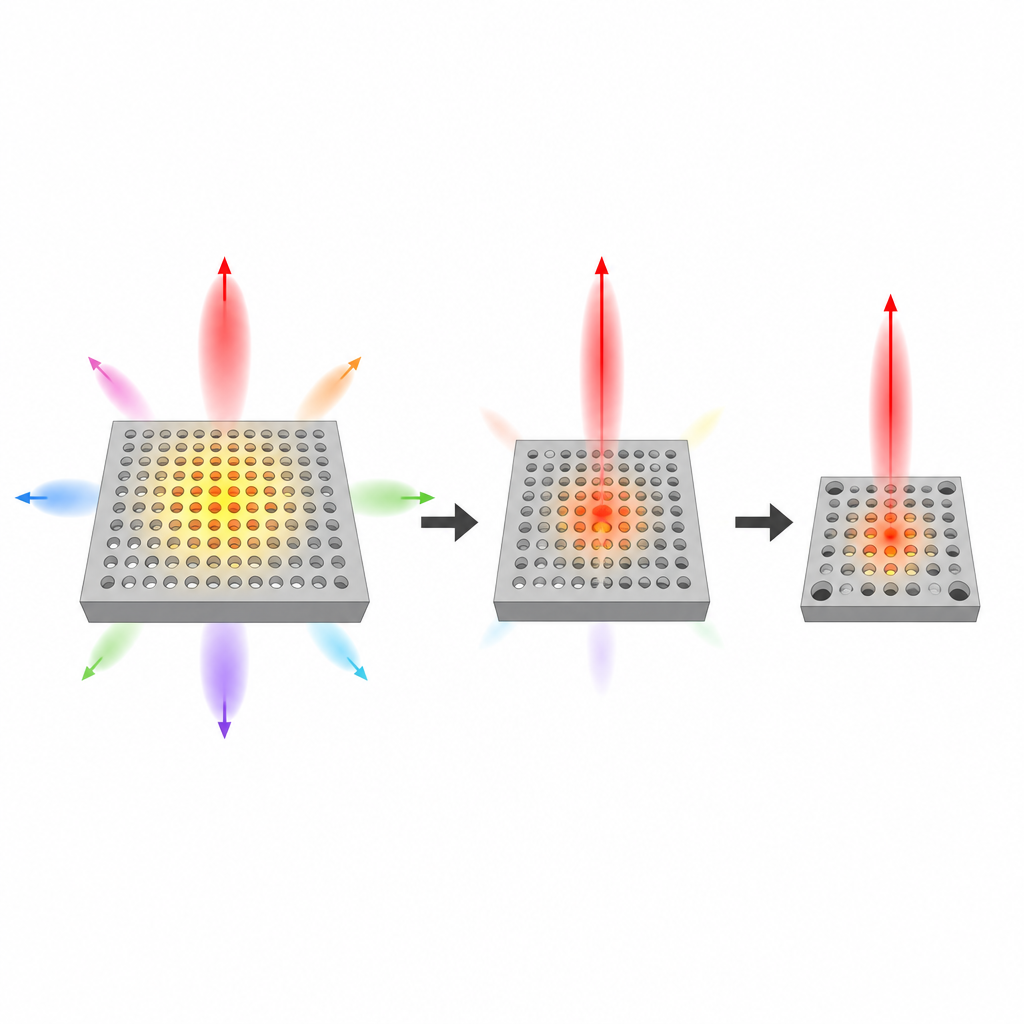
More light in the cavity can also feed other patterns that compete with the main mode. In a real, finite grid, the allowed patterns line up like rungs on a ladder, with different shapes across the device. The authors find that the best behavior does not occur exactly at the perfect merging point but just before it. In this pre-merging setting, the desired mode needs much less gain than its nearest rival. As the pump power climbs, the main mode keeps stealing the available energy, and the competing mode never fully turns on. In tests, the laser stays strictly single-color even when the pump is raised to eighty times the starting threshold, an unusually wide operating range.
Shrinking the laser without losing quality
The team then pushes miniaturization further by making devices only five holes by five holes across, so the patterned area is smaller than the cross section of a human hair. At this scale, light would normally leak out rapidly from the edges. To fight this, the researchers gently shrink the edge holes compared with those in the center. This simple edge shaping improves confinement without enlarging the device. Although more power is needed to start lasing, these tiny chips still manage single-color output over more than ten times the threshold power. Far-field measurements again show the vortex features that signal the same underlying trapping effect.
What this means for future photonic chips
In everyday terms, the study shows how to build very small lasers that prefer to sing one clear note instead of many, and that keep that note steady over a broad range of drive powers. By carefully setting the trap just before the ideal merged condition and tailoring the chip edges, the designers make one light pattern win decisively over all others. This strategy could help future photonic chips pack many stable, high quality light sources into tiny spaces for communications, sensing, and other light-based technologies.
Citation: Peng, K., Moon, J., Meng, Y. et al. Robust single-mode laser via merging bound state in the continuum. Light Sci Appl 15, 255 (2026). https://doi.org/10.1038/s41377-026-02355-w
Keywords: single-mode laser, photonic crystal, bound state in the continuum, nanophotonics, integrated photonics