Clear Sky Science · en
Spectral level repulsion and Lifshitz-like states in hyperuniform disordered photonic networks
Light in a Carefully Shaped Kind of Disorder
We usually think of disorder as something that scatters and wastes light, like fog or frosted glass. This research shows that a special kind of controlled disorder in tiny optical structures can actually be used as a tool to trap, guide, and connect light in useful ways. By engineering patterns that sit between perfect order and total randomness, the authors reveal new ways to manage how light moves, with potential impact on lasers, sensors, and future quantum technologies. 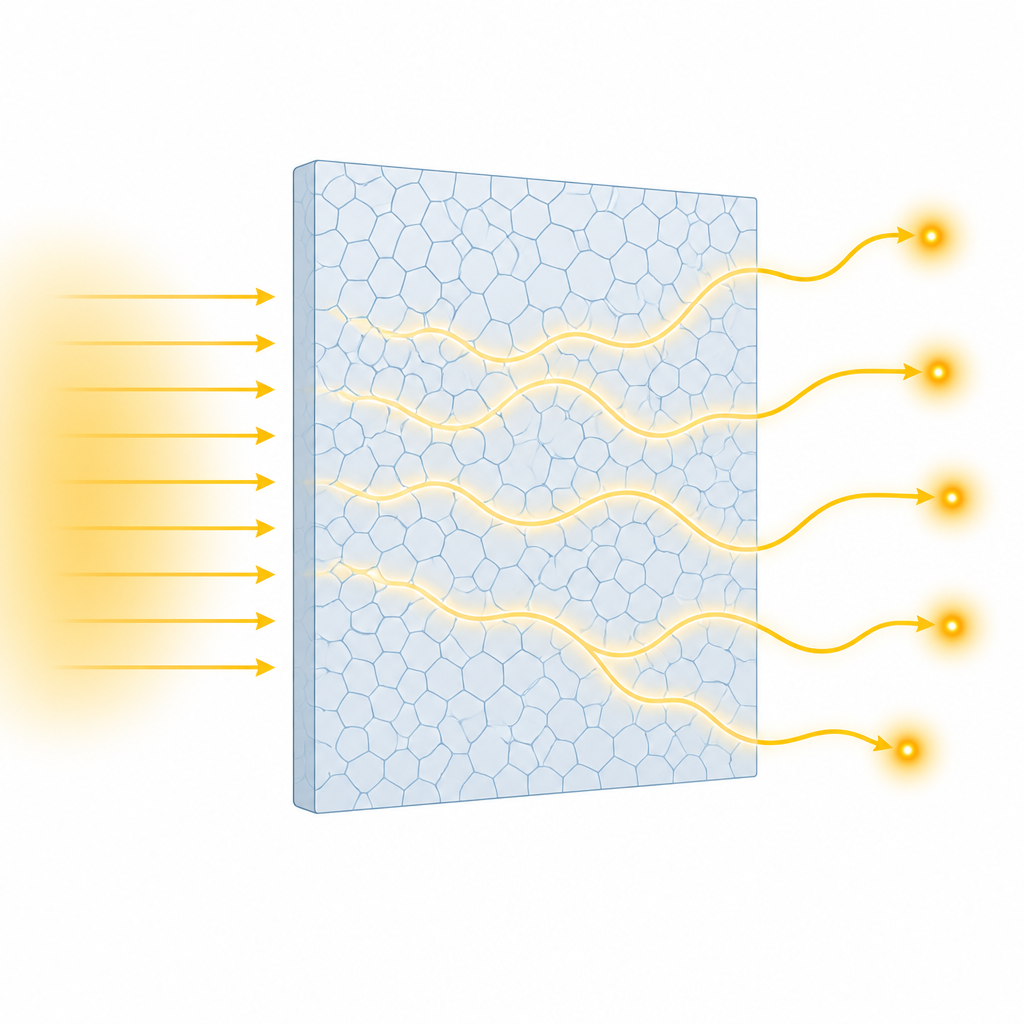
A New Way to Arrange “Random” Materials
The team studies thin semiconductor slabs carved with a pattern called a hyperuniform disordered network. At first glance the pattern looks random, but on larger scales it is finely tuned so that density fluctuations are strongly suppressed. This subtle design gives rise to a photonic band gap, a range of colors that cannot travel through the structure, even though there is no regular crystal lattice. Depending on the color of light, the structure supports either extended waves that spread across it or confined spots where light becomes trapped.
When Light Waves Refuse to Share the Same Color
One question the authors tackle is how to tell apart spreading waves from truly confined ones. In complex systems, extended waves tend to “repel” each other in frequency: two modes that overlap in space avoid having the same color, a behavior known as level repulsion. Using detailed computer simulations and a near-field optical microscope that maps light with nanometer precision, the researchers measure how closely spaced the resonances are and how their spectra correlate. They find clear fingerprints of level repulsion for extended modes, similar to what is seen in chaotic quantum systems, while localized modes behave like isolated, uncorrelated peaks.
Two Different Ways to Trap Light
The study then shows that not all localized light is created in the same way. Some trapped modes arise from multiple scattering throughout the structure, the optical analog of Anderson localization known from electronic materials. Others appear right at the edge of the band gap and are tightly confined to just a few cells of the network. By gradually tuning the amount of structural disorder in simulations and tracking how the size of the modes changes, the authors distinguish between these two families. They link the most strongly confined, band-edge states to particular four-sided cells in the network, making their locations predictable rather than random accidents. 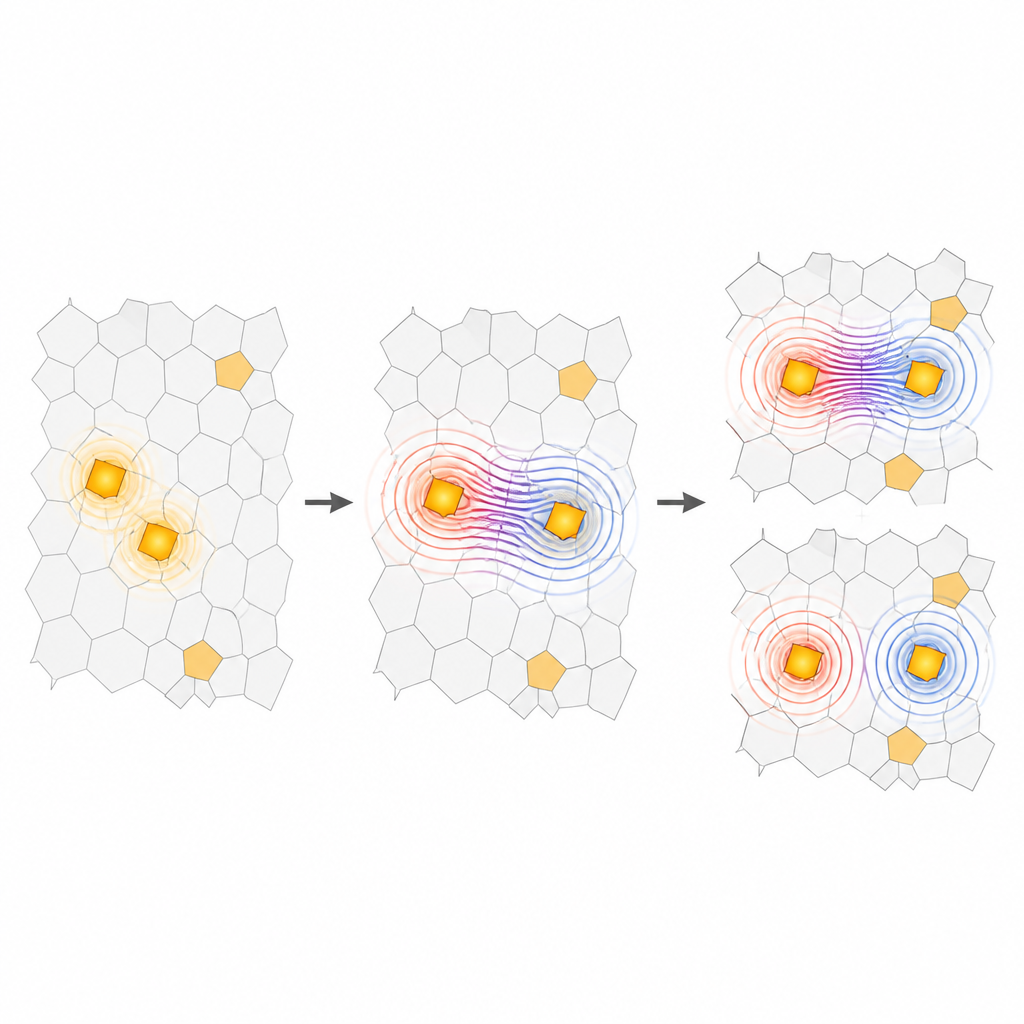
Light Molecules from Paired Defects
Because these special defect-based states can occur close to each other, the team explores what happens when two such sites sit nearby in space and color. High-resolution maps of the emitted light reveal pairs of bright spots that share their energy, forming two slightly different resonances separated in wavelength. Numerical simulations confirm that these act like a “photonic molecule,” with bonding and antibonding patterns where the fields combine in-phase or out-of-phase across the pair. This is similar in spirit to how two atoms form a simple molecule, but here the building blocks are localized light states shaped by the architecture of disorder.
Why This Matters for Future Photonic Devices
By combining controlled disorder with predictable defects, the work outlines a new regime where extended waves, localized traps, and coupled light states coexist in the same material platform. To a lay reader, the key message is that disorder need not be the enemy of optical design; if carefully arranged, it becomes a powerful tool. These findings suggest new routes to create compact random lasers, robust optical filters, and on-chip elements for quantum or neuromorphic photonics, all based on networks where the “randomness” is engineered to place and connect tiny pockets of trapped light on demand.
Citation: Granchi, N., Calusi, G., Stokkereit, K. et al. Spectral level repulsion and Lifshitz-like states in hyperuniform disordered photonic networks. Light Sci Appl 15, 245 (2026). https://doi.org/10.1038/s41377-026-02335-0
Keywords: disordered photonics, light localization, hyperuniform networks, photonic band gap, random lasing