Clear Sky Science · en
Generating vectorial optical fields via surface-wave-excited complex-amplitude metasurfaces
Light on a Chip
Imagine shrinking an entire room full of lenses, mirrors and hologram projectors onto a tiny chip. This paper shows a new way to do just that, by carefully shaping how light behaves on a flat surface so that it can create bright beams and detailed images in open space.
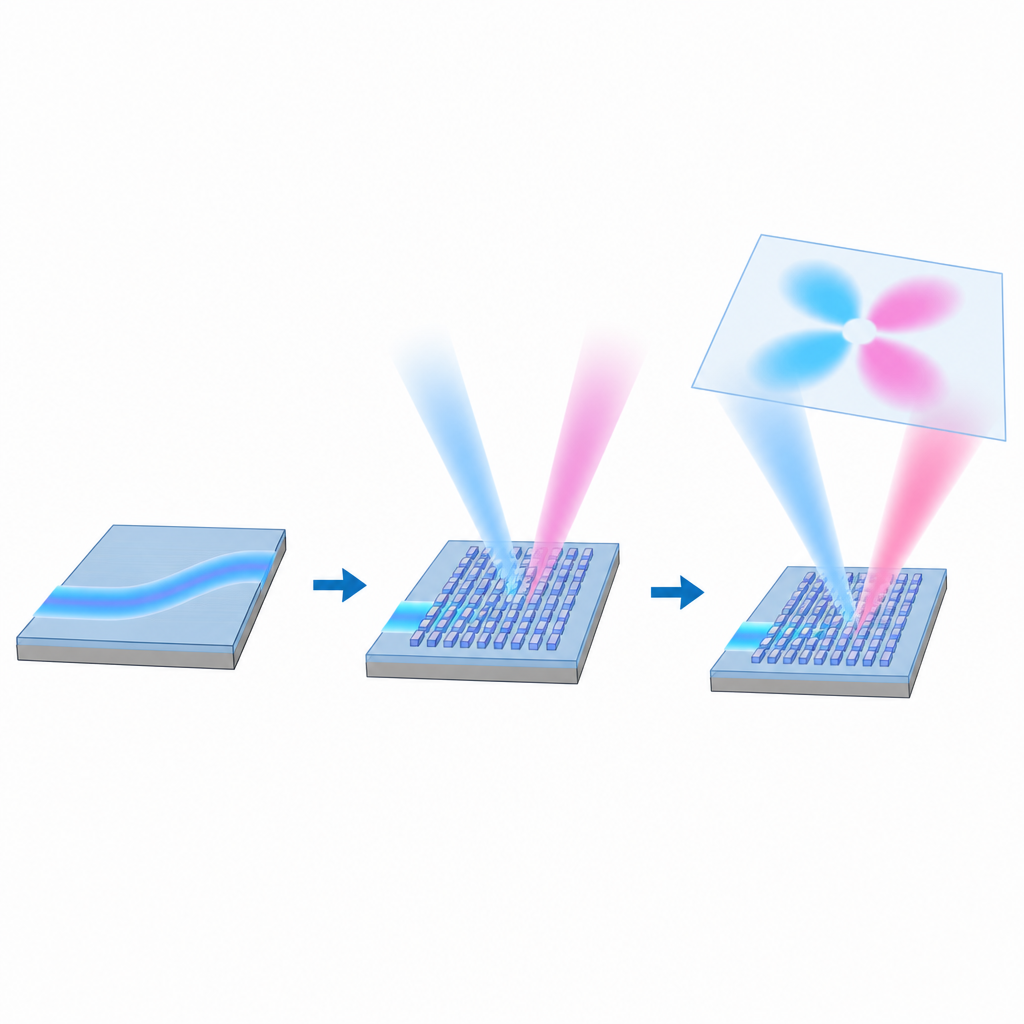
From Simple Light to Rich Patterns
Light does more than just shine; it has both brightness and a kind of internal twist known as polarization. Traditional devices on an optical table can shape these properties, but they are bulky and hard to integrate into compact gadgets. The authors study very thin patterned surfaces, called metasurfaces, that sit on a chip and can sculpt light using microscopic structures smaller than the wavelength of the light itself.
Guiding Waves Beneath the Surface
Instead of shining a beam directly onto the metasurface, the team sends a special guided wave skimming along a metal coated chip. This surface wave acts like a hidden river of energy flowing just under the structures. As it passes each tiny feature, some of the energy is sent upward into free space. By designing how thousands of these features are placed and oriented, the chip can turn the smooth surface wave into almost any light pattern in the air above it.
Independent Control of Brightness and Twist
Most earlier devices of this kind mainly controlled the timing of the light waves, known as phase, while keeping their brightness fixed. That limits the sharpness of images such as holograms. In this work, each building block of the metasurface is actually a small group of four elements. By rotating these four parts differently, the researchers can independently set both the brightness and timing of two distinct polarization components at each point on the surface. This fine control lets them generate light beams with chosen direction, focus, and polarization, all at once.
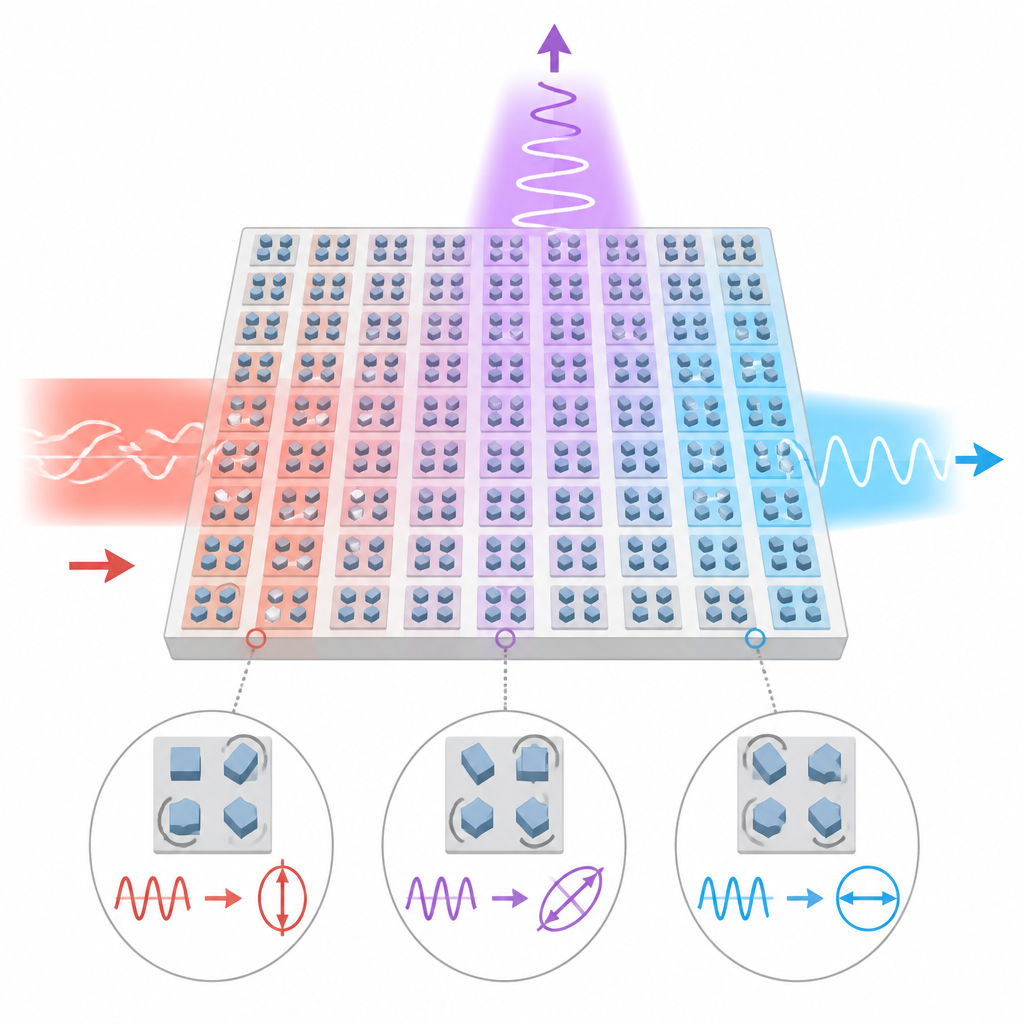
Beams, Lenses, and Holograms on One Platform
Using their design method, the authors build several types of devices that work at terahertz frequencies. One turns the surface wave into two outgoing beams with opposite polarization and a chosen balance in strength. Another acts like a dual-focus lens, producing two bright spots at different positions with controlled relative brightness. The most striking examples are holograms: one produces a simple image with much cleaner detail than a phase only design, while another creates a hologram whose polarization varies across the picture, adding a new layer of information that could be useful for security or data tagging.
Why This Matters
For a non specialist, the key result is that a flat, chip based structure can now sculpt not just where light goes, but also how bright it is and how it is twisted at every point in space. This richer level of control allows sharper holograms, more flexible beam shaping, and images that can hide information in their polarization pattern. Such capabilities could feed into future super resolution imaging, secure holographic displays, and compact augmented reality systems, all built into tiny optical chips rather than bulky lab setups.
Citation: Jin, X., He, Y., Li, J. et al. Generating vectorial optical fields via surface-wave-excited complex-amplitude metasurfaces. Light Sci Appl 15, 256 (2026). https://doi.org/10.1038/s41377-026-02334-1
Keywords: metasurface, surface wave, vectorial light, terahertz holography, integrated photonics