Clear Sky Science · en
Phonon-polaritonic skyrmions: transition from bubble- to Néel-type
Light Whirlpools at the Nanoscale
Imagine being able to sculpt tiny whirlpools of light that keep their shape even when disturbed. This study shows how scientists can create and finely tune such robust patterns, called skyrmions, not in magnets but in light linked to vibrations inside a crystal. These miniature light structures could one day help encode and process information in entirely new ways, using the rules of topology rather than conventional electronics.
What Makes These Patterns So Special
Skyrmions are stable twists in a field, originally proposed in particle physics and now widely studied in magnetism. In magnets, they appear as swirling patterns of spins that cannot be undone without tearing the pattern apart. The same idea can be translated to light: the electric field of light can twist in space in a similar topologically protected way. Earlier work created such optical skyrmions on metal surfaces, where light couples to ripples of electric charge, but those systems suffered from strong energy losses and allowed only a narrow set of skyrmion shapes.
Turning Vibrations into Guided Light
The authors instead use a thin membrane of silicon carbide, a crystal that behaves somewhat like a metal in a specific infrared band. In this range, light couples not to electrons but to vibrations of the crystal lattice, forming surface phonon polaritons that travel along the membrane. Because of the special way silicon carbide responds in this band, small changes in wavelength strongly alter how tightly these waves are squeezed along the surface. This strong tuning ability lets the researchers control the balance between light pointing straight up from the surface and light sliding sideways along it, which is key to shaping different skyrmion types.
How to Build a Lattice of Light Knots
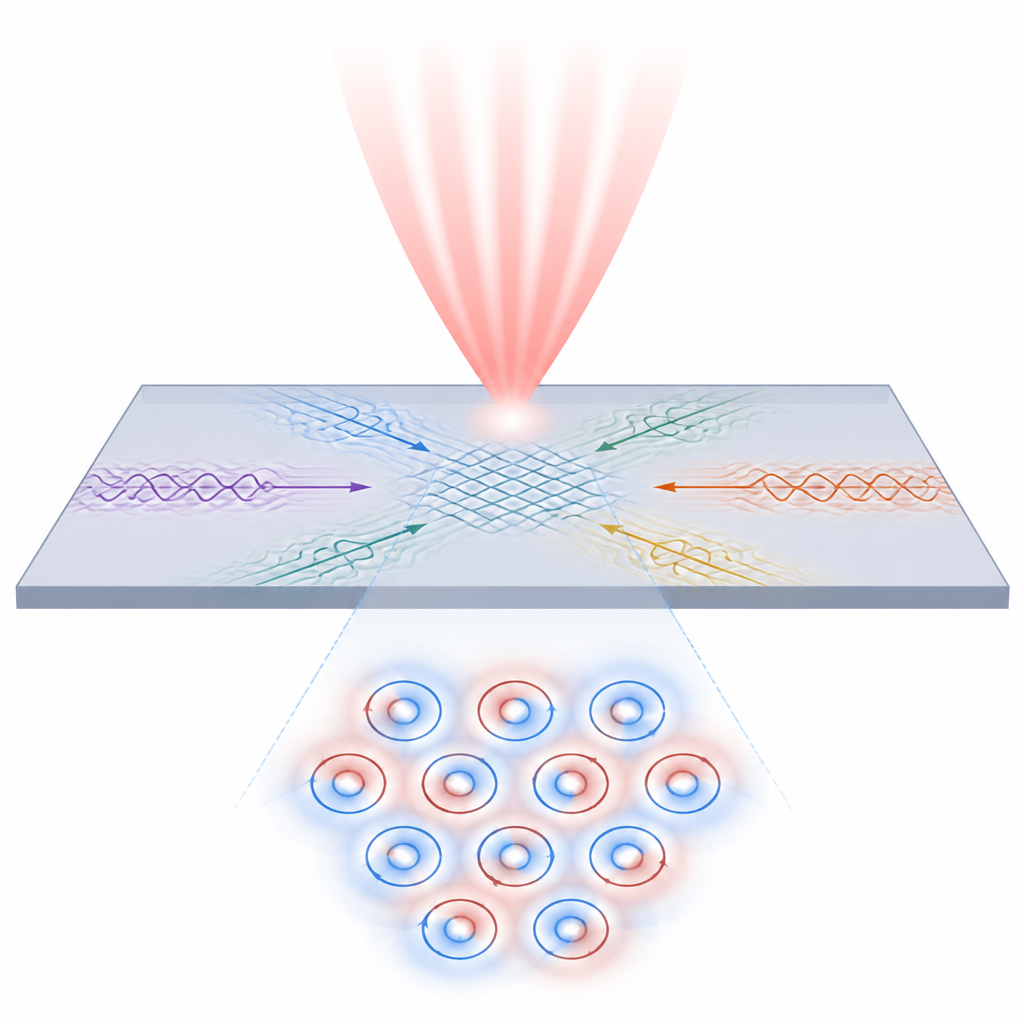
To generate ordered arrays of skyrmions, the team fabricates hexagonal rings of thin chromium ridges on the membrane. When circularly polarized infrared light shines at normal incidence, the ridges launch six surface waves that travel inward and interfere at the center. By adjusting the ridge positions in a spiral-like pattern matched to the surface wave’s wavelength, the waves arrive in step and create a repeating hexagonal lattice, each cell hosting one skyrmion. A specialized near-field microscope, which scans a sharp tip only nanometers above the surface, records the local electric field with both amplitude and phase, revealing details far smaller than the wavelength of the light.
Watching Skyrmions Change Their Character
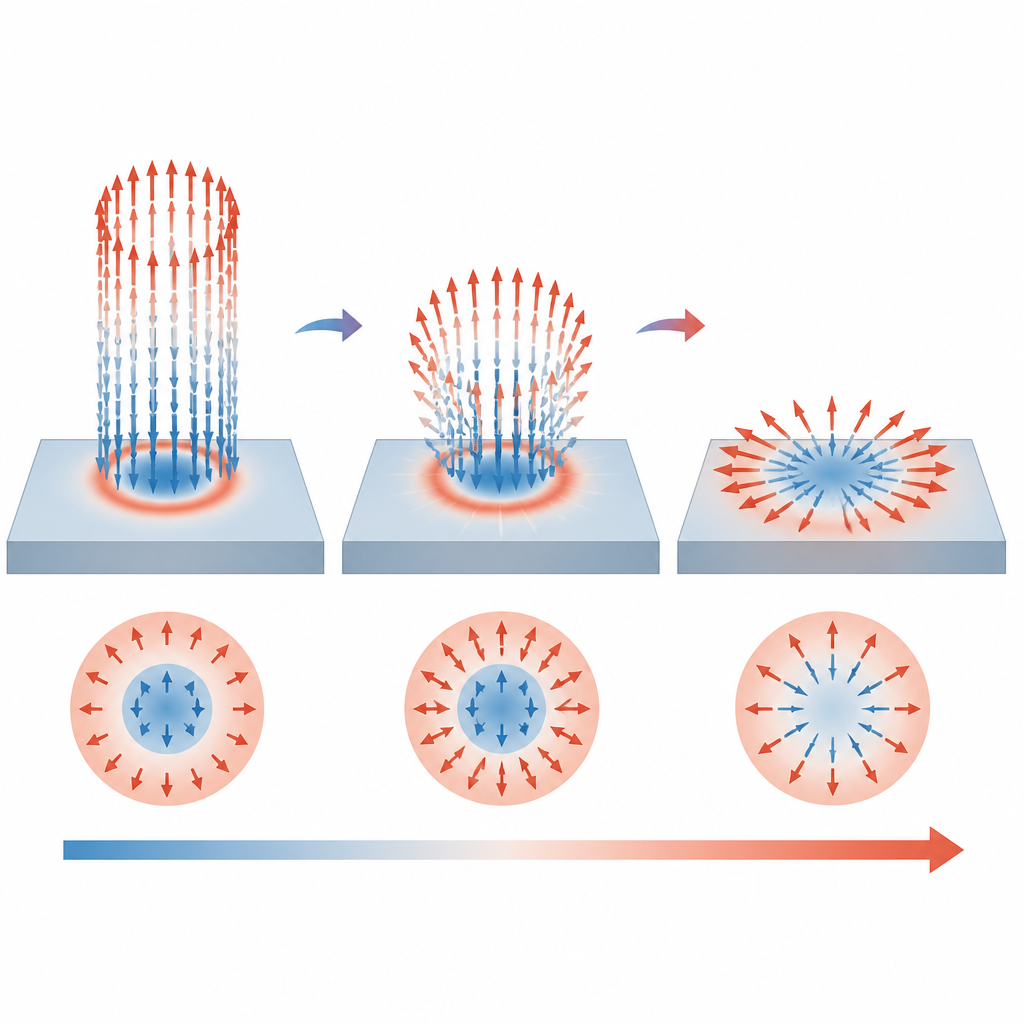
Within each lattice site, the electric field can form different textures. In bubble-type skyrmions, the field is mostly vertical, with a narrow ring where it abruptly flips direction. In Néel-type skyrmions, there is a strong sideways component that fans in or out, and the flip between up and down happens more smoothly across a broader region. By slightly changing the infrared wavelength inside the silicon carbide Reststrahlen band, the researchers continuously tune the surface wave’s in-plane momentum. They observe a smooth evolution from sharp, ring-like bubble skyrmions to broader, gear-like Néel skyrmions, all while the overall topological charge of each skyrmion remains one.
Measuring the Shape of a Topological Twist
To quantify these changes, the team analyzes the “skyrmion number density,” which tracks how rapidly the field direction twists across each unit cell. A bubble-like pattern shows a narrow region of high density, while a Néel-like one shows a more spread-out, mixed pattern. The authors refine earlier measures by avoiding noisy extremes and using percentile values from the data, and they introduce two additional figures of merit inspired by magnetism: the steepness and width of the domain wall where the field flips direction. These metrics all agree that increasing confinement of the surface waves drives a smooth transition from bubble-type to Néel-type skyrmions.
Why These Light Knots Matter
This work establishes phonon-polaritonic skyrmions in silicon carbide as a flexible platform where the character of topological light textures can be tuned with tiny shifts in wavelength. Because the underlying waves are long lived and tightly confined, they offer a promising route to dense, robust information carriers that could be steered, combined, and possibly made to interact through the crystal’s natural nonlinearity. The same design principles might be extended to other materials, including two-dimensional crystals and reconfigurable systems, opening paths toward on-chip computing, advanced imaging, and new ways to control light using the geometry of topological twists rather than traditional circuitry.
Citation: Mangold, F., Baù, E., Nan, L. et al. Phonon-polaritonic skyrmions: transition from bubble- to Néel-type. Light Sci Appl 15, 239 (2026). https://doi.org/10.1038/s41377-026-02332-3
Keywords: optical skyrmions, phonon polaritons, silicon carbide, topological photonics, near-field microscopy