Clear Sky Science · en
High-efficiency multi-scale holographic volumetric 3D printing with a phase light modulator
Printing Objects in a Flash of Light
Imagine creating a detailed 3D object not by stacking thin layers, but by solidifying the whole shape at once inside a jar of liquid. This paper presents a new way to do exactly that, using carefully shaped light to “write” complex objects in seconds, from tiny parts smaller than a grain of sand to pieces the size of a human ear. The work explains how a new type of light-shaping chip greatly boosts efficiency, making fast, precise volumetric 3D printing more practical for engineering, medicine, and biofabrication.
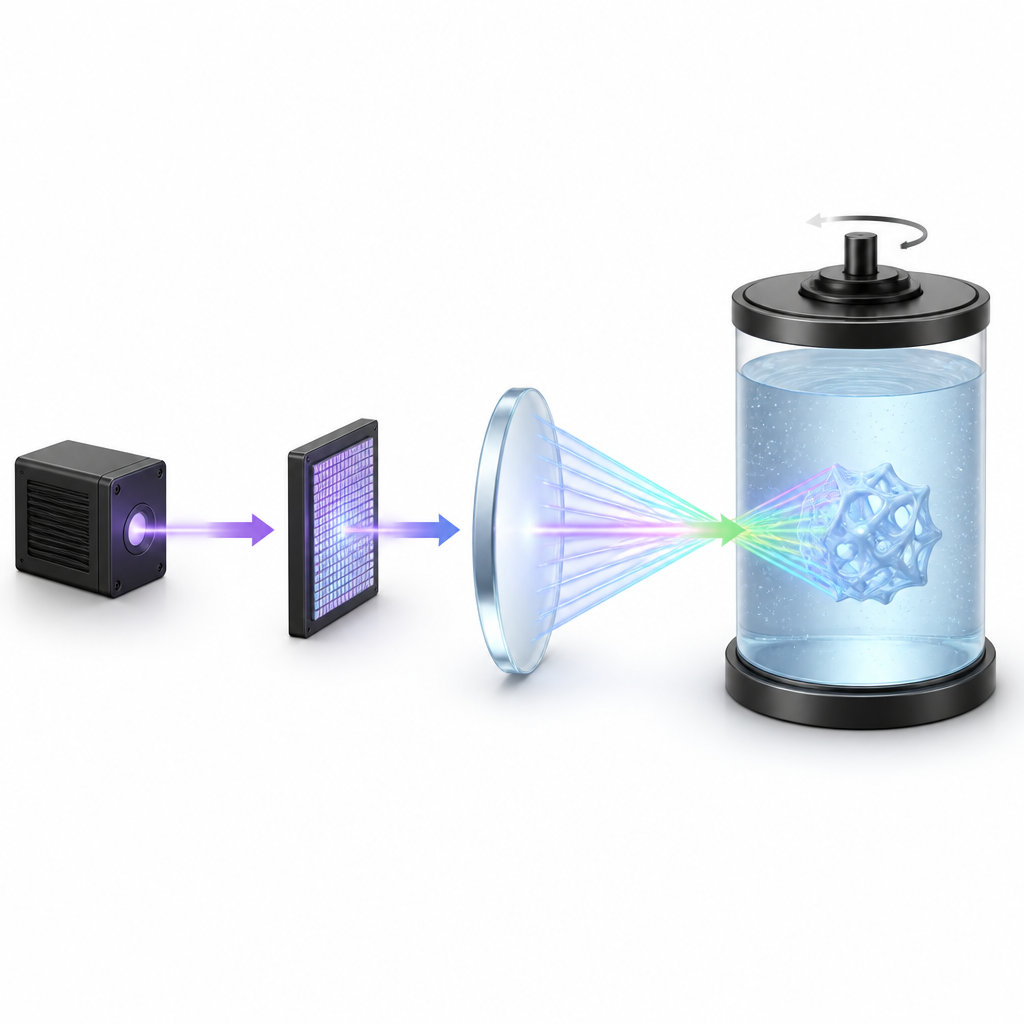
From Layered Printing to Solid Volumes
Conventional 3D printers usually build objects layer by layer, which can be slow and leave visible stair-step marks. Volumetric additive manufacturing skips the layers by shining patterns of light into a photosensitive liquid so that the entire 3D object solidifies in one go. Earlier systems relied on devices that turned tiny mirrors fully on or off to project brightness patterns. While effective, these “amplitude” devices wasted most of the incoming light, meaning powerful and expensive light sources were required to print anything but the smallest parts.
A New Way to Shape Light
The authors replace the traditional mirror array with a new “phase light modulator,” a microchip made of piston-like mirrors that move up and down to delay the light wave instead of simply blocking it. This subtle control over phase makes it possible to form holograms: interference patterns that reconstruct full 3D light fields inside the resin. After carefully calibrating the 16 phase levels of each mirror, the team shows that their phase-based system directs about 24 percent of the laser power into the useful pattern, roughly 70 times more efficient than earlier amplitude setups and twice as efficient as older holographic tricks with standard mirror chips.
Sharpening Focus and Smoothing Noise
To print fine details throughout the whole resin volume, the team reshapes the basic focus of the light beam into a Bessel beam, a special pattern that stays sharp over a long distance instead of blurring quickly. They create this by adding a virtual axicon lens pattern into their holograms so that each bright pixel becomes a narrow, self-sustaining column of light. However, holograms made with coherent laser light tend to be speckled and grainy, which can leave rough streaks or gaps in printed parts. To combat this, the researchers generate several slightly shifted versions of each hologram and flash them in rapid sequence, so the resin “sees” only the average, much smoother intensity. Careful choice of the shift size, matched to the speckle grain, minimizes the unwanted graininess.
Objects from Microscales to Human Size
Armed with a more efficient and cleaner light field, the system prints a series of test objects in different materials. In a commercial acrylate resin, the researchers scale the same digital design up and down to produce fusilli-shaped spirals, the well-known Stanford bunny, and a DNA double helix. Micro-CT scans reveal the smallest positive feature is about 30 micrometers thick, comparable to the width of a fine human hair divided by two. The surface of these prints is markedly smoother when the speckle-reduction method is used. The team then moves to soft hydrogels, including cell-laden gels that mimic biological tissue, demonstrating complex multi-chamber shapes filled with living fibroblast cells. Even in these cloudy, scattering materials, the Bessel beams maintain their focus well enough to form accurate structures. Finally, they show that a human-ear model, measuring 3 by 3 by 4 centimeters, can be printed in about two minutes using only a 150 milliwatt diode laser, thanks to the improved efficiency and a more reactive gelatin-based resin.
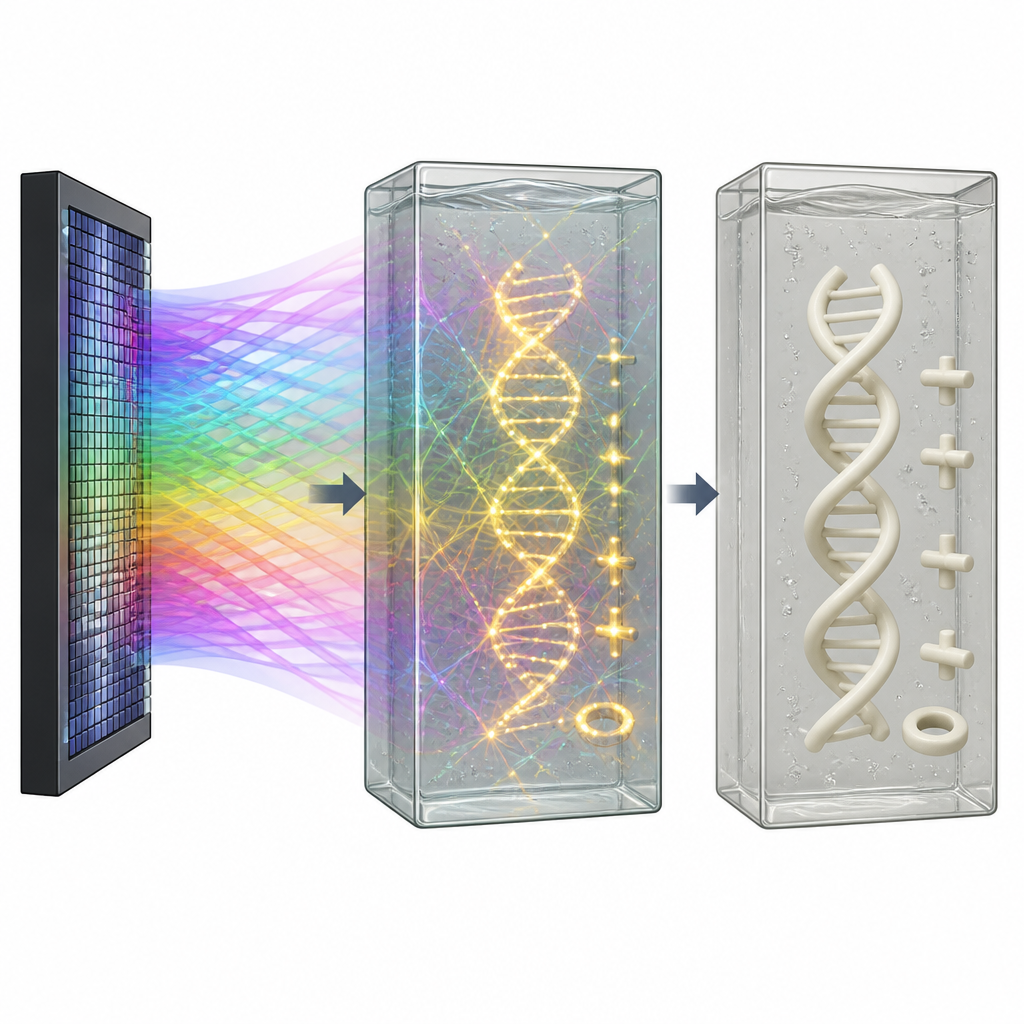
What This Means for Future 3D Printing
In simple terms, this work shows that smarter control of how light waves bend and interfere inside a liquid can transform volumetric 3D printing. By switching from on–off mirrors to a phase-shaping chip, and by taming grainy speckle patterns, the authors achieve faster printing, smoother surfaces, and reliable features that span from tens of micrometers to full centimeters. While chemical factors like oxygen still limit the tiniest details, the approach opens a path toward compact, energy-efficient printers that can rapidly create intricate parts, soft devices, and even living tissue models without relying on bulky, high-power lasers.
Citation: Álvarez-Castaño, M.I., Rizzo, R., Sgarminato, V. et al. High-efficiency multi-scale holographic volumetric 3D printing with a phase light modulator. Light Sci Appl 15, 241 (2026). https://doi.org/10.1038/s41377-026-02331-4
Keywords: volumetric 3D printing, holographic printing, phase light modulator, Bessel beams, bioprinting