Clear Sky Science · en
Reversible optical data storage and encryption enabled by phase-change and hydrogel integration
Hiding messages in everyday light
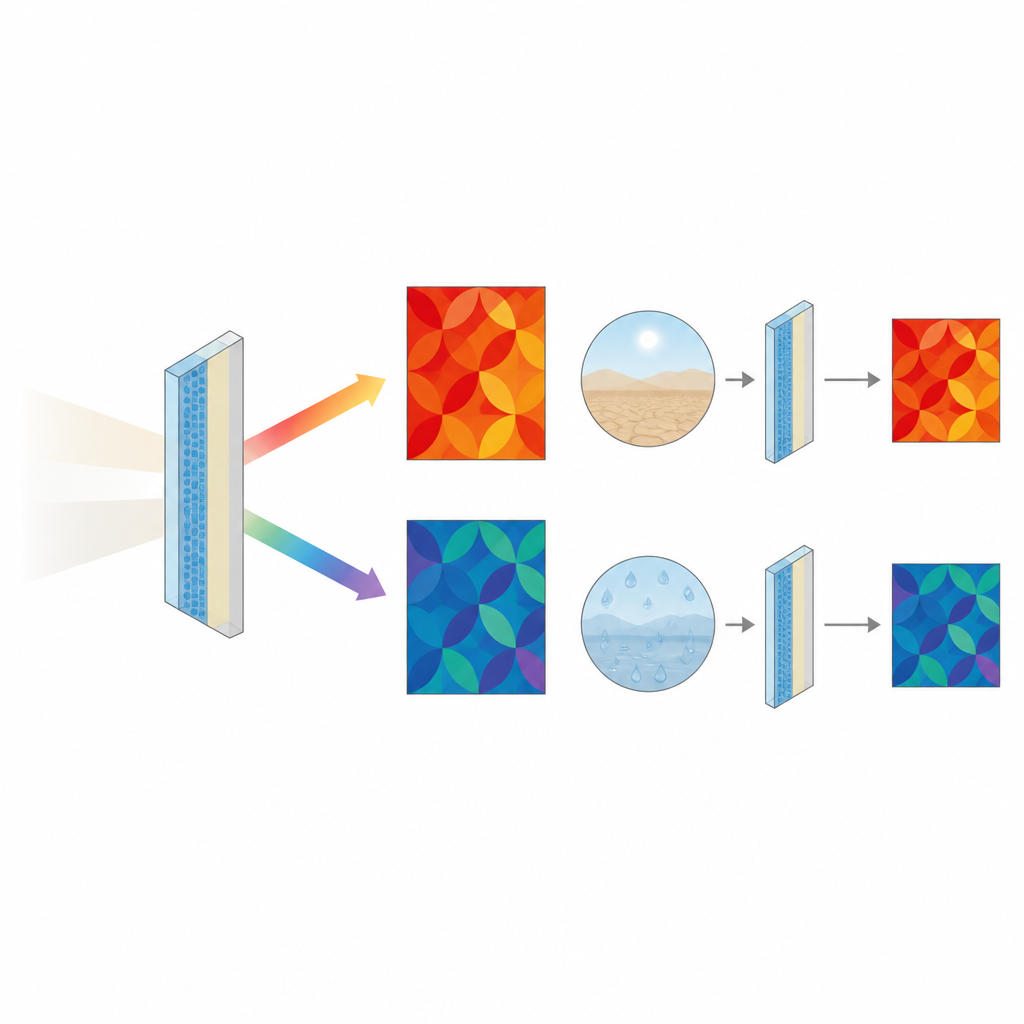
Imagine a postcard that shows one picture in dry air and a completely different one when the room gets humid, all without batteries, screens, or special glasses. This study describes a new way to store and hide colorful images in an ultra-thin film that can be written with light, read under normal room lighting, and switched by nothing more than changes in humidity. The approach could help build secure labels, anti-counterfeiting tags, and smart displays that react to their surroundings.
Building colors from structure, not ink
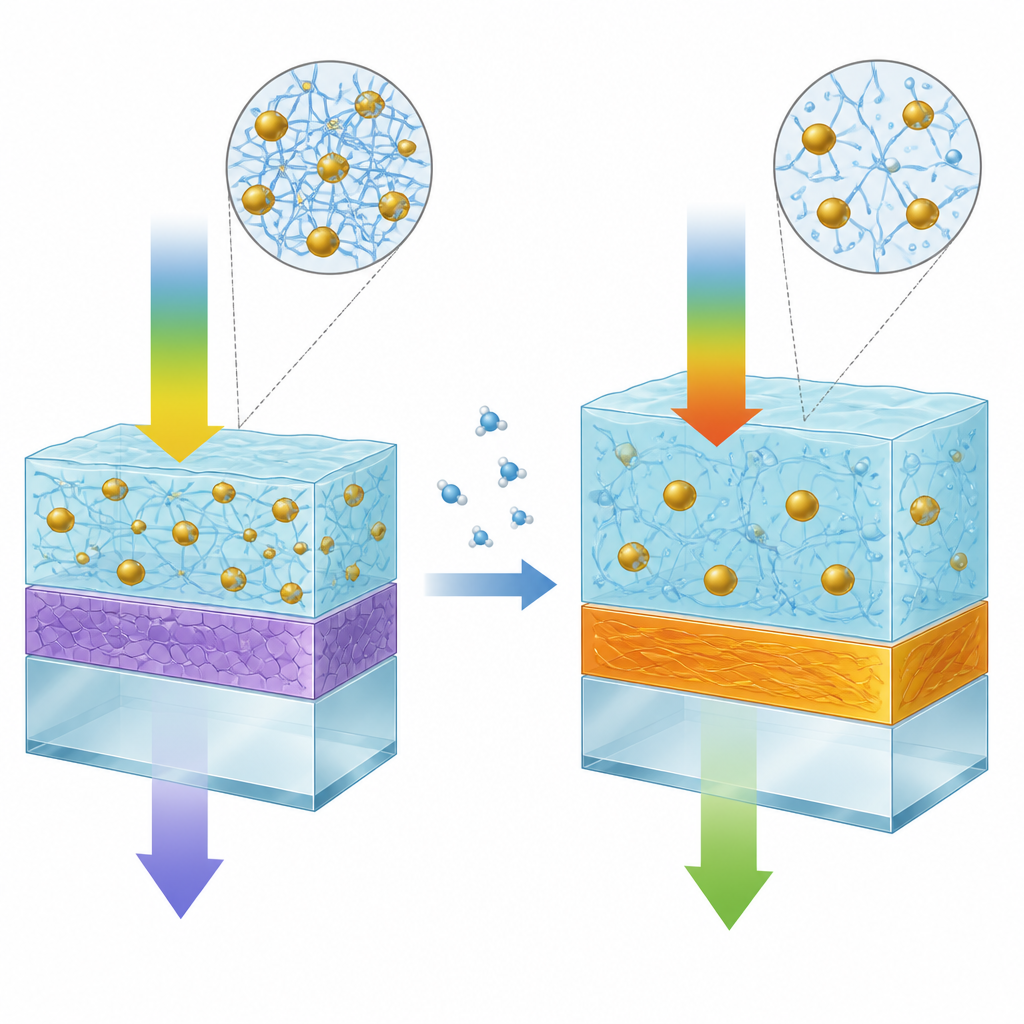
Instead of using traditional dyes or pigments, the device creates color by carefully stacking thin transparent layers so that light waves bounce and interfere in precise ways. At its heart is a glass slide coated with a very thin film of a special material that can change its internal order when heated by a laser. On top sits a soft, water-loving gel layer, and above that a sprinkling of tiny silver islands. When white light shines through this sandwich, the exact thickness and optical properties of each layer decide which colors pass and which are blocked, so each pixel can show a distinct hue.
A film that remembers light and a gel that feels water
The bottom active film is made from antimony trisulfide, a “phase change” material that can reversibly switch between a disordered and an ordered state. Short, intense green laser pulses locally flip small regions, while gentle heating or continuous light flips them back. Each tiny region can therefore be written, erased, and rewritten many times, much like bits on a rewritable disc, but here the change is visible as a shift in the transmitted color. Above it, the gel layer is made from a modified cellulose that swells when it absorbs water from humid air. By pre-exposing selected areas of this gel to ultraviolet light through a stencil, the researchers fix regions that swell a lot and others that swell only a little, encoding a permanent pattern into the material.
Letting humidity reveal or hide information
The trick is that the film and the gel respond to two very different triggers: the phase change layer reacts to focused laser light, while the gel responds to humidity. At low humidity, the gel hardly swells and the entire stack has nearly uniform thickness, so the image written in the phase change layer appears clearly in bright structural color. As humidity rises, the patterned gel swells unevenly, changing the thickness of the light path in different regions and shifting the colors. Under these conditions, a second image, hidden in the gel pattern, becomes visible while the first image fades. By tuning the humidity, the user can toggle which layer’s information is readable, and at very high humidity both sets of data blur and become hard to recognize, adding an extra layer of protection.
Fast response, fine detail, and practical use
Measurements show that the gel layer responds to humidity changes in a fraction of a second and survives many cycles of swelling and drying with little degradation. The scattered silver nanoislands on top help both to enhance color and to let water vapor quickly reach the gel. The team demonstrates separate logos, words, and machine-readable codes stored in the two layers, and reports that they can create pixels only a few micrometers wide, dense enough for detailed images. The patterns remain stable for months, with some color fading mainly due to silver oxidation, suggesting that real-world labels or tags are feasible with further engineering.
Why this matters for secure data
For non-specialists, the key idea is that this thin layered film acts like a two-story storage card: one floor is rewritable by light, the other is permanently set by ultraviolet exposure, and a simple change in air moisture decides which floor you can see. Because it works with ordinary white light and does not need complex optics or electronics, the technology could be built into packaging, identification cards, or sensors, where hidden images or codes appear only under the right environmental conditions. In this way, the research offers a new, physically based method for reversible optical data storage and encryption using nothing more than light and humidity.
Citation: Nauman, A., Gulinihali, G., Moncada, T. et al. Reversible optical data storage and encryption enabled by phase-change and hydrogel integration. Light Sci Appl 15, 238 (2026). https://doi.org/10.1038/s41377-026-02330-5
Keywords: optical data storage, humidity responsive materials, phase change material, hydrogel encryption, anti-counterfeiting