Clear Sky Science · en
Ultraviolet-C to mid-infrared supercontinuum generation in periodically poled lithium tantalate waveguides
Light on a Chip for Many Colors
Being able to generate many colors of light at once lets scientists read the “fingerprints” of atoms and molecules, study distant stars, and monitor pollution in the air. This paper shows how researchers built a tiny chip that turns a single infrared laser into an ultra‑broad rainbow of light, stretching from deep ultraviolet to the mid‑infrared. That span is usually only possible with bulky fiber systems, but here it fits on something smaller than a fingernail.
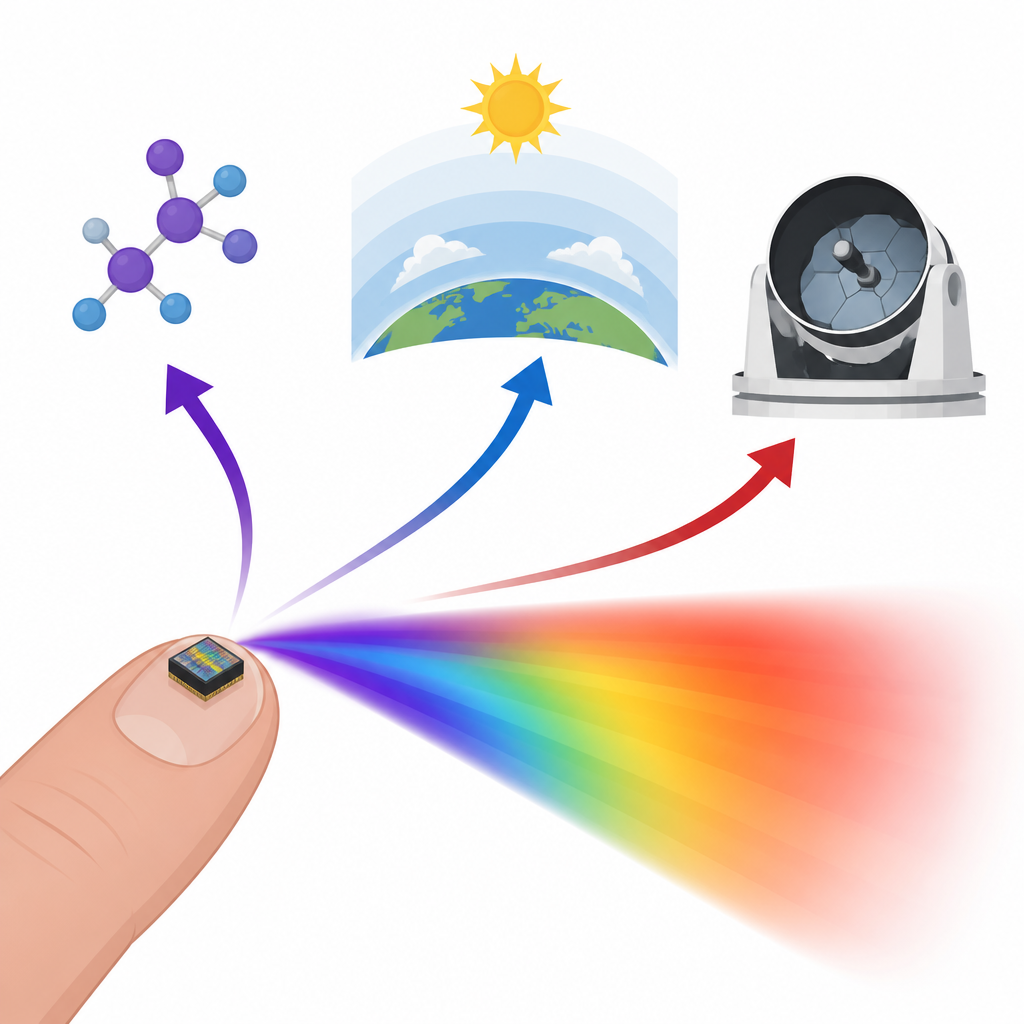
From a Narrow Laser to a Vast Rainbow
The core idea is a process called supercontinuum generation, where an intense, very short laser pulse broadens into a smooth spectrum of colors as it travels through a special material. The authors focus on pushing this rainbow deeper into the ultraviolet than any chip has reached before, while also extending it far into the mid‑infrared. Ultraviolet light is useful for probing electronic transitions in atoms and molecules, while mid‑infrared light is ideal for sensing gases and chemicals through their characteristic absorption bands. Combining both regions in one compact device could simplify many optical instruments.
A Special Crystal and Clever Patterning
To achieve this, the team uses thin‑film lithium tantalate, a crystalline material that is transparent from about 260 nanometers in the ultraviolet up to several micrometers in the infrared. It also responds strongly in a way that lets different colors of light interact and convert into new ones. The researchers carefully pattern this crystal with microscopic regions whose internal orientation flips back and forth in a controlled way. By gradually changing the spacing of these regions along the waveguide, they guide the energy of an incoming infrared pulse into higher and lower frequencies in a stepwise fashion that keeps the process efficient across a huge span of wavelengths.
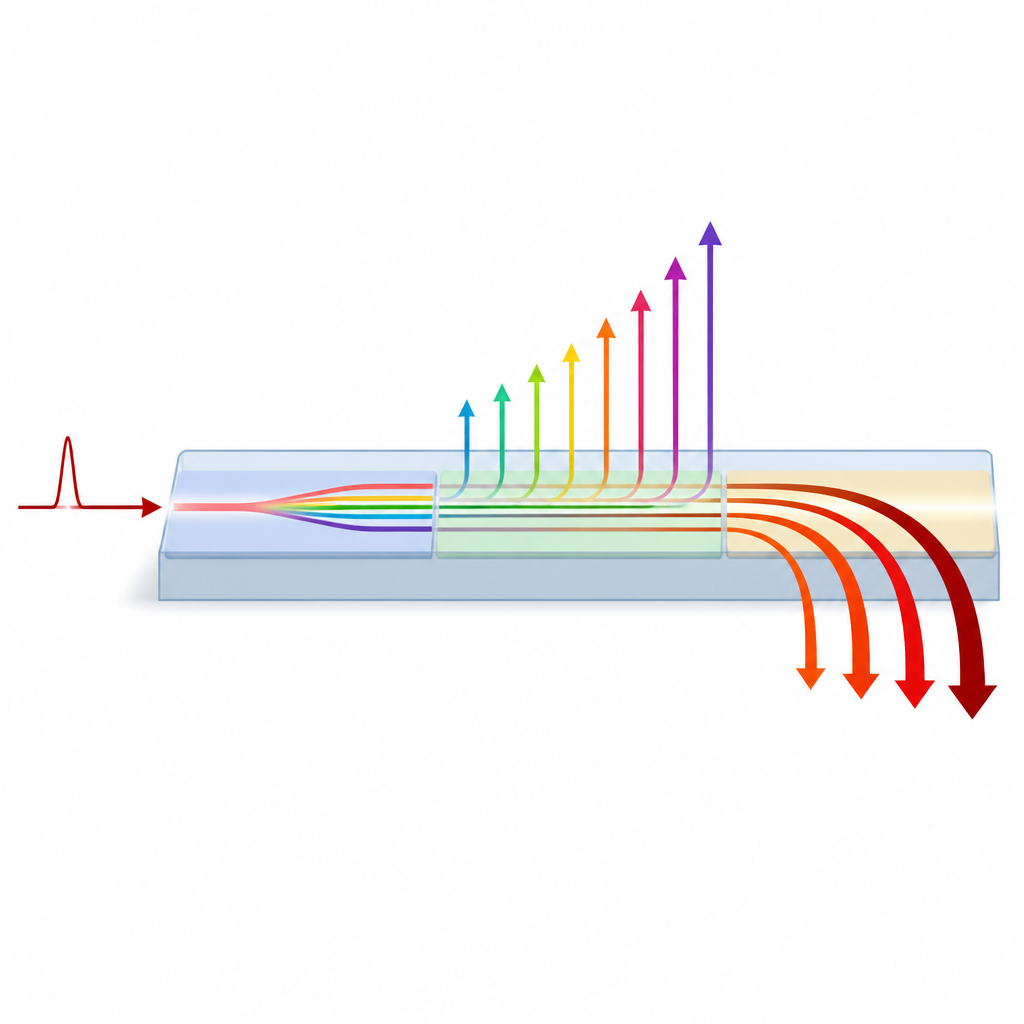
Three Zones, One Continuous Spectrum
The chip’s main channel is divided into three functional sections with different widths and patterns. In the first section, the infrared pulse compresses in time and starts to broaden into nearby colors, helped by interactions that double its frequency and feed additional broadening. In the second section, the microscopic pattern is “chirped,” meaning its spacing slowly shrinks, so that the conditions for converting light are swept from the near‑infrared through the visible and down into the deep ultraviolet. This section drives the spectrum all the way below 270 nanometers, entering the ultraviolet‑C region. In the third section, the pattern spacing increases, favoring interactions that generate longer‑wavelength light and push the spectrum out to beyond 2400 nanometers in the mid‑infrared.
A Tiny Lab for Broad‑Band Sensing
To show what this broad rainbow can do, the authors integrate an additional spiral‑shaped waveguide on the same chip, which serves as a compact sensing path. Light from the supercontinuum source passes through this spiral while samples such as liquids or gases interact with it. By recording how different wavelengths are absorbed, the system can identify or quantify substances. The team measures absorption by a common dye in water, capturing both visible and ultraviolet signatures, and also records detailed absorption lines of industrially relevant gases in the infrared. The agreement with standard reference data confirms that the chip can support precise, wide‑band spectroscopy.
What This Means for Future Devices
In simple terms, the researchers have put a very bright, extremely broad rainbow source onto a single chip and shown it can be used to read the spectral fingerprints of molecules and gases across ultraviolet, visible, and infrared light. Their design reaches shorter ultraviolet wavelengths on a chip than previously reported and covers more than three “octaves” of color using only modest laser energy. This positions lithium tantalate chips as a strong platform for future compact instruments, such as portable spectrometers, environmental monitors, and tools for precision measurements in physics and astronomy.
Citation: Xiong, H., Yao, X., Zhang, M. et al. Ultraviolet-C to mid-infrared supercontinuum generation in periodically poled lithium tantalate waveguides. Light Sci Appl 15, 253 (2026). https://doi.org/10.1038/s41377-026-02323-4
Keywords: supercontinuum generation, lithium tantalate, ultraviolet light, mid infrared spectroscopy, integrated photonics