Clear Sky Science · en
Super-resolution image projection over an extended depth of field using a diffractive decoder
Sharper images from smaller devices
From virtual reality headsets to holographic displays, many gadgets struggle to show sharp 3D scenes without straining our eyes or eating up power and data. This research introduces a new way to project crisp images over a large range of viewing distances, while using compact hardware and reduced data. It combines smart software with cleverly designed optical layers so that simple projectors can behave like much more powerful displays.
Why depth and detail are hard to get
Modern near eye and holographic displays face a basic trade off between depth and detail. Our eyes rely on focus cues to judge distance, but most displays fix the focus at a single plane, which can cause discomfort and fatigue. Holographic systems can in principle provide all natural depth cues, yet they are limited by the number of pixels in the light modulator and by the heavy computations needed to generate holograms in real time. Compressing holograms like ordinary images often erases the fine details that make 3D scenes look convincing.
A split job for computers and light
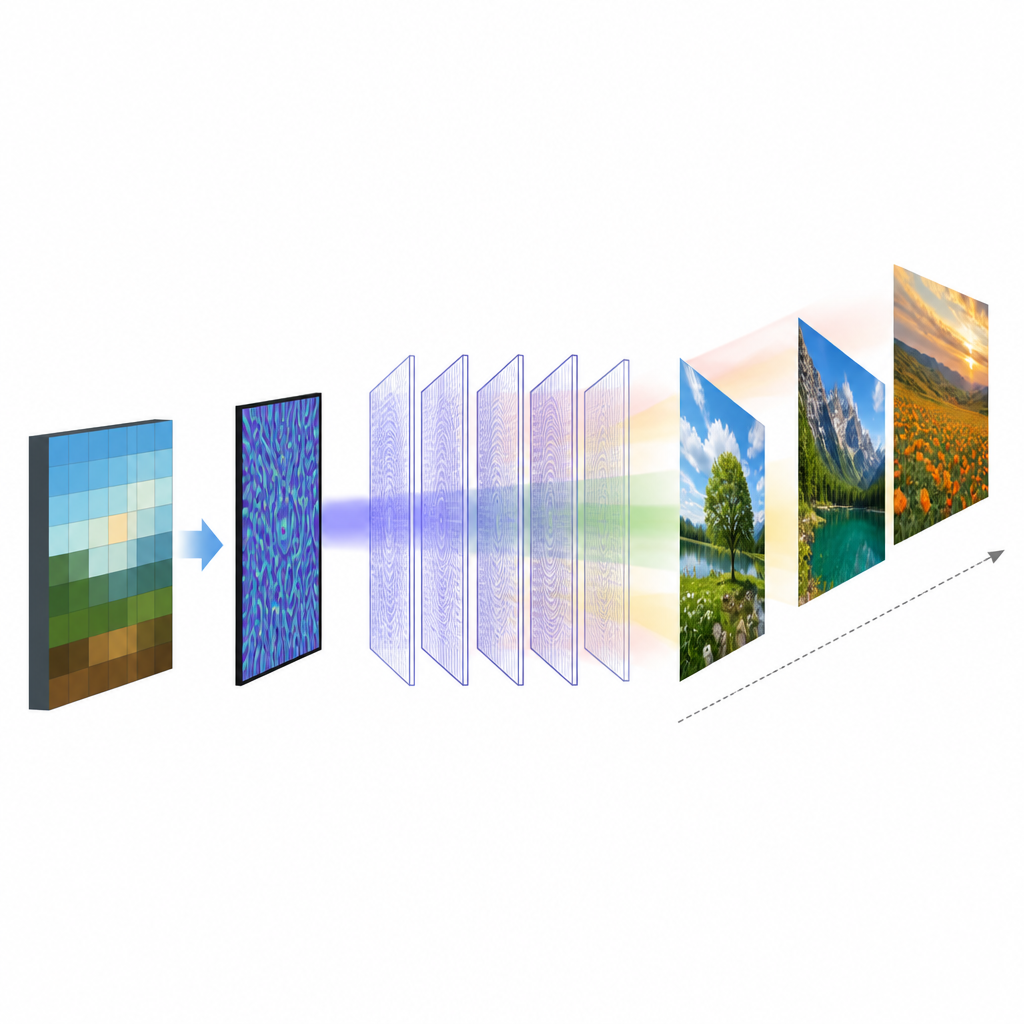
The authors propose a hybrid image projection system where electronics and passive optics share the work. First, a lightweight convolutional neural network acts as a digital encoder. It takes a high resolution image and converts it into a compact phase pattern that can be shown on a low resolution projector. This pattern no longer looks like the original picture, but it carries the same visual information in a coded form. Next, this encoded light passes through one or more specially designed diffractive layers, which form an all optical decoder. These layers reshape the light so that, as it propagates forward, a sharp version of the original image appears over an extended depth range.
More pixels than the display seems to have
Because the diffractive decoder uses the physics of light rather than extra electronics, it can boost the effective space bandwidth product, a measure of how much detail a system can show over a given area. In the demonstrations, the hybrid system turns coarse phase patterns into images with up to about sixteen times more effective detail at each projection plane than the input projector suggests. At the same time, the sharp image persists over an axial distance of at least 250 times the illumination wavelength, which means the picture stays clear as the viewing or detection plane moves back and forth through space. Tests with simple characters, fine stripe patterns, and hand drawn doodles all show that the system generalizes well beyond the images it was trained on.
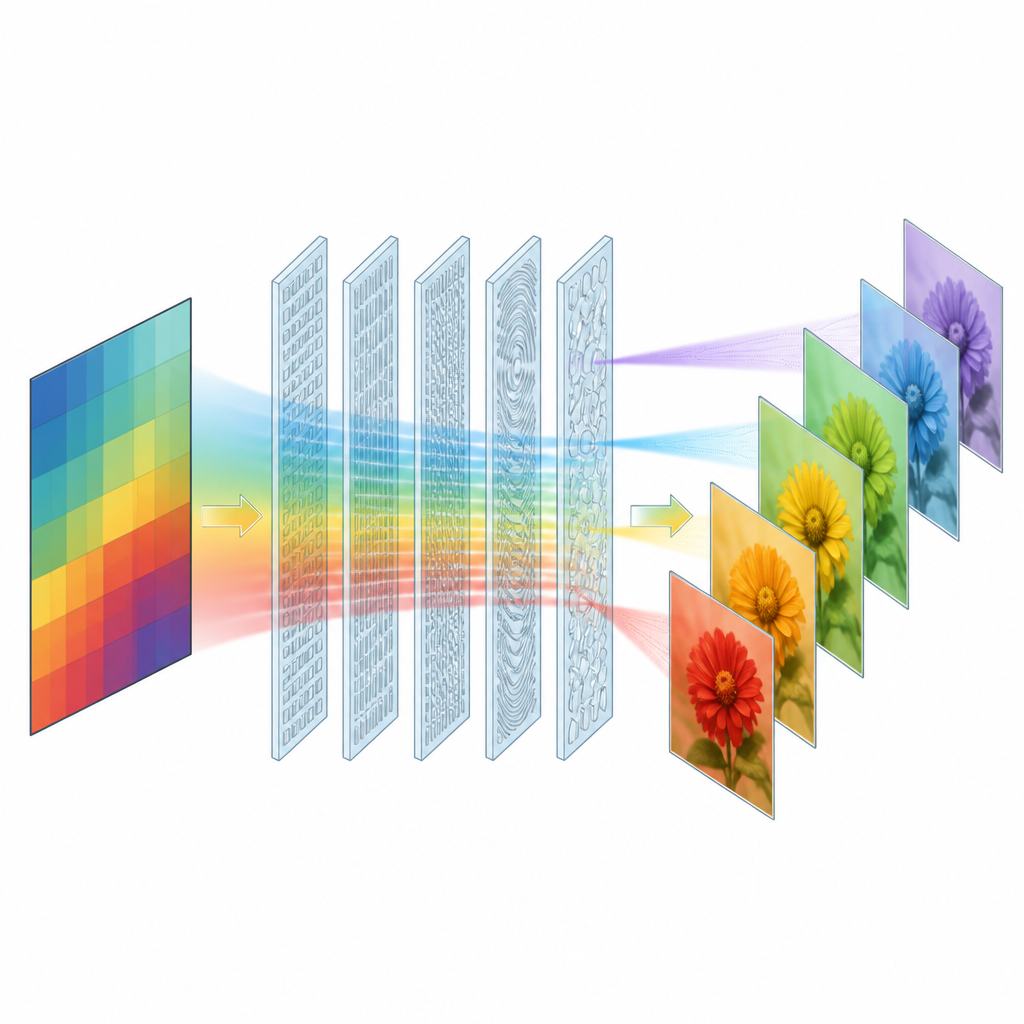
Working across colors and coping with real hardware
The team confirmed the approach in both terahertz radiation and visible light experiments. In each case, they trained the digital encoder together with diffractive layers so that the combined system would tolerate misalignments and coarse control of the optical phase, conditions that are common in practical hardware. They also explored how adding more diffractive layers improves image quality, how the usable depth range depends on design choices, and how the method holds up when only a few discrete phase levels are available during fabrication. The results show that careful co design of the network and optics can keep images sharp across depth even when the components are imperfect.
What this could mean for future displays
In simple terms, this work shows that a low resolution display, helped by a trained optical decoder, can project high resolution images that stay in focus over a long range without extra power at the viewing side. By shifting much of the effort into a fixed set of passive layers and an efficient encoder, the architecture could ease data and power demands for future holographic and near eye displays. The same principles may also benefit microscopes and measurement tools that need to capture fine details through depth without constant refocusing.
Citation: Chen, H., Işıl, Ç., Shen, CY. et al. Super-resolution image projection over an extended depth of field using a diffractive decoder. Light Sci Appl 15, 236 (2026). https://doi.org/10.1038/s41377-026-02320-7
Keywords: holographic display, super resolution imaging, diffractive optics, extended depth of field, computational imaging