Clear Sky Science · en
Additive-free and brine-discharge-free solar-thermal desalination with simultaneous complete mineral mining from ocean water
Turning Sunlight and Seawater into Drinking Water
Many coastal communities face a puzzle: they are surrounded by seawater yet lack safe drinking water. This study describes a new way to turn ocean water into fresh water using only sunlight, while also capturing useful minerals from the sea. The approach avoids the dirty waste brine created by many current desalination plants, aiming for a cleaner and more efficient path to secure water and valuable resources.
Why Current Desalination Falls Short
Conventional desalination plants, such as those based on reverse osmosis, use a lot of energy and release large volumes of concentrated brine mixed with chemicals back into the environment. This brine can harm marine life, coastal ecosystems, and even underground water. At the same time, seawater holds huge amounts of dissolved minerals, including some that are scarce and valuable on land. Ideally, a single system would provide fresh water, turn dissolved salts into solid form, and do so without discharging liquid waste.
A Sun-Driven Metal Panel That Drinks from the Sea
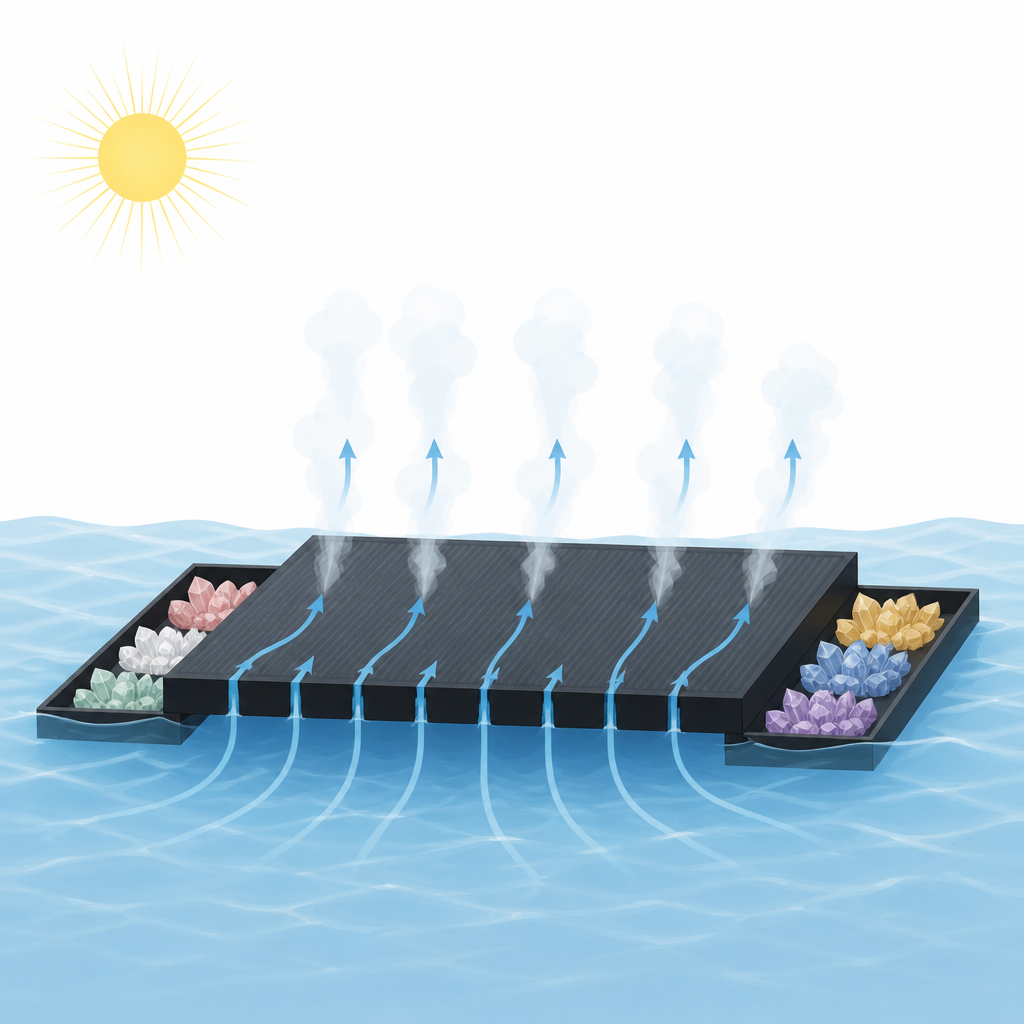
To meet this challenge, the researchers built a special metal panel that both soaks up seawater and traps sunlight. They use a fast laser processing method to sculpt the surface of thin aluminum into forests of tiny grooves covered with even smaller structures. This treatment makes the metal jet black and highly absorbing, so it converts nearly all incoming sunlight into heat. It also makes the surface superwicking, meaning a thin film of water can climb uphill through the grooves, pulled along by capillary forces. When sunlight shines on the panel, the thin film heats up and water quickly evaporates into vapor, leaving the dissolved salts behind on the surface.
Keeping Salt Away from the Working Zone
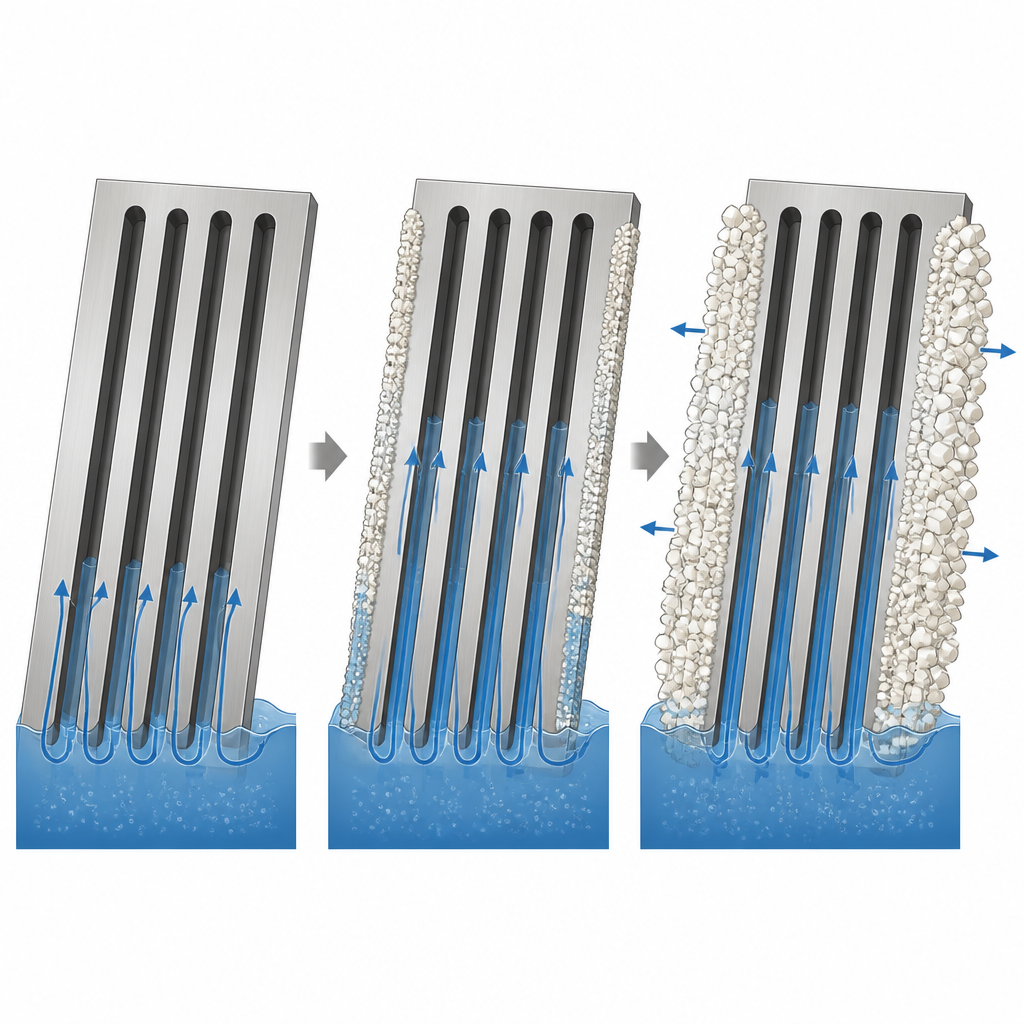
Salt buildup normally cripples solar evaporators by blocking water flow and reflecting light. The key advance in this work is that the laser-shaped panel automatically pushes newly formed salt crystals away from the central working area into side regions where they can be collected. The authors show that deeper and wider surface grooves supply a strong flow of relatively fresh seawater that reaches the growing salt front. Microscopic observations reveal that evaporation first concentrates salt at the outer water boundary, similar to how a coffee ring forms when a drop dries. Then a process called salt creeping takes over: thin films of salty water move over the porous salt crust, dissolve it locally, and re-crystallize further outward. This repeated step causes the salt edge to march away from the active zone, which remains clean and efficient.
Fresh Water and Solid Minerals without Waste Brine
In controlled indoor tests under standard sunlight, the optimized panel design reaches an evaporation rate of about 1.76 kilograms of water per square meter per hour, with roughly three quarters of the incoming solar energy going into vaporizing water. At the same time, nearly all of the salt present in the evaporated seawater appears as solid crystals on the passive regions of the panel, so almost none returns to the water below. Over continuous week-long operation, both water production and salt collection remain stable, while the salinity of the remaining seawater stays nearly constant, showing that liquid waste brine does not build up. Tests with seawater from the Atlantic, Pacific, and Indian oceans give similar performance, and the condensed water meets established drinking water standards.
Mining the Sea While Making it Drinkable
The collected solids contain the expected common salts such as sodium, magnesium, potassium, and calcium, but also trace amounts of more valuable elements like gold, cesium, bromine, and uranium. The authors suggest that by adding selective coatings to parts of the panel, the system could be tuned to grab specific metals such as lithium while still producing fresh water. Because the panel can pull water uphill, it can be tilted to follow the Sun across the sky, improving daily output. In simple terms, this work points to a practical way to turn sunlight and seawater into both drinkable water and mineable minerals, while sidestepping the environmental hazards of brine discharge.
Citation: Tang, L., Singh, S.C., Wei, R. et al. Additive-free and brine-discharge-free solar-thermal desalination with simultaneous complete mineral mining from ocean water. Light Sci Appl 15, 246 (2026). https://doi.org/10.1038/s41377-026-02315-4
Keywords: solar desalination, seawater, zero liquid discharge, mineral recovery, water purification