Clear Sky Science · en
A hybrid-frequency programmable synthetic-dimension simulator with rich coupling on a single chip
Turning Tiny Chips into Physics Laboratories
Modern physics often deals with complex, high-dimensional systems that are nearly impossible to build in real life. This paper shows how a single, thumbnail-sized optical chip can imitate such exotic worlds by treating different colors of light as positions in an artificial space. By cleverly driving the chip with radio waves, the authors create a highly flexible “synthetic dimension” where many different types of quantum-inspired materials and effects can be explored without building huge experiments.
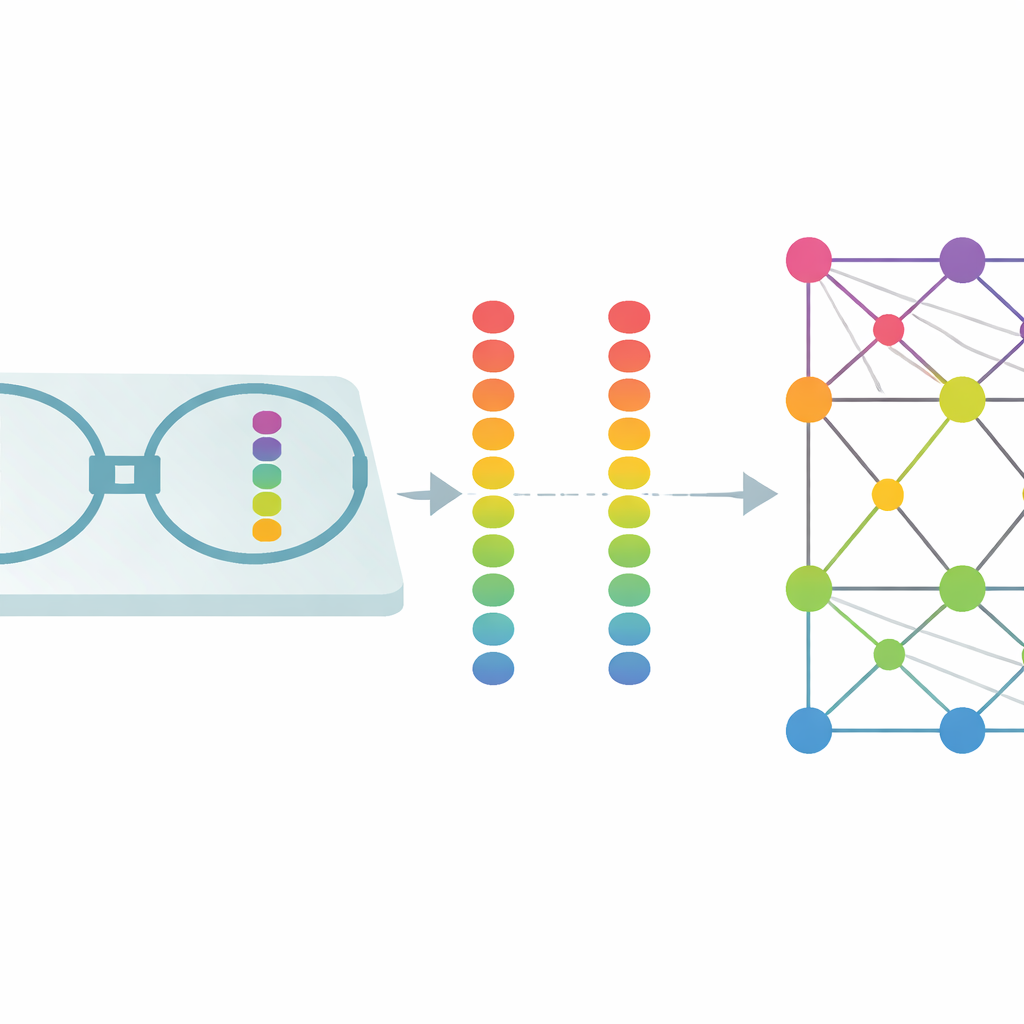
Building Worlds from Colors of Light
Instead of arranging atoms on a physical lattice, the researchers use the frequencies of light circulating in microscopic ring resonators as the lattice sites. Each ring supports many closely spaced colors; by modulating the chip with low-frequency radio signals, these colors are made to interact in a controlled way, as if they were neighboring sites in a crystal. A key innovation is to combine two kinds of synthetic sites: those formed within a single broadened resonance of a ring (“intra-resonant” sites) and those formed between separate resonances of different rings (“inter-resonant” sites). This hybrid design greatly enlarges the accessible synthetic space while still fitting on a compact thin-film lithium niobate chip.
Rich Connectivity on a Single Chip
Real materials are fascinating partly because particles can hop in many directions and over different distances. The same idea holds in synthetic lattices: the more ways light can move between sites, the richer the physics. On this chip, the authors independently program horizontal links within each ring, vertical links between rings, and diagonal “cross” links, simply by shaping the radio-frequency drive and static voltages. This lets them realize several celebrated model systems from condensed-matter theory, such as Hall and Creutz ladders—two-leg structures that mimic charged particles moving in a magnetic field—and even lattices where light can jump over multiple sites, effectively exploring higher-dimensional behavior.
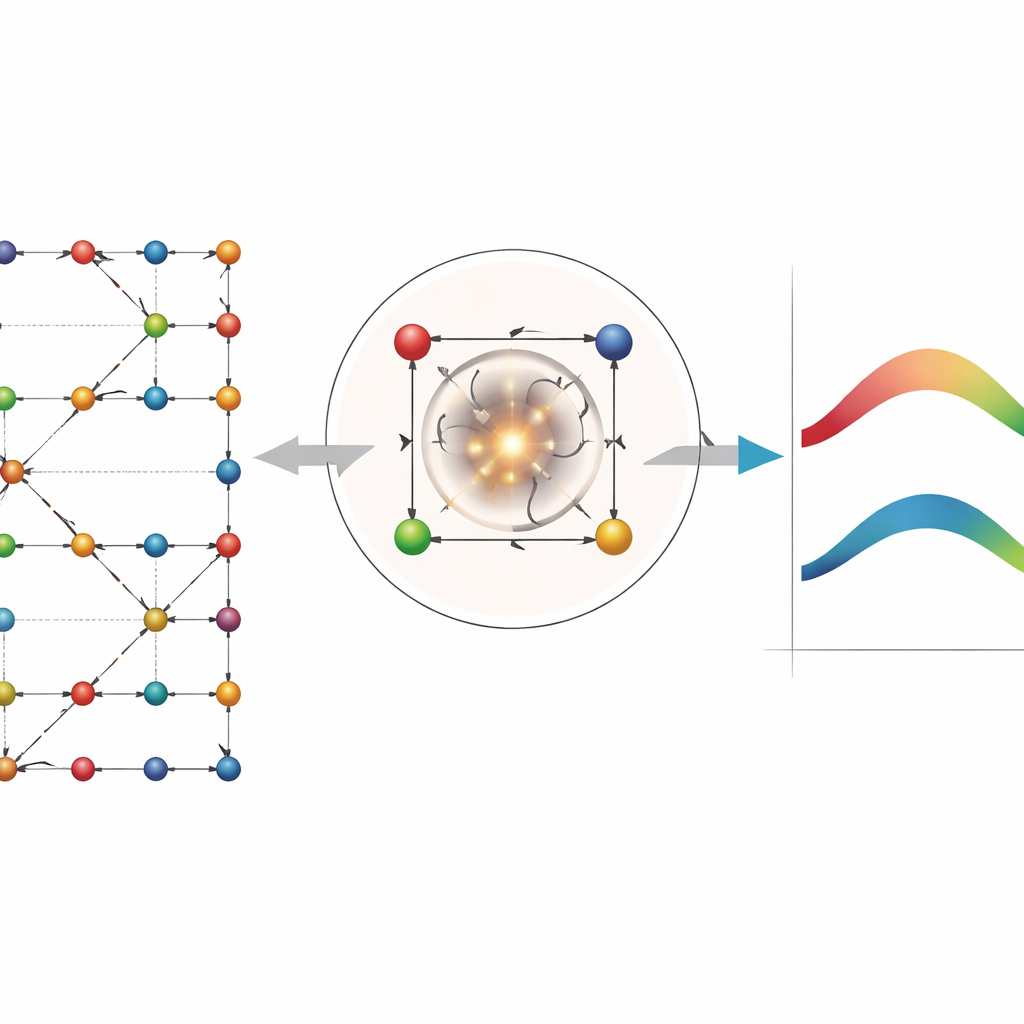
Watching Topological Effects in Action
With these programmable connections, the team directly observes hallmarks of topological physics using only classical light. In the Hall and Creutz ladder setups, they reconstruct band structures—energy-versus-momentum diagrams—by scanning a laser and recording how light exits the chip over time. They see phenomena such as spin–momentum locking, where different “legs” of the ladder prefer opposite directions of motion, and flat bands, where light effectively becomes trapped. In particular, they realize an Aharonov–Bohm cage: by adjusting synthetic magnetic flux, light injected at one frequency becomes confined to a small cluster of sites, unable to spread, demonstrating strong localization engineered purely through interference.
Asymmetry, Long-Range Hops, and Frequency Tools
The architecture is flexible enough to break the usual symmetry between forward and backward motion, enabling simulation of the famous Su–Schrieffer–Heeger (SSH) chain, a minimalist model of topological matter. By purposely detuning the two rings and driving the device with carefully chosen dual radio frequencies, the authors separate and tune forward and backward hops independently and directly read out the SSH band structure—something not previously achieved on such a chip. They also show that adding multi-tone modulation naturally creates long-range couplings, allowing them to emulate more elaborate structures such as coupled ladders and double-walled nanotube–like lattices. Beyond fundamental physics, they outline how these same interference effects can be harnessed as practical tools, for example to shift optical frequencies in a piecewise-continuous way using cascaded chips.
Why This Matters for Future Photonic Simulators
To a non-specialist, the key message is that this work turns a modest integrated photonic device into a highly versatile emulator of complex quantum systems. By working in a low-frequency modulation regime and blending intra- and inter-resonant frequency sites, the authors achieve rich, reconfigurable connectivity and directly observable band structures, all on a stable and scalable platform. This approach paves the way toward large on-chip “quantum simulators” that can mimic exotic phases of matter and intricate gauge fields, while also offering new ways to sculpt the color and flow of light for future optical communication and signal-processing technologies.
Citation: Zeng, XD., Wang, ZA., Ren, JM. et al. A hybrid-frequency programmable synthetic-dimension simulator with rich coupling on a single chip. Light Sci Appl 15, 213 (2026). https://doi.org/10.1038/s41377-026-02309-2
Keywords: synthetic frequency dimension, photonic quantum simulator, topological photonics, lithium niobate chip, frequency lattice