Clear Sky Science · en
Local-nonlocal assisted multifunctional photonic crystals
Turning flat surfaces into light sculptors
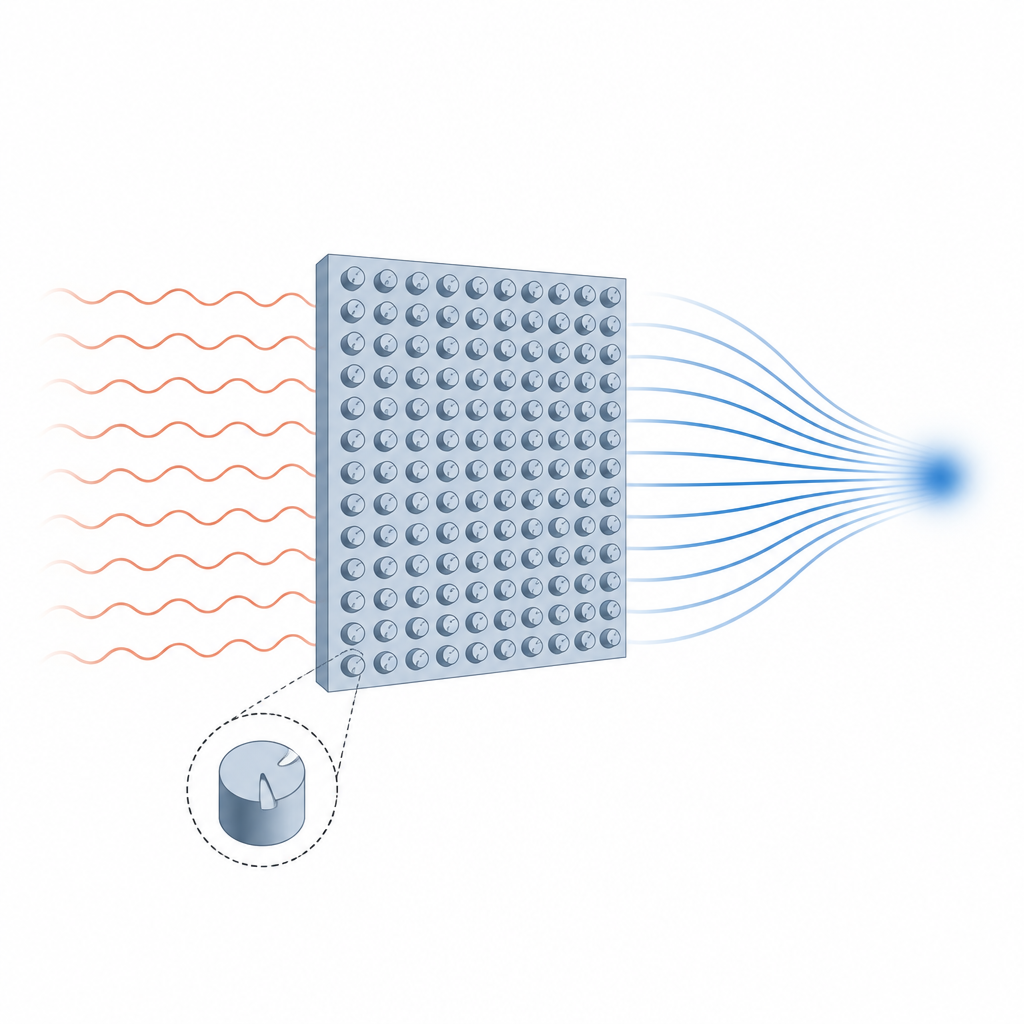
Imagine a single sheet of glass that can both trap light in place and paint a detailed 3D image in midair. This study shows how engineers can combine two once-separate tricks of light control into one simple, flat device, hinting at future cameras, displays, and optical chips that are thinner, smarter, and easier to build.
Two ways to control light
Modern optics often uses two very different tools. Metasurfaces work like finely patterned stamps etched on a surface, where each tiny feature acts locally to bend or delay light in a position-dependent way, ideal for shaping wavefronts or making holograms. Photonic crystals, in contrast, are repeating arrays of structures that act collectively over a larger area, creating sharp resonances that depend on angle and color and can trap light in special modes known as bound states in the continuum, which store energy for a long time without leaking out.
Bringing local and collective control together
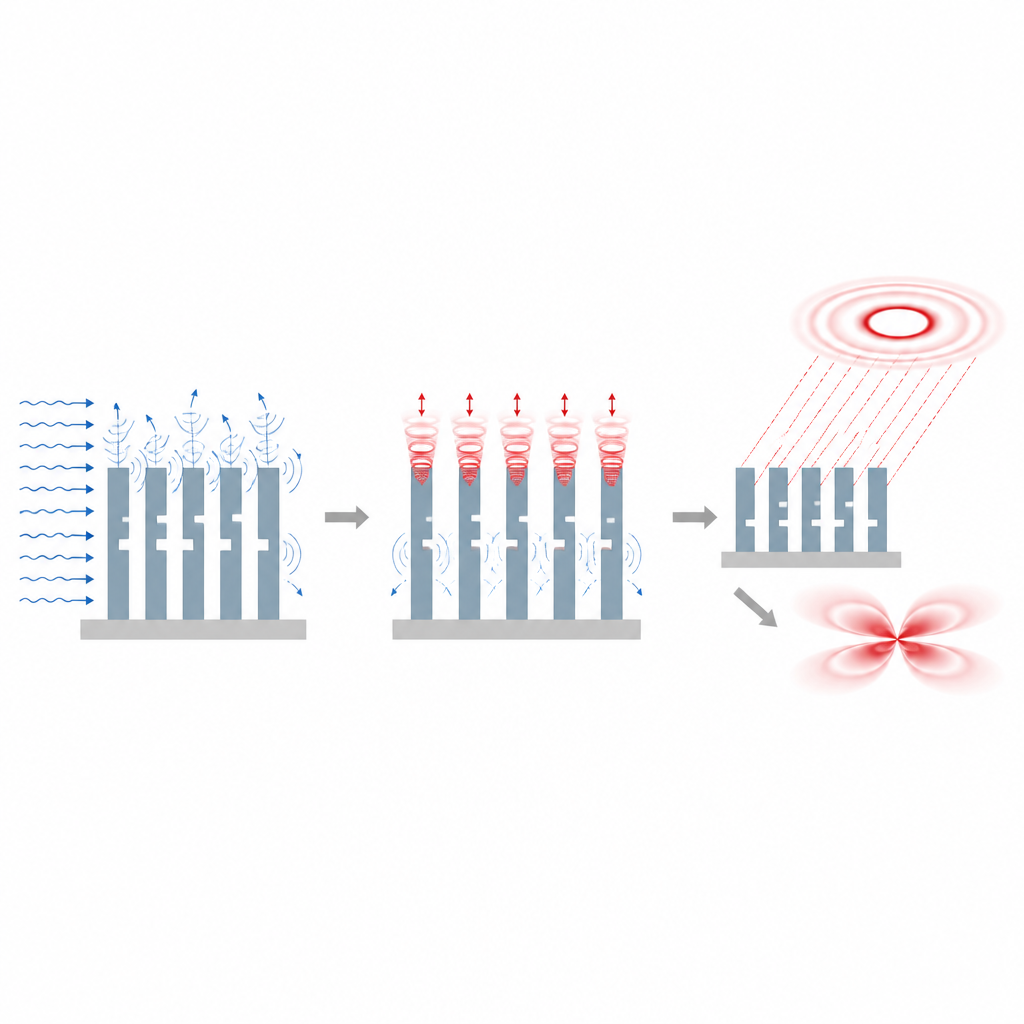
The challenge has been that these two approaches usually fight each other. Metasurfaces need unit cells that can vary from place to place, while photonic crystals rely on strict regularity to support their delicate, nonlocal resonances. In this work, the researchers solve that conflict by adding tiny “meta-notches” inside otherwise identical pillars that form a photonic crystal. The outer pillars stay the same everywhere, preserving the long-lived bound states, while the small internal notches can be tuned locally to adjust how the surface shifts the phase of reflected light across a full 2π range.
A new way to twist the phase of light
Instead of relying on long paths or rotated shapes, the team uses a topological effect tied to a special point where the reflected light intensity drops to nearly zero at a particular color. As the notch width changes, the complex reflection follows a loop around this spectral zero, causing the phase of the reflected light to wind smoothly through a full cycle. This “singularity-assisted” phase control needs only one geometric knob and works even when the pillars are rotated or slightly imperfect, because the key features are protected by symmetry and topology rather than fine-tuned dimensions.
From design and fabrication to working holograms
To prove the concept, the researchers designed holograms by converting target images into phase maps and then assigning a suitable notch width to each pillar in a large array. They fabricated these structures in titanium dioxide on glass using standard lithography, forming devices with hundreds of thousands of unit cells in a single etching step. When illuminated with circularly polarized light at around 550 nanometers, the samples produced clear holographic patterns, while measurements of the angle-dependent reflection showed that the sharp bound state resonance of the underlying crystal survived despite the varying notches.
Why this matters for future optical devices
By folding both precise local wavefront control and robust nonlocal resonances into a single flat platform, this work opens the door to multifunctional optical chips that can shape, store, and process light all at once. In practical terms, such devices could support advanced imaging, compact displays, and analogue optical computing, where the trapped modes act as built-in operators and the notch-controlled phases encode information. The key message is that carefully engineered imperfections inside a regular structure can unlock new, stable ways to command light without adding complexity to fabrication.
Citation: Lv, W., Qin, H., Shi, X. et al. Local-nonlocal assisted multifunctional photonic crystals. Light Sci Appl 15, 243 (2026). https://doi.org/10.1038/s41377-026-02308-3
Keywords: photonic crystals, metasurfaces, flat optics, holograms, bound states in the continuum