Clear Sky Science · en
Skyrmions based on optical anisotropy for topological encoding
Turning Twists of Light into Reliable Data
Digital data are usually stored as tiny electric charges or magnetic bits that can be disturbed by heat and noise. This research explores a very different route: using carefully arranged twists in how a material bends and delays light as a way to store information in a form that is naturally resistant to errors. These twists, called skyrmions, behave like tiny topological knots that are hard to undo, offering a new blueprint for dense, robust optical data storage.
Why Skyrmions Matter
Skyrmions were first imagined in particle physics and later found in magnetic materials, fluids, sound waves, and light. They are special field patterns that wrap a surface in a way that cannot be smoothly undone without tearing. Because of this built in protection, a skyrmion can carry a “topological charge” that stays intact even when the system is disturbed. Earlier ideas for skyrmion based memory focused on magnetic films or special liquid crystals, but these platforms can be sensitive to temperature, hard to read out, or limited in how much information each skyrmion can hold.
Using Light–Matter Interaction as the Medium
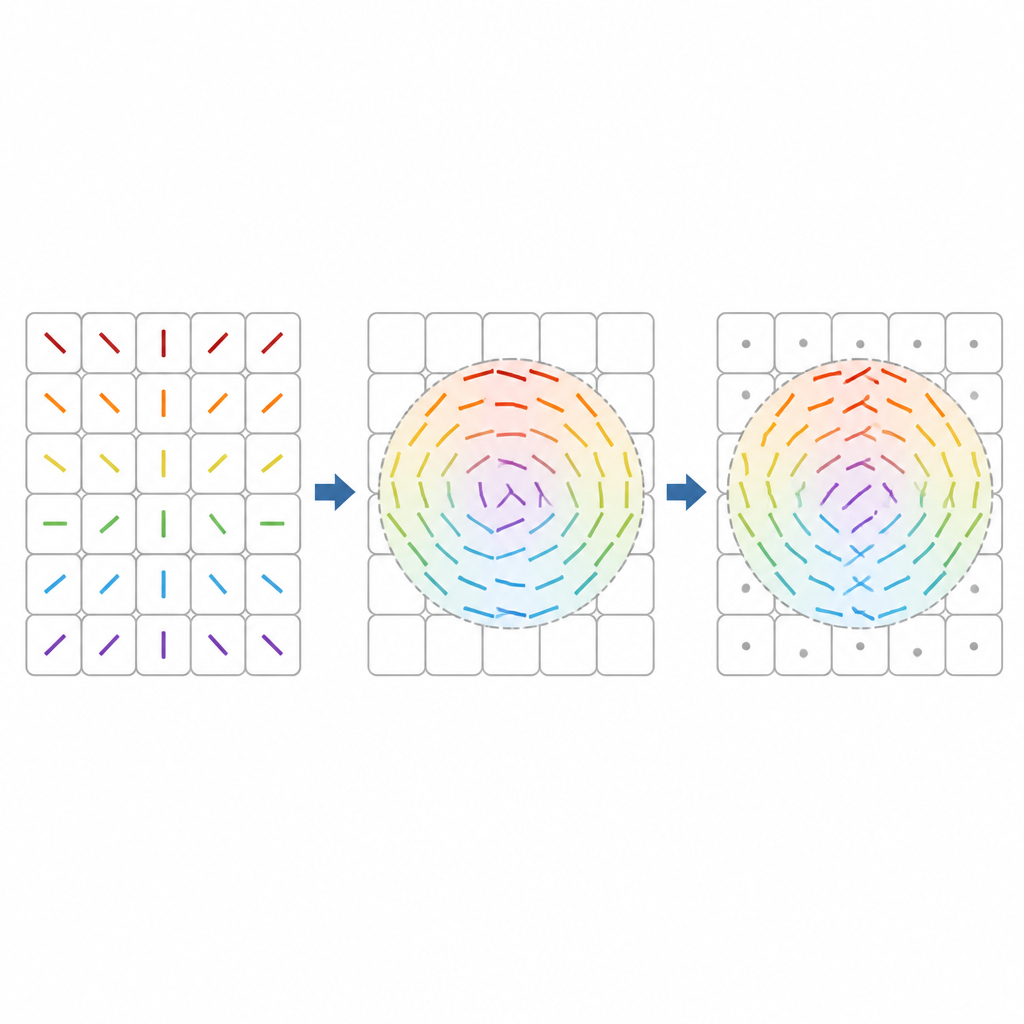
Instead of looking at light alone or matter alone, the authors focus on how structured matter changes the polarization of light that passes through it. This interaction is described mathematically by high dimensional matrices, which might seem too complicated to host simple skyrmion patterns. The key idea of the paper is to reduce this complexity by picking out a two dimensional “direction map” from the full description. In materials that bend light differently along different axes, this map is simply the local optical axis at each point on the surface. When this axis field wraps around in a specific way, it forms what the authors call axis geometry based skyrmions that are directly tied to the material’s anisotropy and can be read optically.
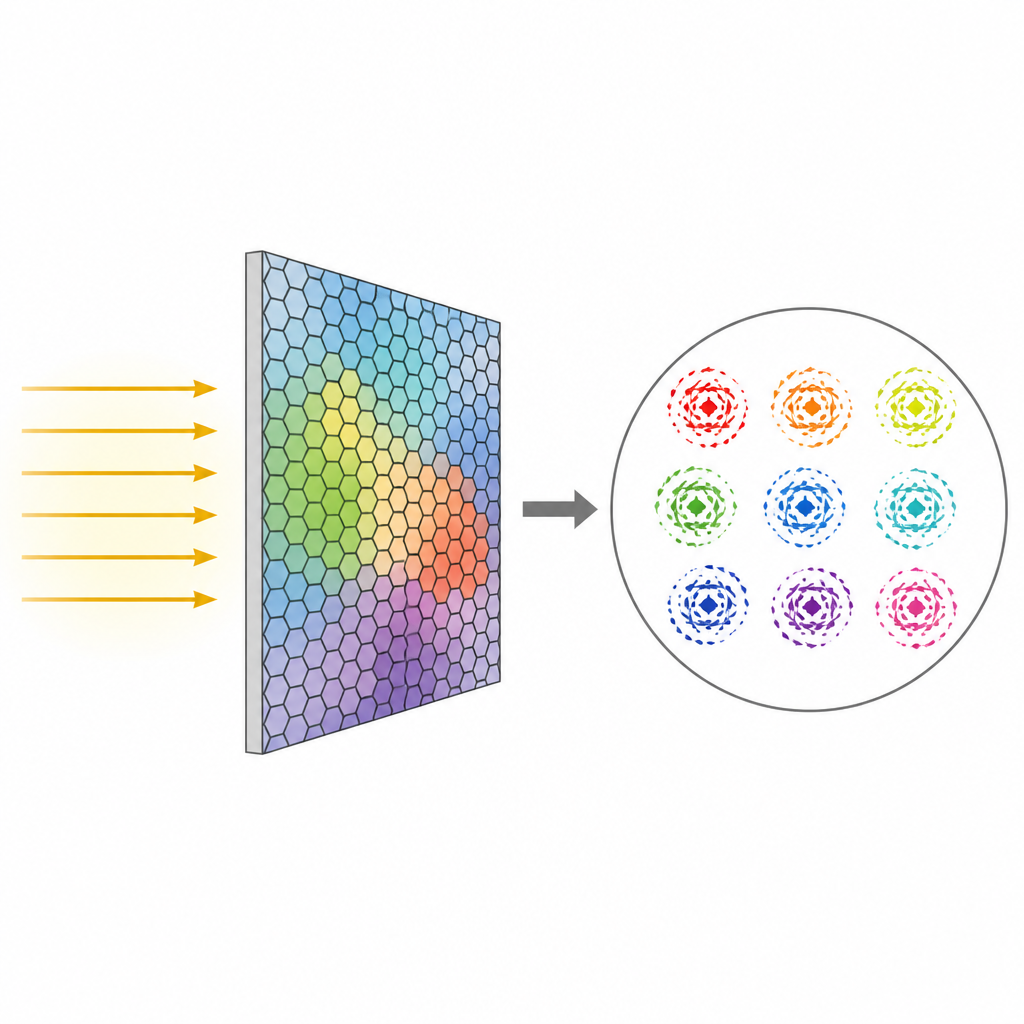
Building Reconfigurable Skyrmion Patterns
To test this concept, the team built a programmable optical device using several liquid crystal spatial light modulators. By stacking and controlling these elements at the pixel level, they created a flexible “retarder array” whose optical axes can be shaped almost at will across the surface. They then used polarimetric measurements to recover the axis field and calculate its skyrmion number, confirming that they could reliably generate many kinds of skyrmion structures. These include single twists, higher order twists, bags that contain multiple skyrmions inside a larger one, and ordered lattices, all formed purely through the geometry of optical anisotropy rather than through the elastic forces that usually limit liquid crystal textures.
Testing Robustness with Noise and a Simple Rule
For any real memory technology, stability under noise is crucial. The researchers therefore added controlled random fluctuations to the device settings, mimicking disturbances such as thermal drift and mechanical vibration, and repeated this many times. They found three regimes: at low noise the skyrmion number stayed exactly fixed; at moderate noise it began to fluctuate; at high noise it collapsed and the pattern lost its topological identity. Their theoretical analysis leads to a practical “60 degree rule”: as long as the actual axis at every point deviates from the intended design by less than 60 degrees, the skyrmion charge is guaranteed to remain unchanged. This gives engineers a clear and generous margin for building robust systems.
Encoding Letters in Topological Knots
To showcase a concrete application, the authors used “skyrmion bags” that contain four inner skyrmions to encode letters in a simple way. By assigning different skyrmion numbers between minus two and plus two to the inner elements, they stored two 16 bit numbers within a single bag, which can then be mapped to standard text characters. They experimentally wrote and read out six letters, even in the presence of noise, and found that the measured skyrmion numbers closely matched the intended values. This demonstration hints at high density, reconfigurable, and optically readable data storage where information is carried not by fragile local states, but by the global topology of the field.
What This Could Mean for Future Memory
In simple terms, the paper shows how to turn subtle twists in the way a material handles light into sturdy information bits that shrug off many types of errors. By generalizing skyrmions to complex light–matter systems and offering a clear design rule for robustness, the work lays the groundwork for next generation optical memory and processing technologies that combine high density with built in error tolerance. Future devices could draw on a wide range of materials and structures, from metasurfaces to laser written plates, to realize fast, rewritable, and compact topological data storage.
Citation: Zhang, Y., Wang, A.A., Zhang, R. et al. Skyrmions based on optical anisotropy for topological encoding. Light Sci Appl 15, 254 (2026). https://doi.org/10.1038/s41377-026-02307-4
Keywords: skyrmions, optical data storage, topological protection, structured light, liquid crystals