Clear Sky Science · en
Gigahertz-rate thin-film lithium niobate receiver for time-bin quantum communication
Why faster quantum keys matter
Every day, more of our private data moves across long-distance fiber networks. Quantum communication promises security rooted in the laws of physics, not in software that might be cracked later. This paper presents a tiny chip that can read delicate quantum signals carried by light pulses in optical fibers at billion-times-per-second rates. By making this receiver fast, stable, and compatible with standard telecom hardware, the work points toward practical quantum-secure networks woven into today’s internet.
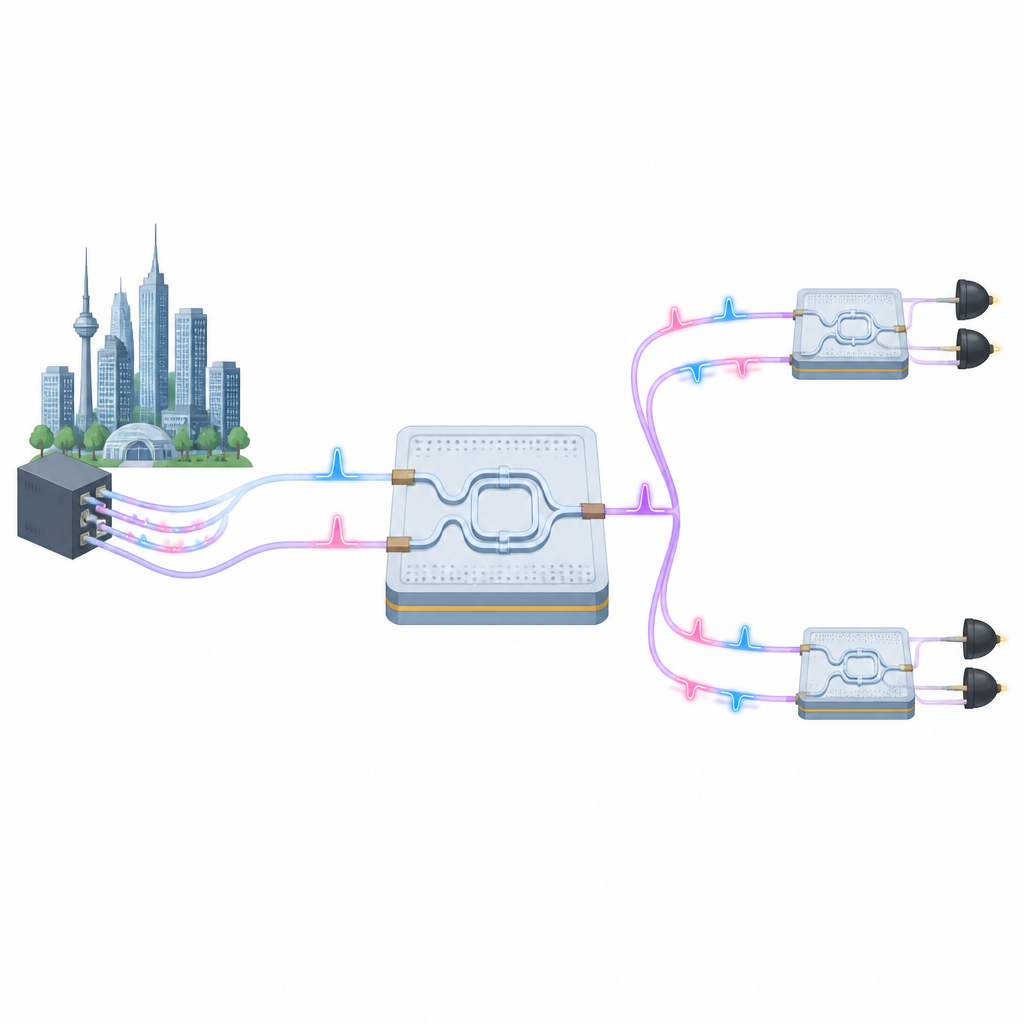
Turning the ticking of light into information
In many quantum communication schemes, information is encoded not in the color or polarization of light, but in its arrival time. A single photon can be prepared in a superposition of “early” and “late” time slots, forming a time-bin qubit. Pairs of such photons can be entangled so that their timings are mysteriously linked, no matter how far apart they travel. Time-bin encoding works well over long stretches of optical fiber and fits naturally with telecom infrastructure. However, reading these states reliably has been difficult, requiring bulky interferometers and extremely fast single-photon detectors that strain current technology.
A chip that tames fragile quantum timing
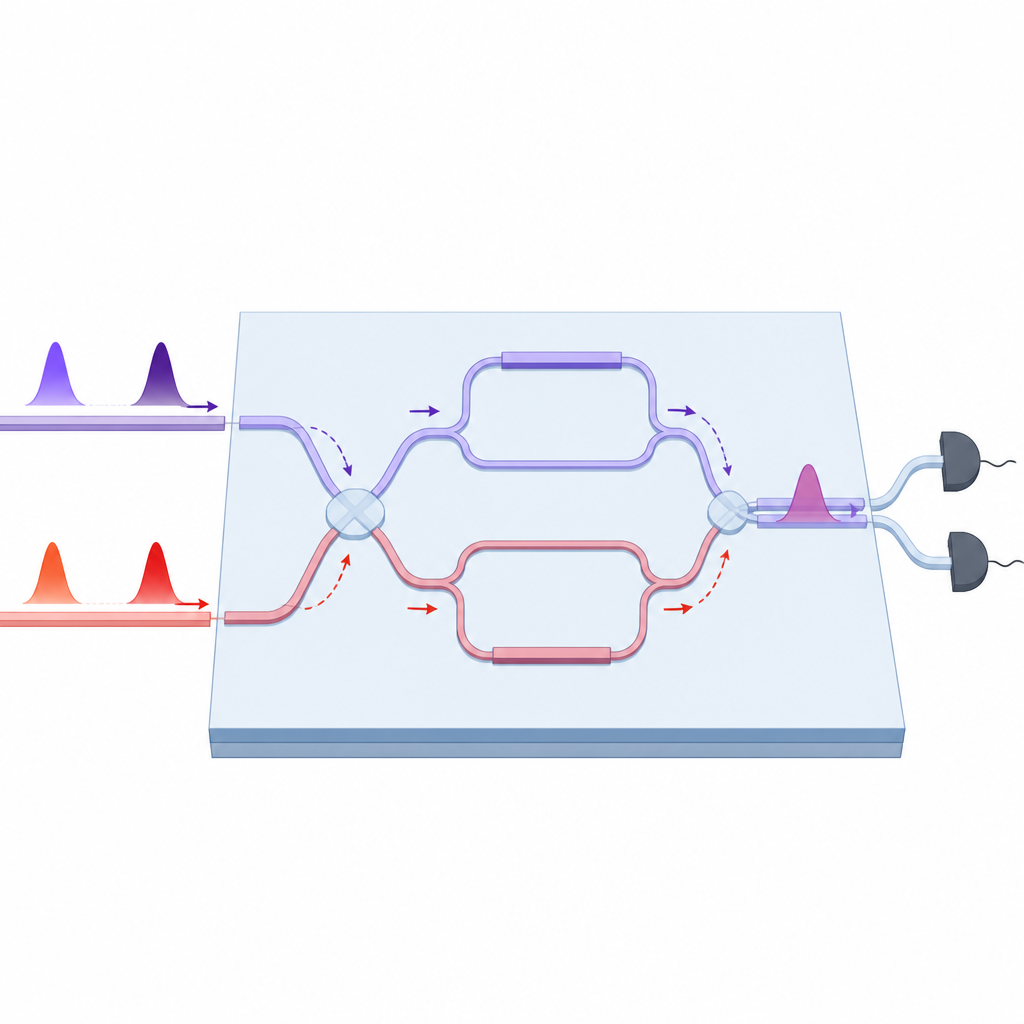
The authors build a compact receiver on a thin slice of lithium niobate, a material whose optical properties change quickly when driven by electrical signals. On this platform, they integrate waveguides, beam splitters, thermal phase shifters, and high-speed electro-optic modulators into a circuit smaller than a postage stamp. The device has two main stages: a fast optical switch that can steer photons into different paths, and an unbalanced interferometer that delays one path by about one-tenth of a billionth of a second. By carefully timing the switching, the chip can force early and late time-bin pulses to overlap and interfere, revealing the quantum state without having to throw away many detection events.
Closing a key security loophole
Earlier time-bin systems suffered from what is known as the post-selection loophole. Because only those photons that happened to overlap in time at the measuring interferometers showed quantum interference, many detection events were discarded. Clever attacks could, in principle, exploit this filtering to mimic quantum correlations with classical signals. In the new receiver, the high-speed switch deterministically routes early and late bins so that all of them interfere. Experiments with entangled photon pairs show strong violation of Bell and CHSH inequalities without any timing-based filtering, confirming genuine entanglement and removing this specific weakness in security analyses.
From laboratory tests to secure keys
To show real-world relevance, the team plugs their chips into a fiber-based link and runs an entanglement-based quantum key distribution protocol. In a first version, a simple fiber splitter randomly chooses whether each photon is measured in one basis or another, while the chip handles the demanding interferometric basis. In this passive scheme they obtain secure key rates above 25 kilobits per second for more than twelve hours of continuous operation, a record for time-bin entanglement-based systems. A second version uses the chip’s fast phase control to actively switch measurement bases at gigahertz rates using pseudorandom electrical patterns. Although this approach has more optical loss and lower key rates, it demonstrates that basis choices can be made on-chip at electronic speeds, with error rates low enough for secure operation.
What this means for future quantum networks
In plain terms, the researchers have turned a delicate tabletop setup into a rugged, chip-scale component that can read quantum timing information quickly and reliably. By eliminating the need to discard large fractions of data and by relaxing the demands on detector time resolution, their receiver makes time-bin quantum communication more efficient and easier to integrate with existing telecom gear. While further improvements in loss, clock rate, and on-chip randomness are still needed, this work shows a clear path toward scalable, fiber-based quantum networks that can deliver secret keys at practical speeds using industry-grade photonic technology.
Citation: Bernardi, A., Clementi, M., Bacchi, M. et al. Gigahertz-rate thin-film lithium niobate receiver for time-bin quantum communication. Light Sci Appl 15, 237 (2026). https://doi.org/10.1038/s41377-026-02306-5
Keywords: time-bin entanglement, quantum key distribution, lithium niobate photonics, integrated quantum optics, fiber quantum networks