Clear Sky Science · en
Helical opto-thermoviscous flows drive out-of-plane rotation and particle spinning in a highly viscous micro-environment
Light that quietly stirs thick liquids
Many of the tiniest things scientists want to study or build live in thick, syrupy liquids where ordinary tools struggle to move or turn them. This research shows how a gently warmed laser beam can stir such viscous fluids into graceful three dimensional spirals that catch microscopic objects, rotate them in space, and hold them steady for sharper imaging and more precise control.
Turning a laser into a contact free handle
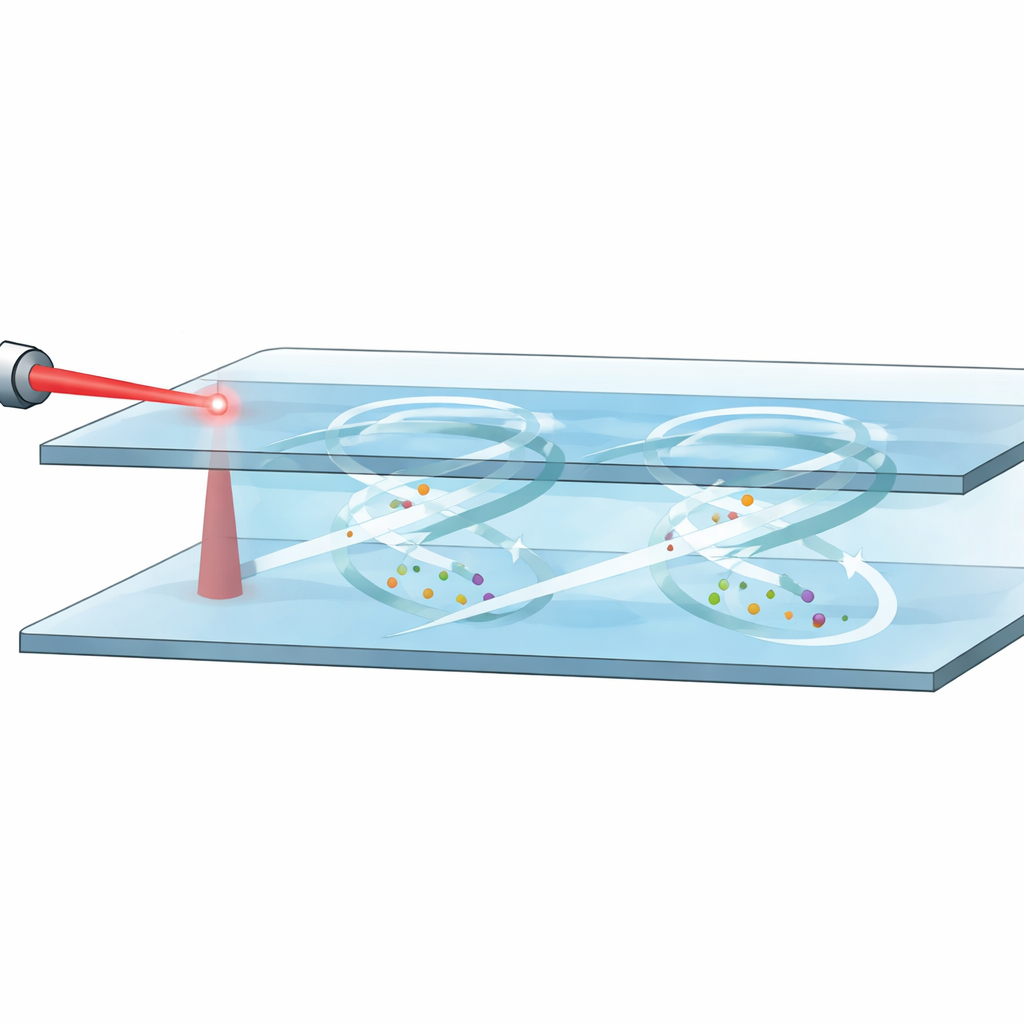
Instead of grabbing tiny objects directly with light or magnets, the team uses the laser to move the surrounding fluid. By rapidly scanning a mildly heating infrared beam back and forth in a carefully designed pattern between two glass plates, they create flows driven by small temperature induced changes in viscosity. In thick, honey like mixtures, these thermoviscous flows are strong enough to carry along suspended particles of many kinds without touching them, providing a universal handle that does not depend on shape, material, or magnetism.
From flat currents to three dimensional spirals
Earlier work with similar heating patterns mainly produced flat, in plane currents in very thin chambers. Here, the authors deliberately use a thicker chamber and place the laser scan close to one wall rather than in the middle. This breaks the symmetry and forces some of the fluid to move up and down as well as sideways. With the right scan speed and path, the result is a helical flow a corkscrew like motion that simultaneously transports particles along one direction while causing them to orbit around an axis, tracing out three dimensional spirals through the liquid.
Self focusing streams that find the right height
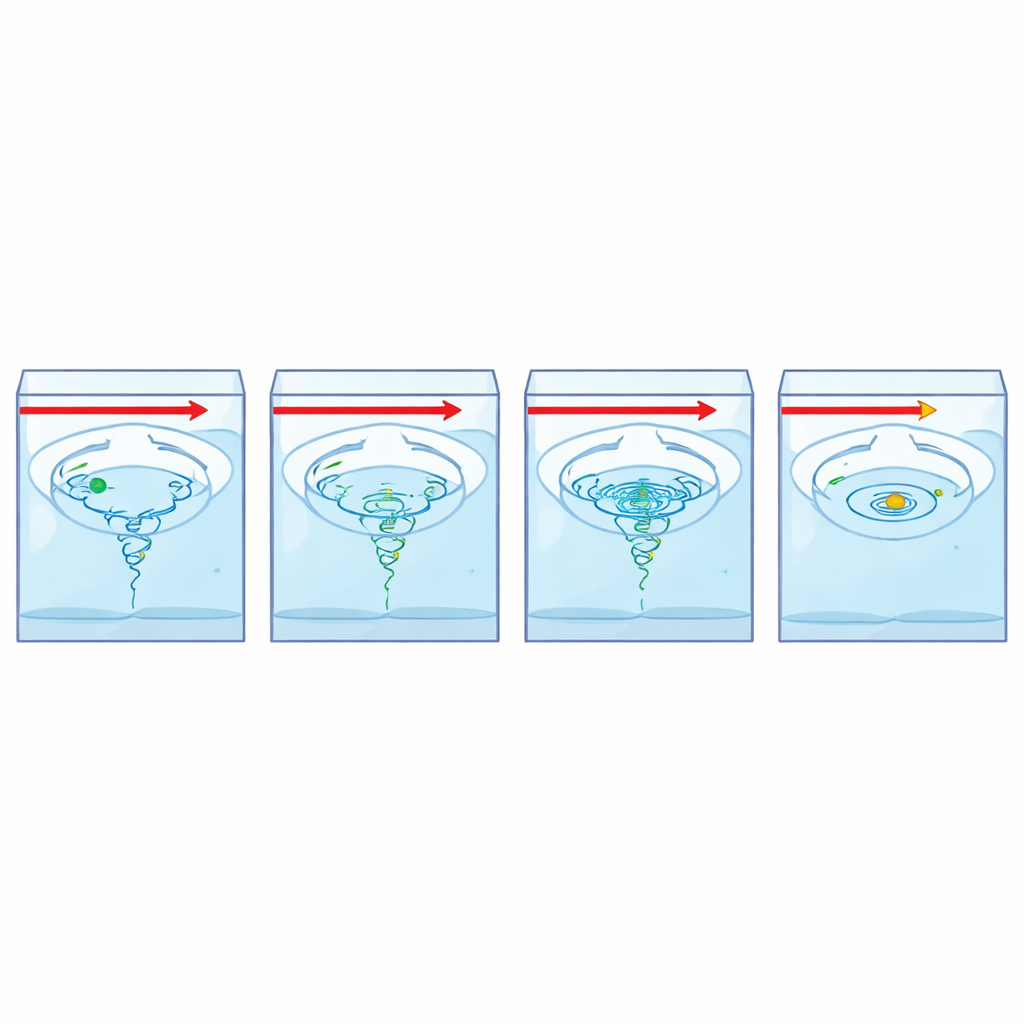
When the researchers tracked single fluorescent beads in three dimensions, they noticed that the spiral paths gradually tightened and settled at a preferred height in the chamber. This "opto hydrodynamic focusing" does not rely on extra sheath flows or complex channel shapes, which are common in microfluidic sorting devices. Instead, it emerges from the coupling between the rotating flow and a gentle vertical drift that depends on particle size and local temperature. Larger particles experience stronger damping and focus more efficiently, eventually entering a stable state where they spin about a fixed point with position fluctuations below a few hundred nanometers.
Rotating tiles, beads, and cells on demand
By cleverly alternating the scan direction, the authors can cancel unwanted sideways drift while preserving the vertical vortices, isolating pure out of plane rotation and steady spinning. They show this with many examples: tightly clustered beads that merge into a spinning dimer, flat polymer micro tiles peeled from a surface and twirled in different orientations, and even yeast and human cancer cells rotated to reveal hidden features. Because the high viscosity strongly suppresses random Brownian motion, the system behaves a bit like a microscopic stepper motor, allowing stop and go rotation in controlled angular steps.
Sharper three dimensional views from simple microscopes
The most striking benefit appears in microscopy. Conventional three dimensional imaging with a single objective lens blurs details along the viewing axis, often hiding closely spaced structures such as neighboring cell nuclei. By combining stepwise rotation driven by these helical flows with repeated volumetric imaging and standard multi view fusion software, the authors recover clearer, more isotropic resolution. In one example, a cell cluster that appears to contain only one nucleus in a standard stack is revealed, after rotation and fusion, to hold two distinct nuclei separated by a narrow gap.
What this means for future tiny machines
To a lay reader, the core message is that the researchers have turned a simple moving heat spot into a versatile three dimensional steering wheel for microscopic objects in very thick liquids. Their approach does not require custom particles, complex channels, or strong forces, yet it can rotate, focus, trap, and assemble a wide variety of microstructures with high stability. This opens the door to more accessible multi view microscopes, new ways to sort and arrange particles, and future microrobotic systems that harness carefully shaped flows rather than direct mechanical grabs.
Citation: Nan, F., Liao, W., Puerta, A. et al. Helical opto-thermoviscous flows drive out-of-plane rotation and particle spinning in a highly viscous micro-environment. Light Sci Appl 15, 231 (2026). https://doi.org/10.1038/s41377-026-02303-8
Keywords: thermoviscous flow, microparticle rotation, optofluidics, multi-view microscopy, micro-robotics