Clear Sky Science · en
Attosecond three-stage formation and coherent exciton dynamics in a two-dimensional material under strong field
Why ultrafast light–matter dances matter
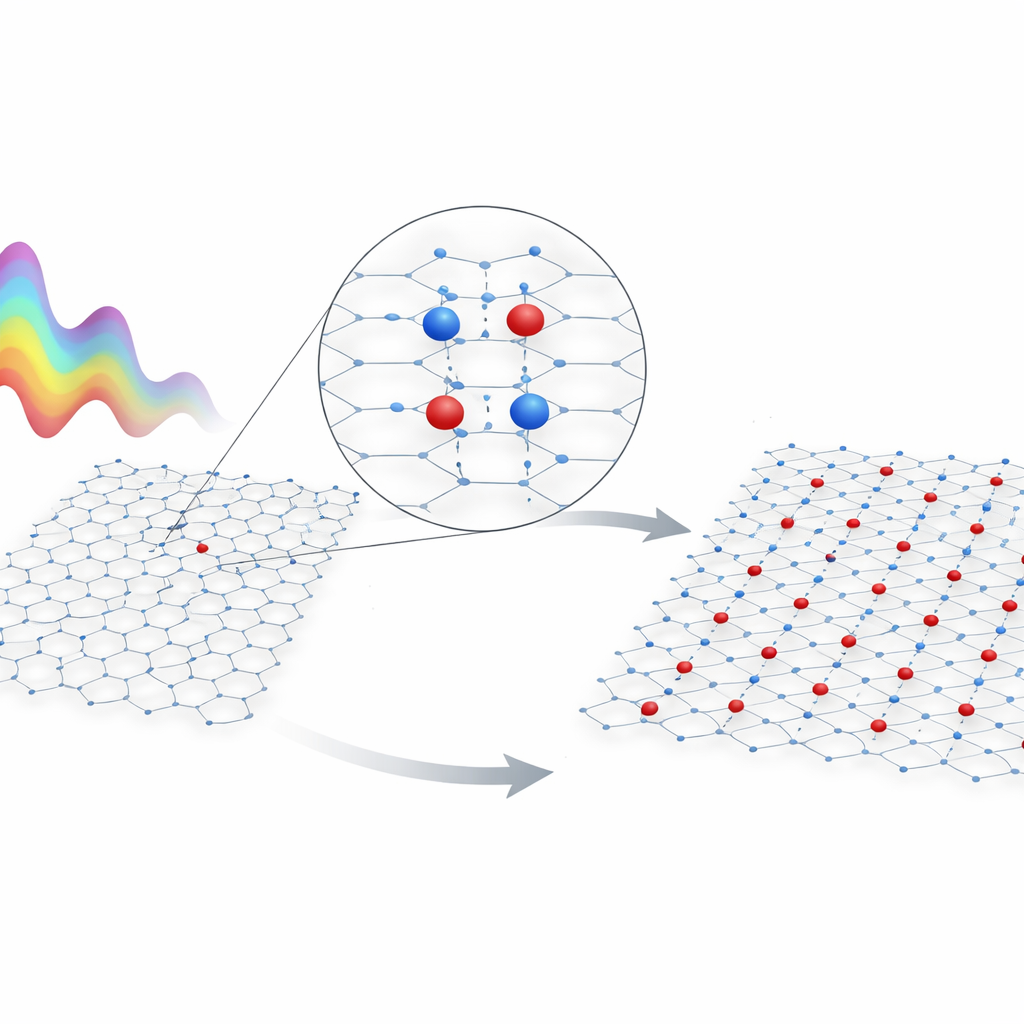
Modern screens, solar cells, and future quantum technologies all rely on how quickly a material can grab energy from light and turn it into useful electronic signals. In atomically thin materials, this process is dominated by short‑lived bound pairs of electrons and holes called excitons. This paper peeks into the very first few quadrillionths of a second of that process in a single layer of hexagonal boron nitride, revealing how excitons are born, how they interfere with each other, and how intense light can even force them to fall apart.
Seeing invisible particles in ultra‑slow motion
Because excitons form and evolve so quickly, they are extremely hard to watch directly in experiments. The authors tackle this challenge using advanced computer simulations that track how electrons move in real time when a short laser pulse hits a two‑dimensional crystal. They use a refined version of density functional theory that treats long‑range electron interactions more accurately than standard approaches. This improved method reproduces known properties of hexagonal boron nitride, such as its large energy gap and strong exciton peaks seen in experiments, giving confidence that the simulated ultrafast behavior is realistic.
How excitons are born in three quick steps
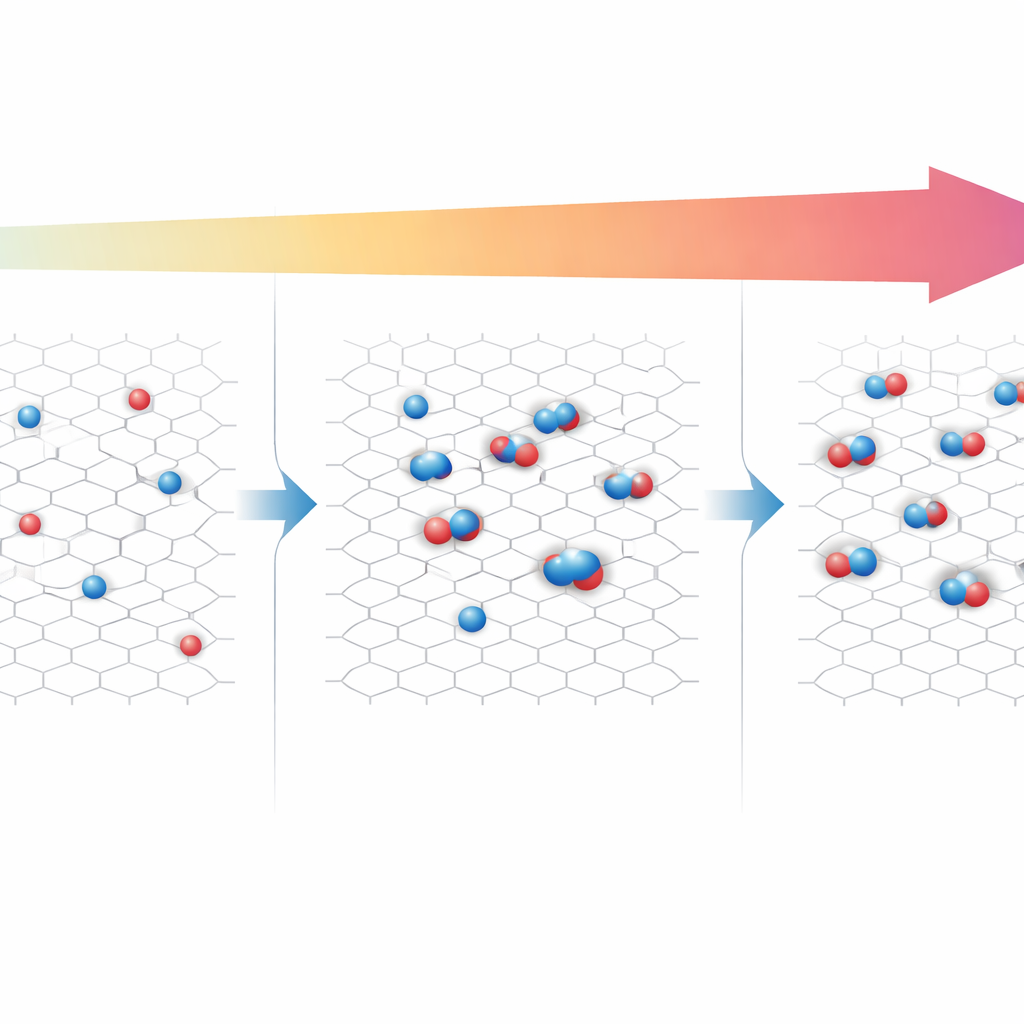
The simulations reveal that under light tuned to directly excite excitons, formation is not truly instantaneous. Instead, it unfolds in three distinct stages over only about 2.5 femtoseconds. First, the laser pulse creates free electrons and holes that are spread out across the crystal. Second, attraction between opposite charges, helped by the driving electric field, pulls them closer together into compact, short‑range bound clusters the authors call “exciton cores.” Third, these cores gradually gain the more extended structure needed to become fully formed excitons, with a stable average separation of just a few ångströms. This sequence is visible in how the simulated electron–hole distance shrinks and then slightly increases as long‑range correlations settle in.
When excitons beat in unison
Once stable excitons have formed, their story is not over. The light pulse actually excites more than one type of exciton, with slightly different energies and spatial patterns. These different species coexist and interfere with each other, producing regular oscillations in how many electrons are found in specific regions of momentum space, like ripples overlapping on a pond. The frequency of these oscillations matches the energy spacing between the exciton types, confirming that they are “quantum beats” between them. Because the simplest exciton has a nearly uniform phase, the timing of the oscillations at different points in momentum space effectively encodes the phase pattern of the more complex excitons, offering a way to reconstruct otherwise hidden information about their internal structure.
Turning up the light to push excitons apart
The authors then explore what happens when the same resonant light pulse is made stronger. As the field increases, more excitons are packed into the two‑dimensional layer and start to overlap. The regular beats in some momentum directions fade away first, while remaining robust in others, revealing that exciton stability depends on direction within the crystal. By comparing the average distance between excitons with their size along and across the field direction, the study connects this selective loss of coherence to a Mott‑like transition, in which overlapping excitons screen each other and begin to dissolve into an electron–hole fluid. At even higher fields, a new oscillation mode appears whose energy shifts with carrier density, hinting at emerging collective excitations such as plasmons or dense electron–hole liquids.
What this means for future light‑based devices
Altogether, this work provides a frame‑by‑frame picture of how excitons appear, interact, and break down in an atomically thin insulator under intense light. It shows that even when light is tuned exactly to an exciton resonance, formation involves a rapid but structured three‑stage process, not an instantaneous jump. The predicted quantum beats and their directional suppression offer concrete signatures for next‑generation ultrafast measurements to test. Beyond deepening our basic understanding, the ability to track and ultimately control these ultrafast exciton dynamics could guide the design of faster, more efficient optoelectronic and quantum devices based on two‑dimensional materials.
Citation: Chen, Q., Chen, D., Wang, C. et al. Attosecond three-stage formation and coherent exciton dynamics in a two-dimensional material under strong field. Light Sci Appl 15, 217 (2026). https://doi.org/10.1038/s41377-026-02293-7
Keywords: excitons, two-dimensional materials, ultrafast dynamics, hexagonal boron nitride, strong laser fields