Clear Sky Science · en
Statically foveated freeform OST-HMD system with wide FOV and high perceived resolution
Sharper digital worlds where it matters most
When you put on a pair of smart glasses or a virtual reality headset, you probably want two things at once: a wide view that feels natural and sharp detail that makes text and objects easy to see. Today’s headsets struggle to do both without using enormous displays and heavy hardware. This study introduces a new kind of see through smart glasses that concentrate visual detail where your eyes actually need it most, cutting data and pixel use while still looking crisp and natural.
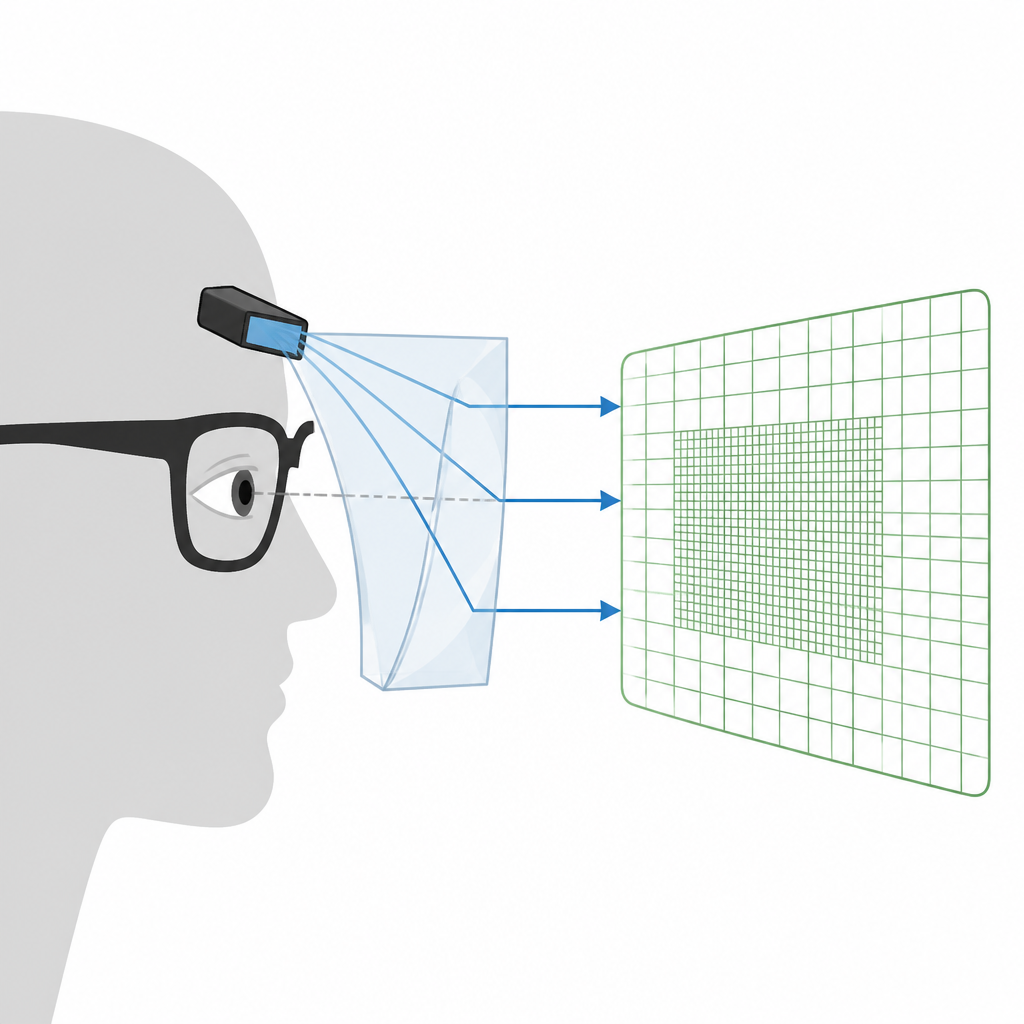
Why current headsets hit a wall
Most head mounted displays spread pixels evenly across the entire view, like painting a wall with the same number of dots everywhere. But the human eye does not see that way. We see fine detail only in the tiny central region called the fovea, while sharpness drops quickly toward the edges of our vision. To cover a wide field of view with uniform 20/20 level detail, a headset would need tens of millions of pixels, far beyond what is practical for small, lightweight devices and fast graphics. Existing foveated systems try to fix this by moving a high detail region to wherever you look, using eye trackers and moving optics, but that adds cost, bulk, and complexity.
A new way to bend light in smart glasses
The authors present a different strategy they call static foveation. Instead of chasing the eye with moving parts, they design the optics so that the center of the image is always shown with very fine detail, and the resolution gently declines toward the edges. This is done with a custom three piece freeform eyepiece, a transparent block shaped so its optical power varies across the field of view. Combined with a standard 4K micro display, this eyepiece produces an 80 degree diagonal image with peak sharpness matching normal 20/20 vision near the center. Crucially, it also acts as an optical see through window, so wearers can see the real world along with the virtual image.
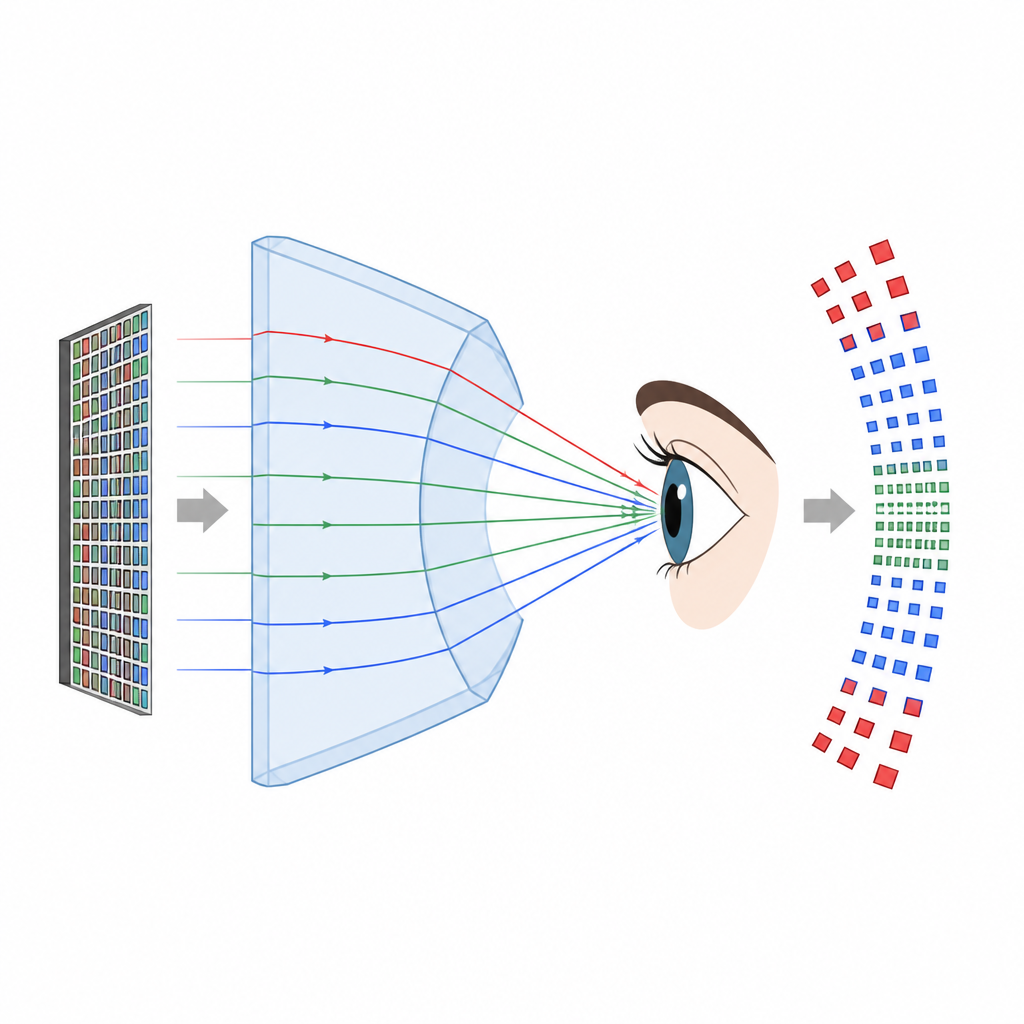
Doing more with fewer pixels
By carefully controlling how much the eyepiece magnifies different parts of the display, the system spreads the same fixed set of pixels unevenly over the wearer’s view. Near the center, more pixels are packed into each degree of vision, while fewer are used in the outer zones where the eye is less sensitive. Simulations show that this design maintains about 60 pixels per degree in the central region and around 40 pixels per degree at the edges, closely matching how our visual acuity naturally falls off. Compared with a conventional design that keeps resolution uniform, the new system achieves the same peak sharpness and field of view while using more than one third fewer pixels, or about 4.4 million fewer individual picture elements.
From lab concept to working prototype
To test the idea, the team fabricated the freeform eyepiece and built a glasses style prototype. Because the available micro display had larger pixels than the ideal design, the peak resolution in the prototype was about 26 pixels per degree, lower than the target but still high enough to show the intended pattern: crisp detail in the center that gradually softens toward the periphery. They calibrated how the eyepiece magnifies different regions by showing dot patterns and measuring how their size and spacing changed across the field. By pre warping images fed to the display to compensate for this magnification map, they obtained output images that looked undistorted but exhibited the designed falloff in clarity away from the center.
What this means for future smart glasses
Overall, the work demonstrates that it is possible to build thin, glasses like see through displays that feel sharp and natural where people most often look, while quietly saving pixels and data at the edges. Because the system does not rely on eye tracking, moving mirrors, or multiple screens, it simplifies hardware and could make future augmented reality glasses lighter and more power efficient. As higher density displays become available, the same optical design can deliver even finer central detail without changing the basic approach, pointing toward more comfortable and capable everyday wearable displays.
Citation: Lyu, P., Hua, H. Statically foveated freeform OST-HMD system with wide FOV and high perceived resolution. Light Sci Appl 15, 233 (2026). https://doi.org/10.1038/s41377-026-02291-9
Keywords: augmented reality, head mounted display, foveated display, smart glasses, optical design