Clear Sky Science · en
Topological control of chirality and spin with structured light
Twisting Light to Twist Matter
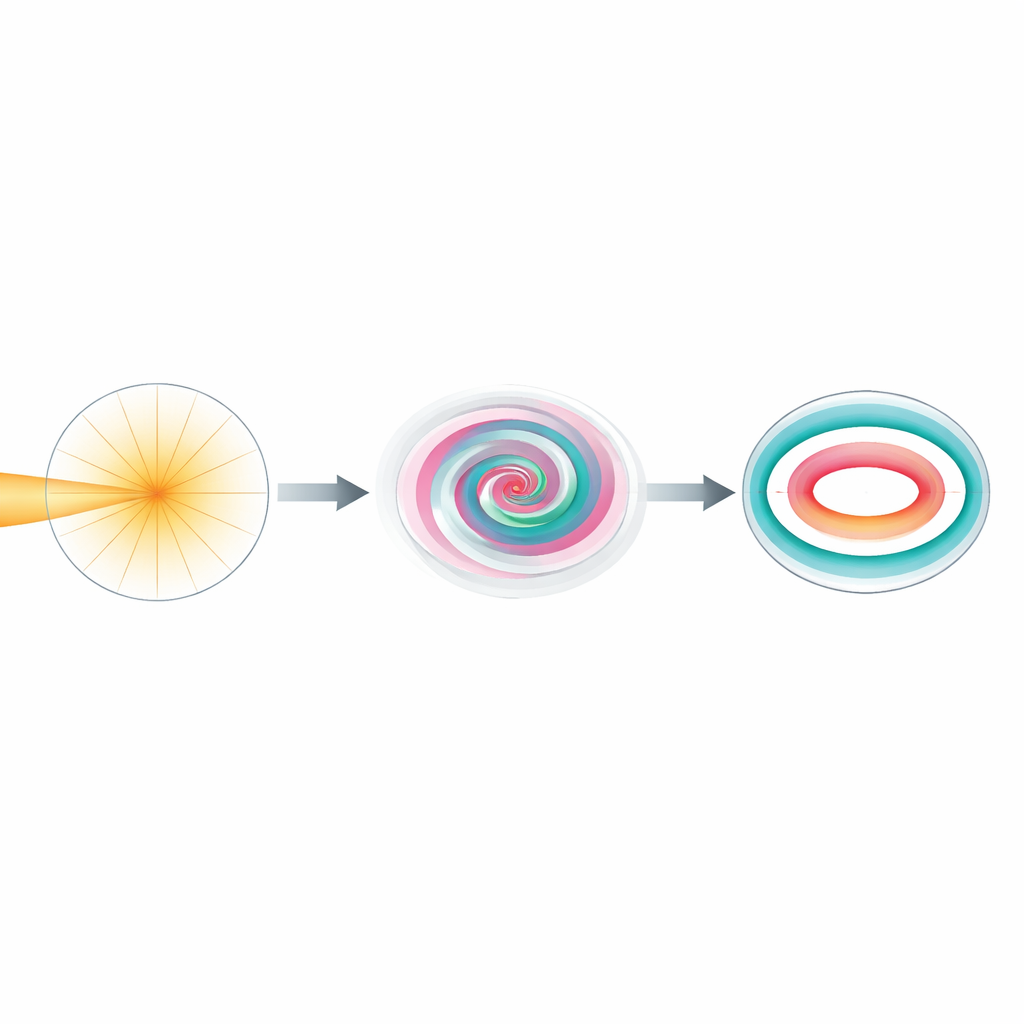
Light is more than just brightness and color: it can also spin and twist in ways that influence how it pushes, pulls, and talks to matter. This paper explores how to take an ordinary laser beam and, just by shaping its internal structure, make it generate tiny whirlpools of “handedness” — regions where light behaves as left- or right‑handed. These patterns of spin and chirality (a kind of optical handedness) are important for everything from manipulating microscopic particles to sensing chiral molecules, such as many drugs and biological building blocks.
Why Light’s Hidden Spin Matters
Light carries angular momentum in two main forms: spin, linked to circular polarization (right‑ or left‑handed), and orbital, linked to a corkscrew-like wavefront. Together they define how light can exert twists and torques. Usually, strong coupling between spin and orbital motion — called spin–orbit interaction — shows up only when light is tightly focused with powerful lenses or when it interacts with carefully engineered materials like metasurfaces or patterned crystals. In those systems the spin components of light can separate in space, an effect reminiscent of the Hall effect in electronics, where electrons with different spin drift in different directions. But such arrangements are complex and often require non‑paraxial, strongly focused beams or special materials.
Steering Spin with Topological Twists
The authors show that you can instead trigger and control spin–orbit interaction using only the intrinsic topology of the beam itself, in free space and within the gentle (paraxial) regime that most lasers naturally occupy. They start with a perfectly balanced, radially polarized beam: its polarization points outward like spokes on a wheel, and at the starting plane there is no net spin or chirality anywhere. Then they imprint a special kind of global phase pattern characterized by an integer called the Pancharatnam topological charge. This number sets how the polarization–phase pattern winds around the beam and determines its total orbital angular momentum. Crucially, while this “topological twist” does not change the initial polarization map, it secretly forces the right‑ and left‑handed circular components to belong to slightly different families of paraxial modes that spread and accumulate phase at different rates as they propagate.
How a Neutral Beam Grows Spin
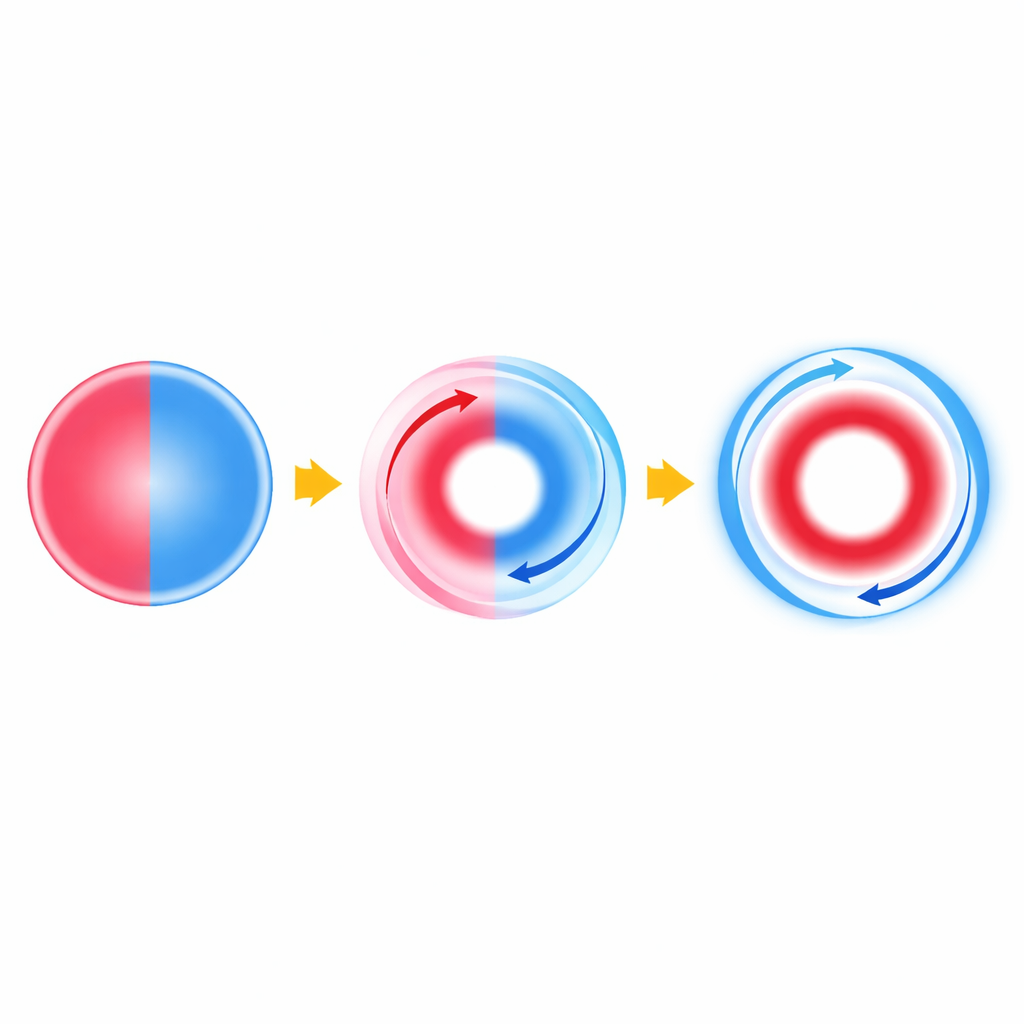
As the beam travels forward, those two hidden components — initially identical in amplitude — begin to diverge in how they focus and in the extra phase they pick up, known as Gouy phase. This subtle mismatch reshapes their radial intensity profiles: one circular component becomes stronger near the center, while the other becomes stronger in an outer ring. The result is a beam whose cross‑section develops concentric regions dominated by opposite circular polarizations, even though it started with none at all. The authors track this evolution using standard polarization diagnostics (Stokes parameters) and visualize it on the Poincaré sphere, a geometric map of all possible polarization states. Initially the beam populates only the equator, representing purely linear polarization. With propagation, it gradually fills the entire sphere, revealing the emergence of local spin and chirality across the field.
A Free-Space Optical Hall Effect
In the far field, the separation between inner and outer spin regions becomes striking, forming clear rings of opposite handedness and associated orbital angular momentum. This pattern corresponds to a free‑space optical Hall effect: spin components spatially separate solely because of the beam’s topology, not because of lenses or materials. Experiments using a spatial light modulator and a spin–orbit device (a q‑plate) confirm that simply changing the Pancharatnam charge reverses which handedness dominates at the center and reshapes how far out each ring lies. Larger values of this topological charge increase the radial spacing between rings, providing a single, tunable “knob” for designing spin‑structured beams.
New Ways to Use Light’s Handedness
To a lay reader, the central message is that light can be engineered to create its own patterns of handedness as it propagates, without needing exotic materials or extreme focusing. By adjusting a single integer that describes how the beam’s phase twists, one can dial in where left‑handed and right‑handed regions appear and how strongly they are separated. This opens pathways to more flexible optical tweezers that twist microscopic objects, improved sensing of chiral molecules, and high‑dimensional information encoding in which messages are carried not only by brightness and color, but also by intricate spatial patterns of spin and orbital angular momentum.
Citation: Mkhumbuza, L., Ornelas, P., Dudley, A. et al. Topological control of chirality and spin with structured light. Light Sci Appl 15, 214 (2026). https://doi.org/10.1038/s41377-026-02278-6
Keywords: structured light, spin–orbit interaction, optical chirality, orbital angular momentum, topological photonics