Clear Sky Science · en
Beyond the visible: metal-ion-doped inorganic UV phosphors for advanced photonics
Light We Cannot See
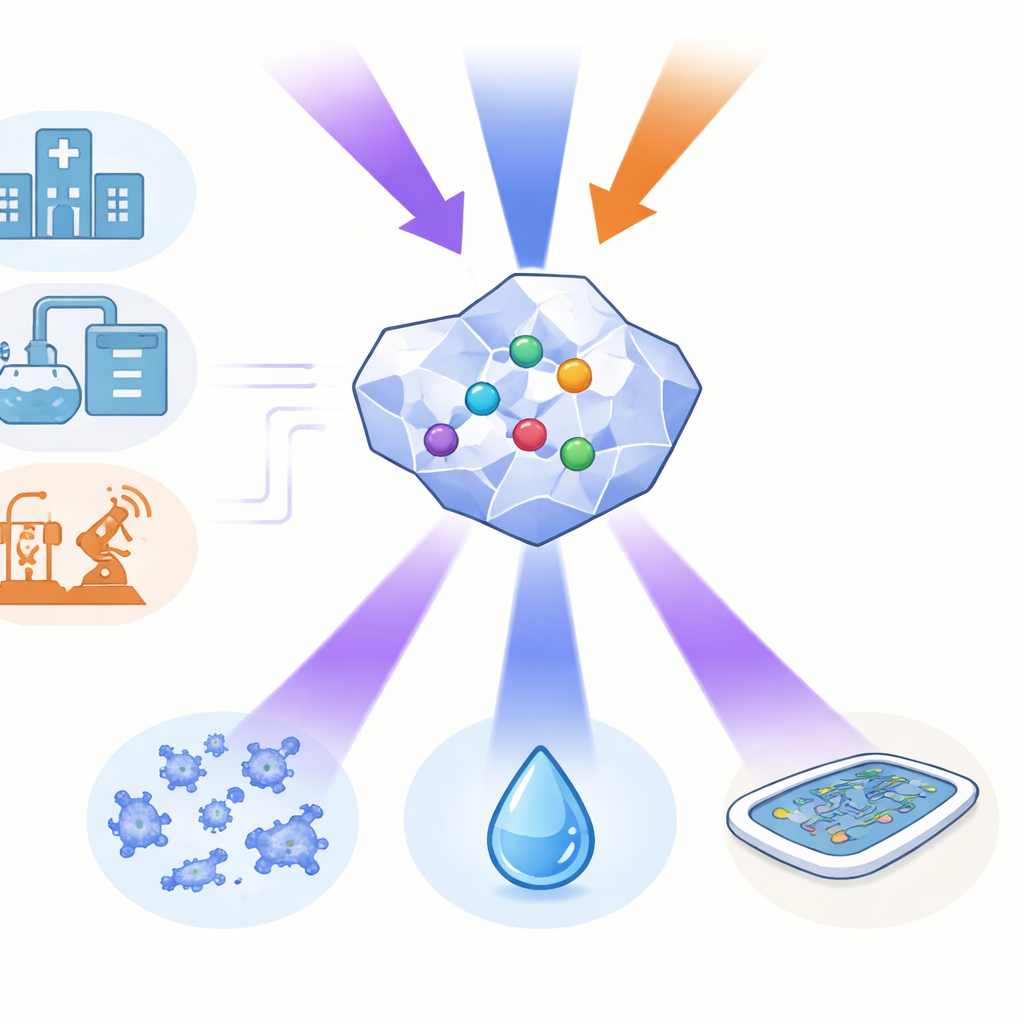
Ultraviolet (UV) light is all around us, but most of it never reaches our eyes or even the Earth’s surface. This invisible light can quietly disinfect water and air, help doctors treat skin disease, and power new kinds of sensors and data tags. The paper reviewed here explains how specially engineered crystals, doped with tiny amounts of metal ions, can turn different kinds of energy into useful UV light in smarter, safer, and more efficient ways.
The Hidden Sides of Ultraviolet Light
UV light spans a wide range of wavelengths, from relatively gentle UVA (used in photocatalysis and some therapies) to intense UVC, which is lethal to microbes but normally filtered by the ozone layer. Because different UV bands have different energies and penetration depths, each is suited to its own tasks: UVA can drive chemical reactions in murky liquids, UVB can modulate the immune system and treat skin conditions like psoriasis, and UVC excels at sterilization and “solar-blind” optical tagging that is unaffected by sunlight. The paper traces how UV technology evolved—from early mercury lamps to modern LEDs and nanomaterials—and argues that metal-ion-doped inorganic phosphors now sit at the heart of the next wave of UV photonics.
Smart Crystals That Store and Release Light
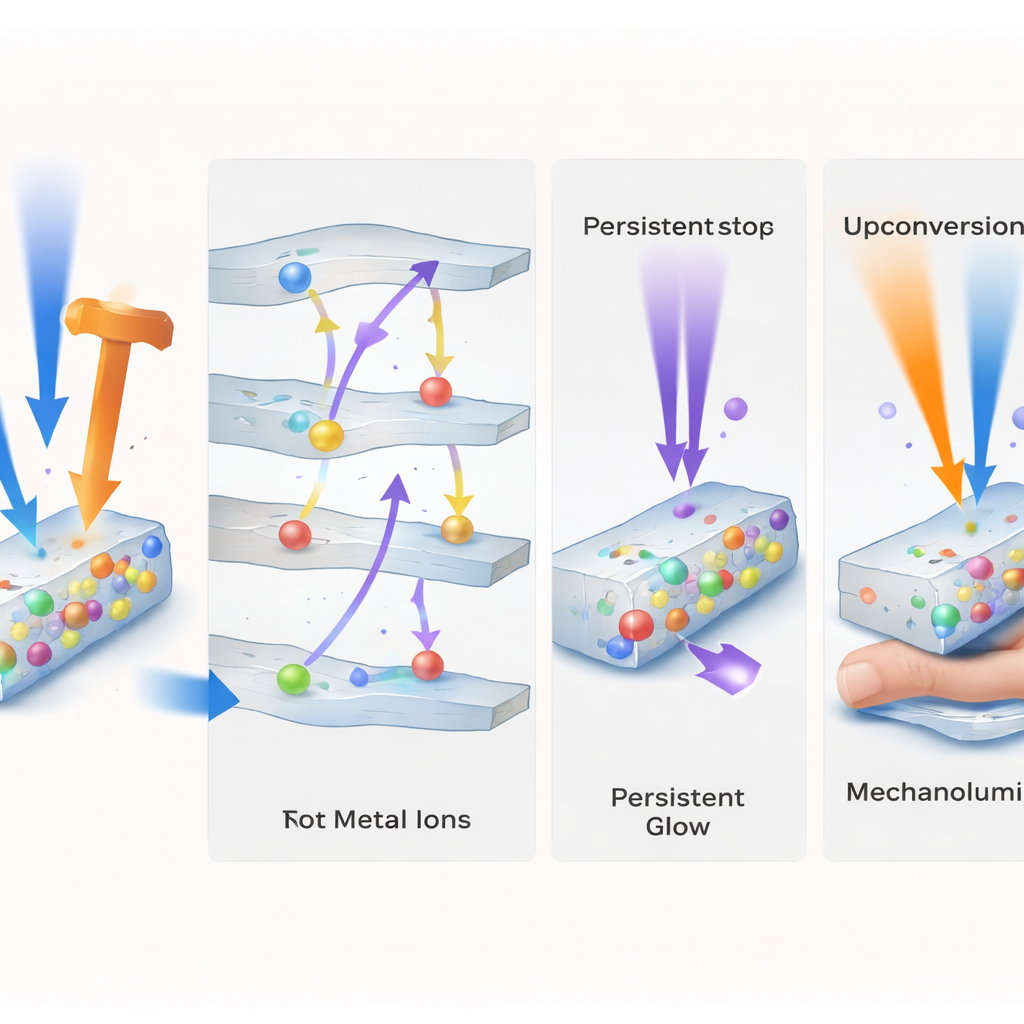
A central focus is on “persistent” UV phosphors, materials that keep glowing after the excitation source is switched off. These crystals are built from a wide-bandgap host (such as oxides, fluorides, or silicates) seeded with rare-earth or heavy-metal ions like Gd, Pr, Bi, Pb, or Ce. When energized by UV lamps or X-rays, electrons are kicked into higher-energy states and then trapped at defects in the crystal. Over minutes, hours, or even days, these electrons slowly leak back and release UV light. By tailoring the traps’ depths and the choice of ion, researchers have created materials that emit in UVA, UVB, or even far-UVC, some glowing for more than 100 hours and others strong enough to inactivate drug-resistant bacteria without any power source during operation.
Climbing the Energy Ladder with Upconversion
The review next explores “upconversion” phosphors, which do the opposite of what we expect from light: they absorb two or more low-energy photons (often in the near‑infrared or visible range) and emit a single higher‑energy UV photon. This is achieved by stacking energy levels in doped ions and handing energy stepwise from sensitizers (such as Yb or Pr) to activators (such as Gd, Tm, Ho, or Er). Clever core–shell nanoparticle designs and host crystals with very low vibration energies have pushed this to extremes, including seven‑photon processes that convert infrared laser light into deep‑UV or even vacuum‑UV emission. Researchers are also developing “upconversion charging,” where low‑energy light fills traps that later release UV afterglow—opening the door to UV sources driven only by blue LEDs or even flashlights.
Light from Pressure, Stretching, and Friction
A third mode is mechanoluminescence: crystals that light up when you bend, press, or rub them. Some rely on stored charges in traps that are released by stress; others generate internal electric fields or triboelectric charges at interfaces that directly trigger emission. Recent work has produced flexible elastomers in which UVC-emitting phosphor particles are embedded in silicone. These sheets produce “solar-blind” UVC flashes without any pre-irradiation, cycle through tens of thousands of stretches, and recover their brightness after rest. Because UVC is invisible to the eye but easy to detect with specialized cameras, such materials can act as self-powered stress maps, covert trackers, or sterilizing surfaces that respond only when mechanically disturbed.
From Invisible Glow to Real-World Uses
Finally, the authors connect specific UV bands to application niches. UVA-emitting phosphors can drive photocatalysts that clean water or support light-based cancer therapies. UVB emitters, especially narrow-band materials centered around 310–313 nm, can be built into patches or upconverting coatings for targeted skin treatments and secure indoor optical tags. UVC and far-UVC phosphors enable remote outdoor tagging that sunlight cannot wash out, along with power-free antimicrobial tiles and films. The review concludes that while the physics and chemistry are now well mapped, key challenges remain: boosting efficiency, lowering excitation thresholds, expanding control over wavelength, and designing materials that respond to multiple stimuli. Solving these will help turn today’s exotic glowing powders into tomorrow’s everyday tools for health, security, and environmental cleanup.
Citation: Zhang, Y., Liang, Y., Liu, F. et al. Beyond the visible: metal-ion-doped inorganic UV phosphors for advanced photonics. Light Sci Appl 15, 220 (2026). https://doi.org/10.1038/s41377-026-02276-8
Keywords: ultraviolet phosphors, persistent luminescence, upconversion, mechanoluminescence, UV sterilization