Clear Sky Science · en
Self-recoverable mechanoluminescence in simple oxides: Al2O3:Cr
Light from Everyday Pressure
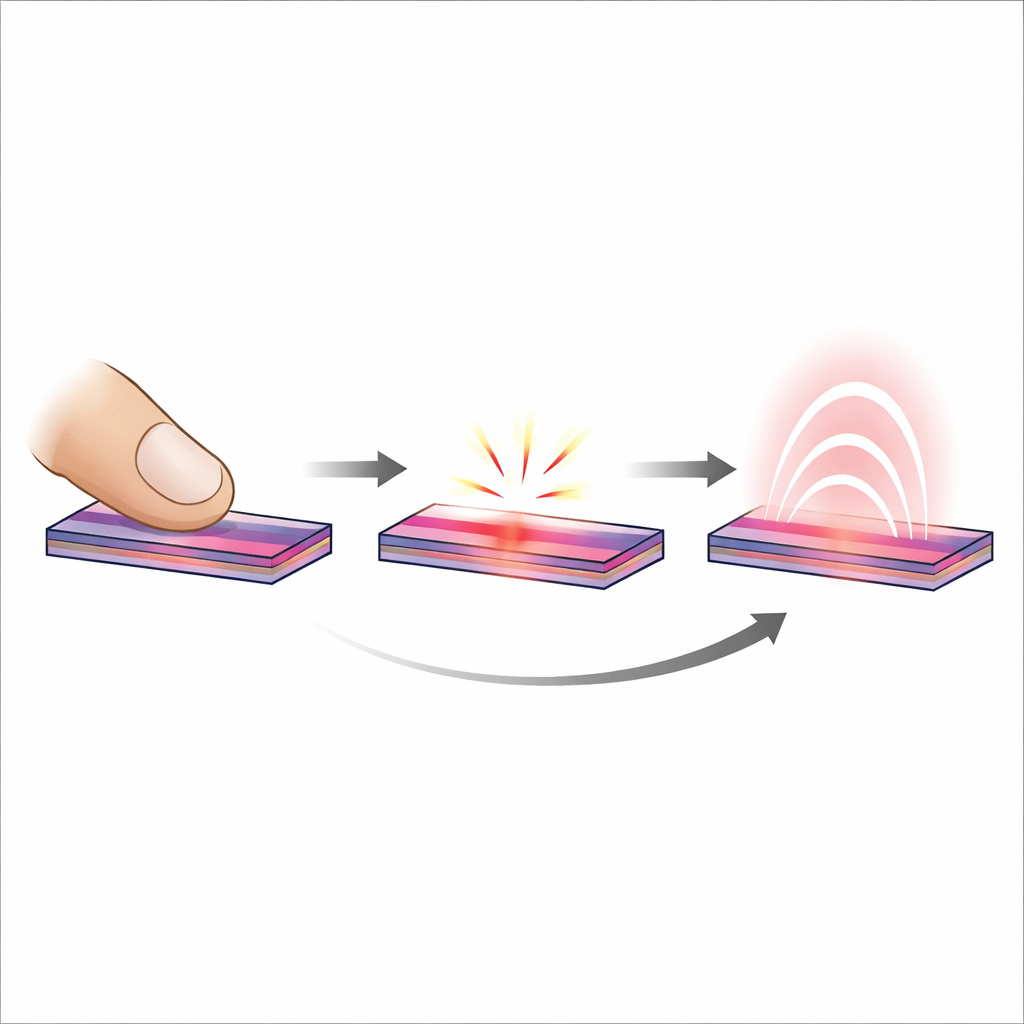
Imagine if a simple squeeze, scratch, or vibration could make materials glow without batteries, wires, or lasers. This study shows that a common, low-cost ceramic—alumina, the same oxide used in spark plugs and abrasives—can be engineered to emit invisible near‑infrared light whenever it is pressed and then quietly reset itself, ready for the next push. That ability opens doors for smart papers that record how you write, metals that reveal where they are stressed, and security tags that are nearly impossible to fake.
Turning Force Directly into Light
The key phenomenon in this work is mechanoluminescence: light produced directly by mechanical action such as pressing, bending, or rubbing. Most known materials of this kind glow in visible colors and often need to be “recharged” with ultraviolet light, or they wear out as they crack. Here, the researchers focus instead on near‑infrared emission, which travels farther through fog, tissue, or complex machinery, and on systems that reset themselves automatically. They show that alumina (Al2O3), doped with a small amount of chromium ions, produces unusually strong, repeatable near‑infrared light under stress without any external power source.
How a Simple Ceramic Stores and Releases Energy
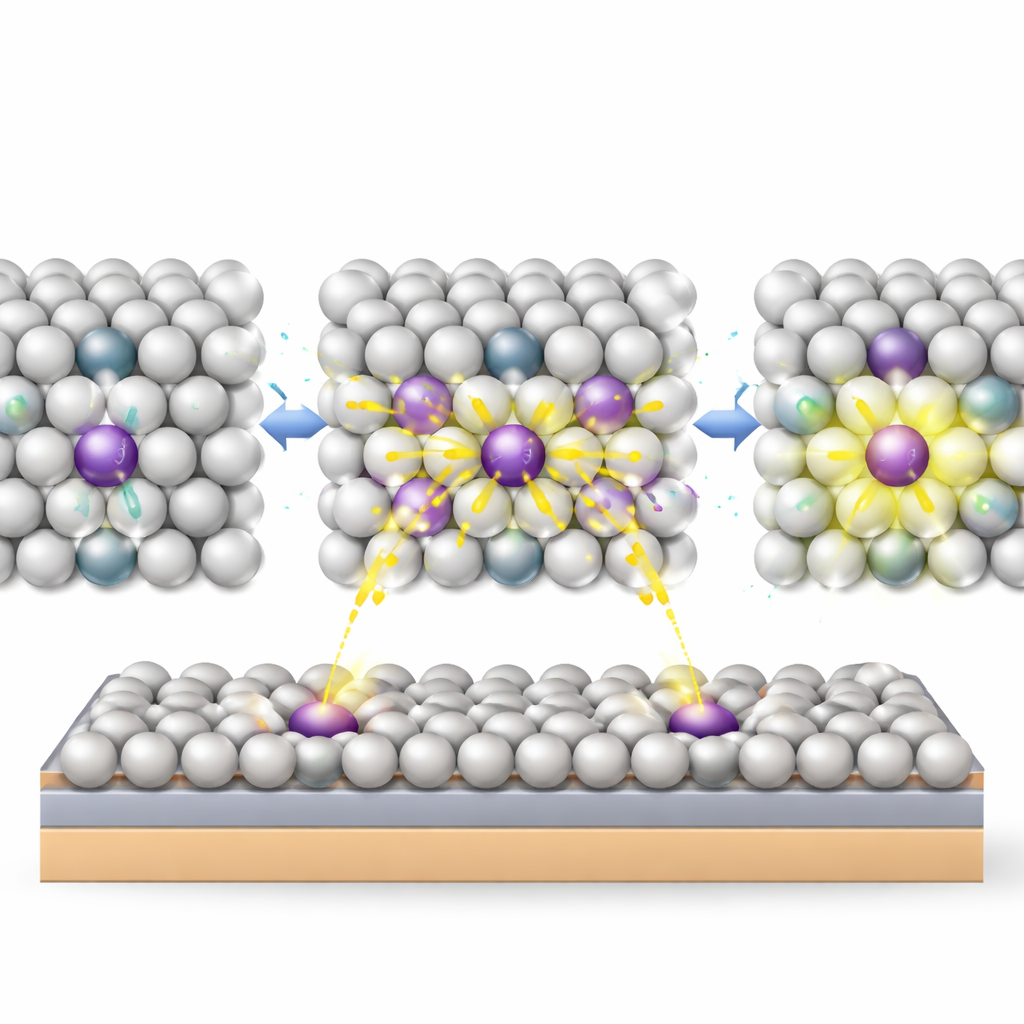
At the heart of the effect are chromium ions sitting in the alumina crystal lattice. Using advanced quantum‑mechanical calculations, the team reveals that these ions can switch between two charge states when the material is stressed. Mechanical strain subtly bends the energy landscape inside the solid, nudging electrons away from chromium centers and into higher‑energy positions. When the stress is released, the electrons fall back and the chromium centers emit near‑infrared light as they relax. Because this ionization and recapture cycle is reversible, the material “self‑recovers” and can be excited over and over again, rather than gradually draining a fixed energy reservoir.
Engineering Brighter and Tougher Glow
Although the underlying crystal is simple, the brightness depends strongly on how the material is prepared. The researchers systematically tuned the amount of chromium, the firing temperature, and the atmosphere during heat treatment. They found that there is an optimal chromium content: too little and there are not enough glowing centers; too much and neighboring ions quench each other. High‑temperature annealing dramatically boosts performance by increasing the concentration of useful defects and mobile charges by several orders of magnitude. Calculations and measurements together show that hotter synthesis creates more carriers that can participate in the mechanical‑to‑light conversion, leading to one of the brightest chromium‑based mechanoluminescent materials reported so far.
From Smart Paper to Self‑Sensing Metals
Building on this understanding, the team embeds the optimized powders into everyday structures. Mixed into paper pulp, the particles produce a flexible “mechanoluminescent paper” that looks ordinary in daylight but glows in the near‑infrared when written on, scratched, or folded. Under night‑vision optics, handwritten patterns and pressure trails become vividly visible, suggesting uses in anti‑counterfeiting, secure data storage, and motion tracking. The researchers also grow a thin glowing layer directly on chromium‑aluminum alloys simply by heating them in air. The resulting oxide skin bends with the metal, survives repeated loading, and lights up wherever the alloy is stressed, offering a passive way to see stress maps on structural parts without electronics.
Why This Matters for Future Smart Structures
For non‑specialists, the main takeaway is that a cheap, chemically robust ceramic can now behave like a built‑in, battery‑free stress sensor that speaks in light. By clarifying how mechanical forces shuffle electrons in alumina doped with chromium, and by showing practical forms such as paper and coated alloys, this work moves mechanoluminescence from laboratory curiosity toward real tools. In the future, bridges, aircraft components, and medical devices could be coated or built with such materials, allowing engineers and doctors to literally see where the invisible forces are concentrated, long before failure occurs.
Citation: Fang, Z., Pan, X., Zhang, Q. et al. Self-recoverable mechanoluminescence in simple oxides: Al2O3:Cr. Light Sci Appl 15, 200 (2026). https://doi.org/10.1038/s41377-026-02274-w
Keywords: mechanoluminescence, near-infrared sensing, stress visualization, smart materials, alumina ceramics