Clear Sky Science · en
Vectorial lasing with designable topological charges based on Möbius-like correspondence in quasi-BICs
Twisting Light in Tiny Devices
Light can do more than simply shine; it can twist, swirl and carry intricate patterns that are useful for advanced microscopes, precision measurements and even secure communications. The catch is that generating such “structured light” usually requires bulky optical setups or complicated components. This paper reports a way to build ultra-compact lasers on a chip that emit twisting beams with a chosen amount of “twist,” opening a path to smaller, more versatile photonic technologies.
Why Twisted Light Matters
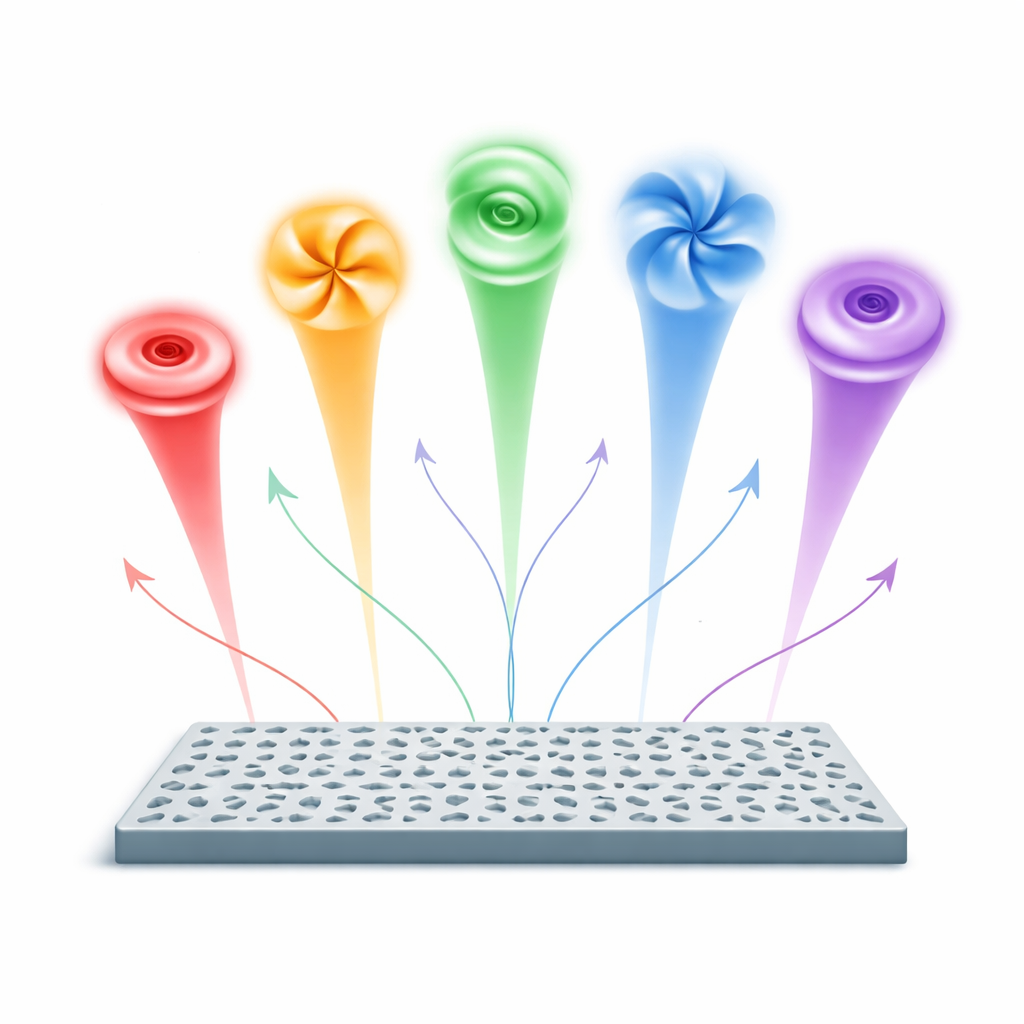
In ordinary flashlights or laser pointers, the electric field of light oscillates in a uniform direction. In structured beams, this direction can rotate across the beam, forming a vortex-like pattern. The number of times the polarization winds around the center is called the topological charge. Different charges can be used like extra channels to carry information, to probe materials with high sensitivity, or to trap and move tiny particles. The challenge has been to create these beams directly from a single microscopic laser in a way that allows engineers to choose in advance what charge they want.
Hidden Order in a Perforated Film
The authors work with a very thin film of silicon nitride drilled with a regular triangular array of tiny holes, known as a photonic crystal slab. Such structures can support special light modes called bound states in the continuum, which trap light strongly and thus are excellent for low-loss lasers. When the holes are perfectly symmetric, these modes come with fixed, symmetry-protected twisting patterns that are hard to change. The key idea in this work is to gently break that symmetry by stretching the holes into ellipses and rotating them. This transforms the original modes into “quasi-bound” modes that still confine light well but whose polarization direction becomes tunable.
A Möbius-Like Link Between Shape and Polarization
By systematically rotating the elliptical holes and studying how the laser emission responds, the team discovers a surprisingly simple relationship: as the rotation angle in real space is swept from zero to half a turn, the polarization of the emitted light at a particular resonance sweeps through a full two turns. This behavior can be mapped onto a Möbius strip, where moving once around the strip flips orientation in an elegant, continuous way. In practical terms, each choice of hole rotation produces a predictable polarization direction, and pairs of different structures can yield the same polarization. This Möbius-like correspondence provides a design rulebook for stitching together regions of the crystal with different hole orientations so that the polarization changes smoothly from one sector to the next.
Building Vortex Lasers Like a Puzzle
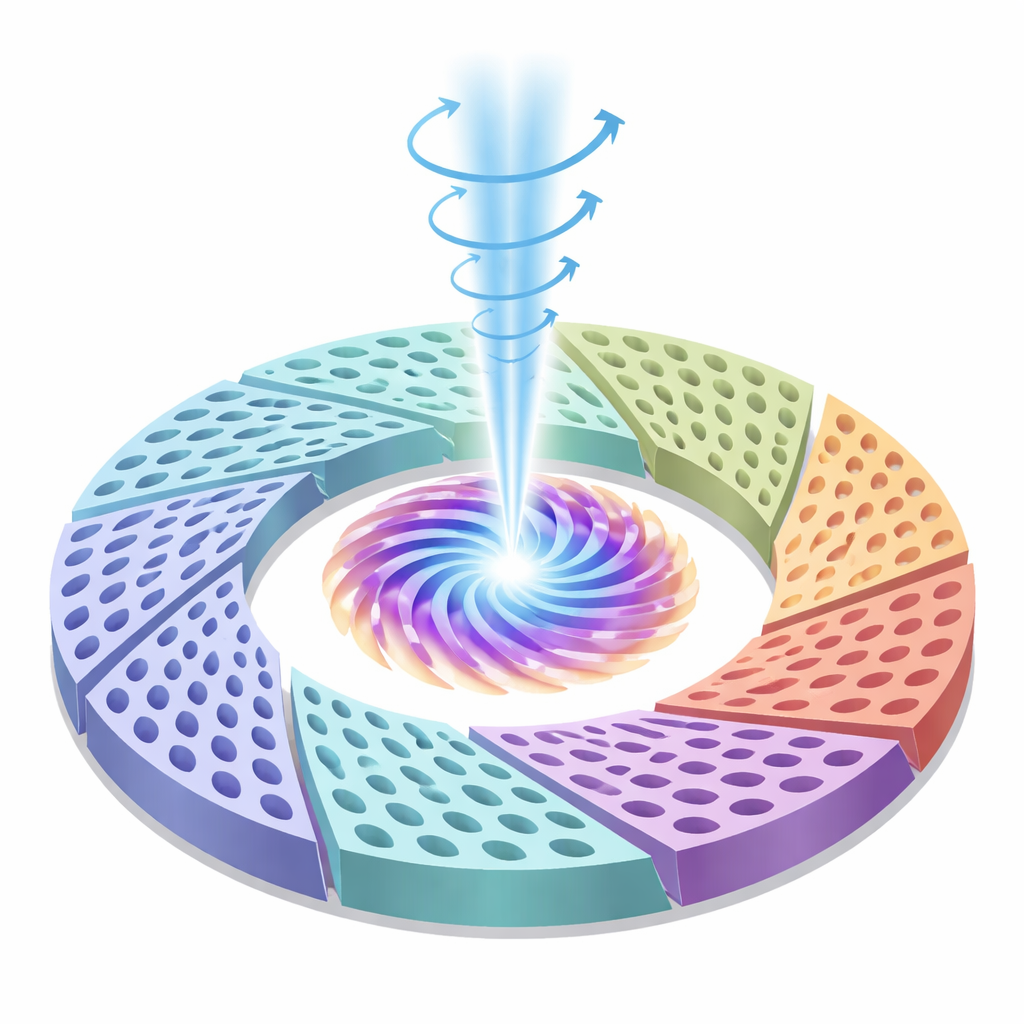
Using this rulebook, the researchers construct “compound cavities” by piecing together multiple angular sectors of the photonic crystal, each sector having a distinct ellipse orientation. When arranged in a repeating pattern around a central point, these sectors force the polarization of the supported laser mode to wind around the center, forming a vortex. The number of repeated sectors and their order directly set the total winding number, that is, the topological charge of the emitted beam. As a result, there is a one-to-one match between the geometric design of the cavity and the charge of the output light: repeat the pattern four times in one direction and you obtain charge +4, reverse the direction and you obtain −4. The authors fabricate these intricate patterns with standard nanofabrication tools and pump them with short laser pulses, measuring highly directional emission that matches the predicted twisting patterns.
A Flexible Platform for Future Photonics
By demonstrating vectorial lasing with topological charges ranging from −5 to +5 in a single-layer device, this work shows that complex structured light can be generated on demand from compact, integrated sources. Instead of relying on fixed symmetries or trial-and-error simulations, engineers can now design the desired twist of the beam simply by choosing how many sectors to include and how to orient their microscopic holes. This approach could seed future on-chip systems where multiple beams with different charges are produced side by side, supporting denser optical communications, more powerful imaging methods and finely controlled light–matter interactions in a footprint small enough to fit on a chip.
Citation: Wang, X., Wu, Z., Wang, J. et al. Vectorial lasing with designable topological charges based on Möbius-like correspondence in quasi-BICs. Light Sci Appl 15, 184 (2026). https://doi.org/10.1038/s41377-026-02269-7
Keywords: structured light, topological photonics, vortex lasers, photonic crystal slabs, integrated photonics