Clear Sky Science · en
Ultra-broadband single-stack mid-infrared semiconductor lasers grown by MOCVD
Light that Sees the Invisible
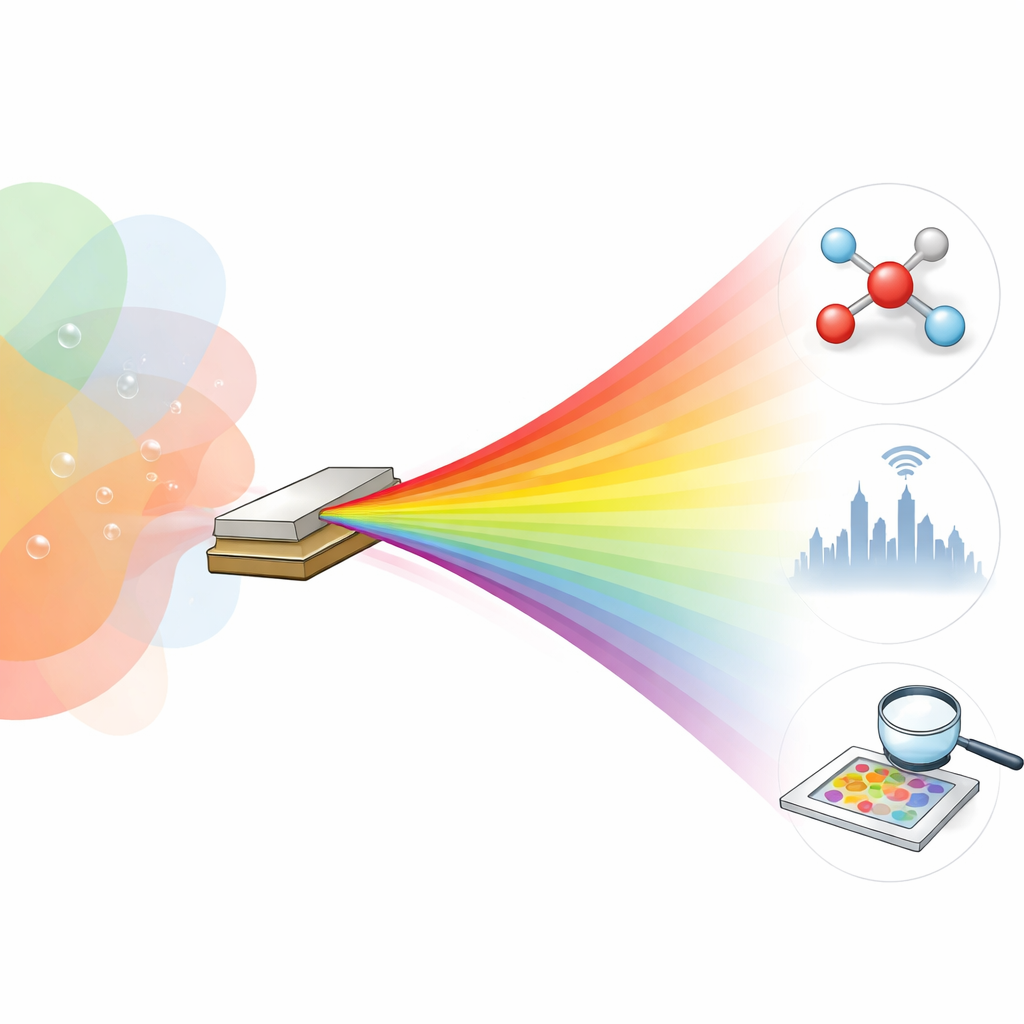
Many of the molecules that shape our daily lives—from greenhouse gases in the air to chemical fingerprints in our breath—reveal themselves most clearly in the mid‑infrared part of the spectrum. To listen to this hidden world, scientists rely on compact semiconductor lasers that can shine across a wide spread of mid‑infrared colors at once. This paper reports a major step forward: a single microscopic laser structure that covers an exceptionally broad range of mid‑infrared wavelengths, opening paths to sharper environmental sensing, medical diagnostics, and secure optical links through the air.
A New Kind of Infrared Engine
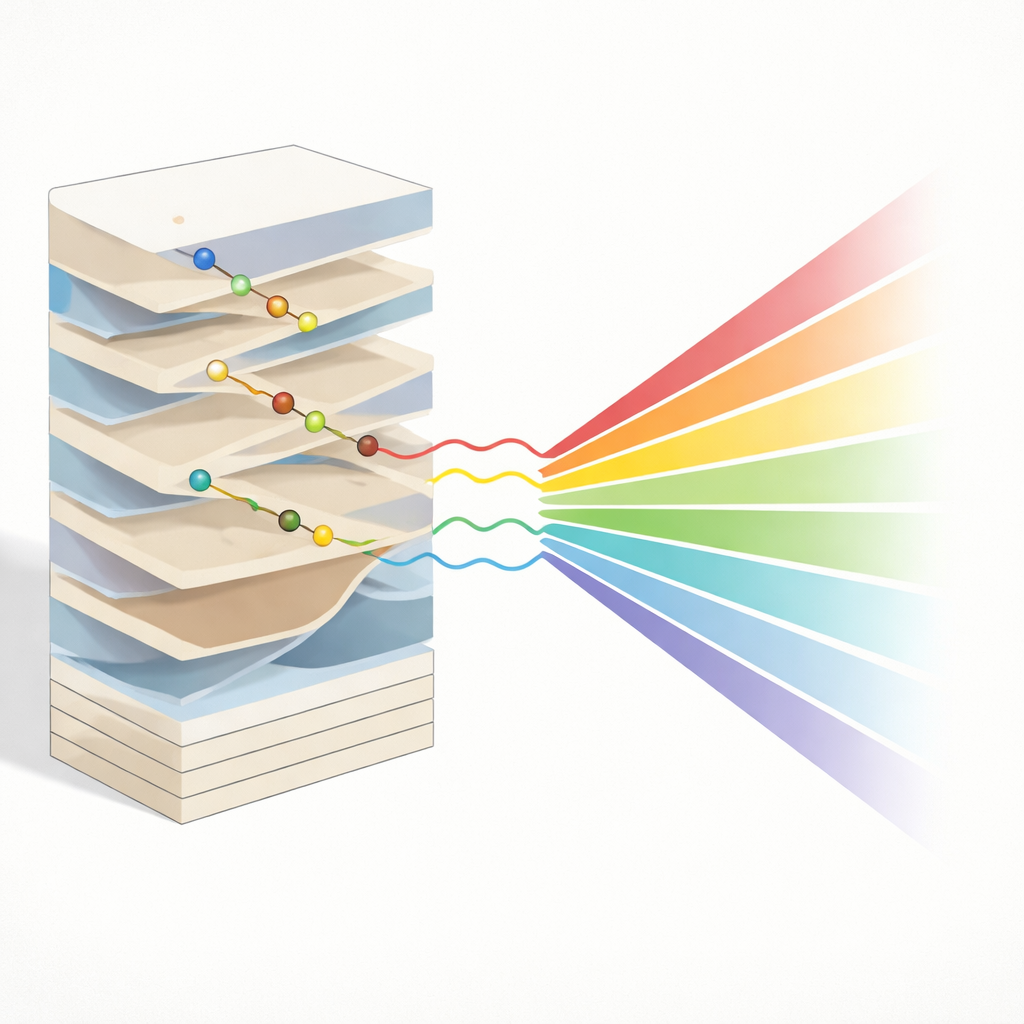
At the heart of this work is a device called a quantum cascade laser, or QCL. Unlike ordinary lasers, where light comes from electrons jumping between two fixed energy levels, a QCL is built as a nanometer‑scale staircase of semiconductor layers. Electrons cascade down this staircase, emitting a photon at each step. By engineering the height and spacing of the steps, researchers can tune which colors of light are emitted. Until now, getting a truly broad spread of mid‑infrared colors usually meant stacking several different "cores" inside one chip, each designed for a different color range. That approach works, but it makes the device more complex, harder to cool, and prone to uneven output with gaps in the spectrum.
Spreading the Light with a Single Stack
The authors take a different route: they design a single, carefully shaped active region that naturally emits over a very wide band of mid‑infrared wavelengths. Their "multi‑state‑to‑continuum" design creates several closely linked upper energy levels and a broad set of lower levels. Electrons entering this region are strongly mixed among the upper states and can radiate down along several diagonal paths, each path producing slightly different photon energies. Because the relevant transitions are engineered to have similar strength, the combined effect is a smooth, flat gain profile—meaning the laser can amplify many nearby colors nearly equally, without big dips or spikes.
Growing Perfect Layers Atom by Atom
To bring this design to life, the team uses metal‑organic chemical vapor deposition, an industry‑friendly technique for growing semiconductor structures. They alternate ultra‑thin layers of two materials, InGaAs and InAlAs, on an indium phosphide wafer, carefully adjusting thickness and composition to balance internal strain. Atomic‑force microscopy images show that the resulting surface is extremely smooth, while high‑resolution X‑ray measurements reveal that the 50 repeated periods of the active region are nearly perfectly uniform. This level of structural precision is crucial: even slight deviations could spoil the delicate balance among energy levels and narrow the possible bandwidth.
Record‑Wide Colors and Strong Output
When the researchers drive small test structures, they measure spontaneous mid‑infrared emission that remains very broad over a wide range of voltages, with a linewidth corresponding to about 600 cm⁻¹—substantially wider than comparable designs. Turning the structure into ridge‑shaped lasers, they obtain pulses at room temperature with peak output power reaching 2.72 watts and an energy‑conversion efficiency around 6 percent, figures competitive with high‑performance devices that do not offer such broad coverage. The emitted spectrum spans about 1.2 micrometers in wavelength around 9 micrometers at room temperature, and an impressive 1.93 micrometers when cooled to 80 kelvin, all from this single engineered stack. Along the way, the team explores how different transverse modes inside the laser cavity compete for power, using both measurements of the far‑field beam pattern and numerical modeling to explain the appearance of additional peaks around 8 micrometers at higher currents.
Why This Matters for Sensing and Combs
For non‑specialists, the key point is that this work delivers a compact mid‑infrared light source that is both powerful and unusually broadband, without resorting to complex multi‑core structures. Such a laser could act as a versatile "illumination engine" for systems that analyze gas mixtures, image subtle chemical contrasts, or create mid‑infrared frequency combs—light sources whose evenly spaced colors can serve as ultra‑precise rulers for measuring light. The authors argue that by stacking several of their broadband designs tuned to different central colors, it should be possible to span a full octave in frequency, a long‑standing goal that would enable the most advanced comb‑stabilization techniques. In short, this single‑stack, ultra‑broadband quantum cascade laser is a promising building block for future instruments that will see, measure, and control the invisible mid‑infrared world with unprecedented flexibility.
Citation: Liu, P., Zhang, L., Wu, Y. et al. Ultra-broadband single-stack mid-infrared semiconductor lasers grown by MOCVD. Light Sci Appl 15, 196 (2026). https://doi.org/10.1038/s41377-026-02268-8
Keywords: quantum cascade lasers, mid-infrared, frequency combs, semiconductor lasers, spectroscopy