Clear Sky Science · en
Quasi-BIC metasurfaces enable rapid, localized singlet-oxygen generation
Lighting Up Oxygen on Demand
Many modern cancer treatments and water-cleanup technologies rely on a special, highly reactive form of oxygen called singlet oxygen. It can kill tumor cells, break down pollutants, and sterilize surfaces, but today we usually make it with dye molecules that behave a bit like chemical sunblock. These dyes are often fragile, can irritate tissues, and are hard to control precisely in space and color. This paper introduces a tiny light-catching surface that can generate huge bursts of singlet oxygen in a very small region, within seconds and without any added dye molecules, opening doors to faster, more targeted therapies and cleaner chemical processes.
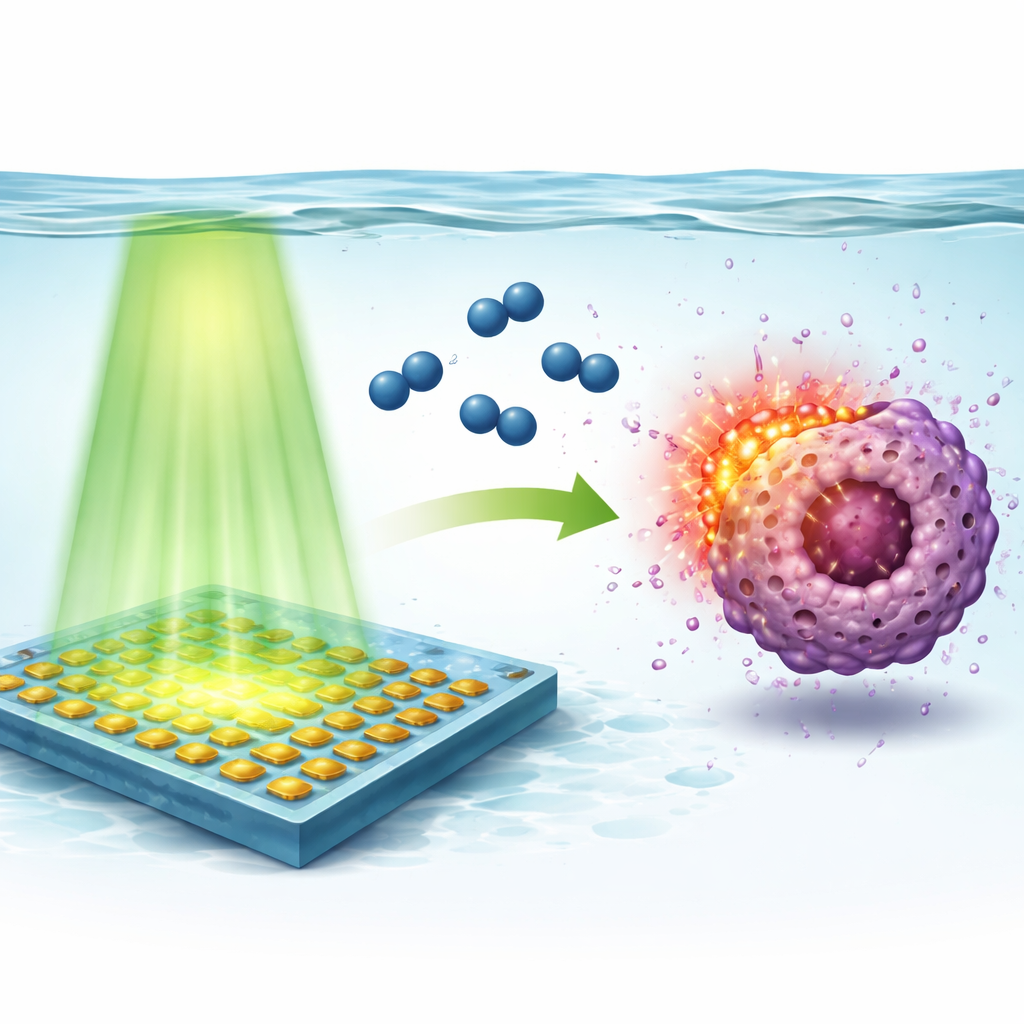
Why Singlet Oxygen Matters
Oxygen in the air and in our bodies normally sits in a low-energy "resting" state. When promoted into singlet oxygen, it becomes far more reactive, able to damage cell membranes and drive useful oxidation reactions. That power is already used in photodynamic cancer therapy and in advanced water purification, where light turns a "sensitizer" into a local oxygen activator. However, conventional sensitizers are usually organic dyes that are turned on by a broad range of colors, bleach quickly under light, and can be toxic or poorly tolerated by the body. As a result, doctors often must use high doses and long exposures to reach effective singlet-oxygen levels, which can increase side effects and patient discomfort.
Turning a Flat Surface into a Light Trap
The authors tackle this problem using a patterned "metasurface" made of a thin layer of gold sitting on tiny pillars of titanium dioxide (TiO2) arranged in a precise grid. By slightly breaking the symmetry of this pattern, they create special optical states known as quasi–bound states in the continuum, or quasi-BICs. In simple terms, these are light-trapping modes that hold onto incoming light instead of letting it scatter away. At a specific shade of green (around 532 nanometers), the metasurface can absorb nearly half of the incoming light even though the structure is only about 100 nanometers thick—about a thousand times thinner than a human hair. Careful tuning ensures that the rate at which light leaks out matches the rate at which it is absorbed, a "critical coupling" condition that maximizes energy capture at the gold–TiO2 interface.
From Trapped Light to Reactive Oxygen
When this trapped light is absorbed by the ultrathin gold film, it briefly heats the electrons in the metal, creating so‑called hot carriers. Because the gold is in intimate contact with TiO2, some of these energized electrons hop over an energy barrier into the semiconductor instead of quickly recombining and wasting their energy as heat. The metasurface is deliberately designed to use much less gold than typical nanoparticle systems, which has two payoffs: the same absorbed power is concentrated into a smaller volume, boosting electron activity, and there are fewer sites where electrons and holes can annihilate each other, so their lifetimes are extended. At the solid–liquid boundary, these long‑lived hot carriers drive a series of redox reactions that turn ordinary oxygen into singlet oxygen right next to the surface, within distances of only hundreds of nanometers.
Measuring a Local Oxygen Storm
To prove that singlet oxygen is truly being created, the team detects its faint near‑infrared glow at 1270 nanometers, a well‑known fingerprint, using sensitive photon counting. Despite the metasurface being optically thinner than a micron, the recorded signal rivals that from a standard dye solution with a millimeter‑thick light path. By comparing lifetimes and intensities to a benchmark dye (Rose Bengal), and accounting for oxygen sticking to the TiO2 surface, they estimate that the local singlet-oxygen concentration at the metasurface reaches around one mole per liter—about a million times higher than what typical dye-based methods achieve in the same region. Complementary chemical probes that brighten or bleach in the presence of singlet oxygen show rapid changes within about eight seconds of green-light exposure, confirming fast generation and strong reactivity exactly where the metasurface is illuminated.
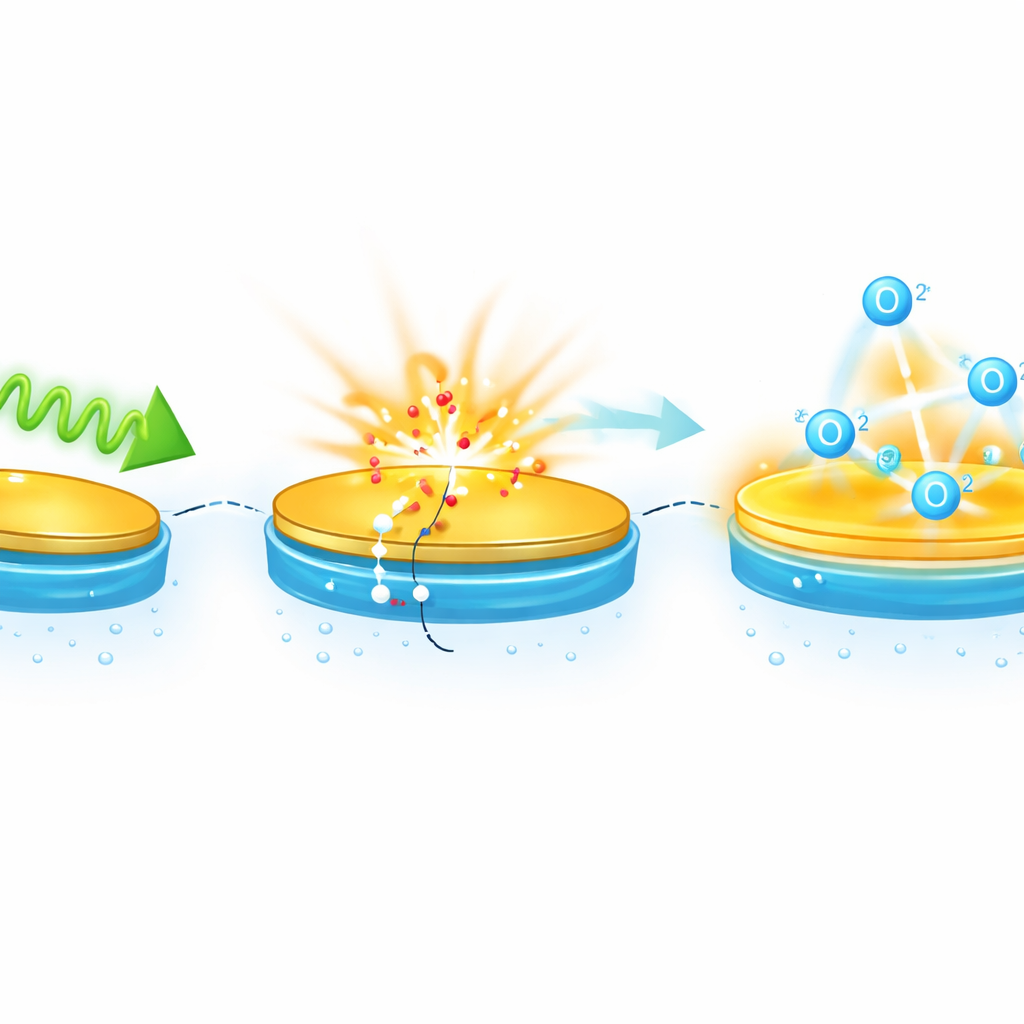
Pixel-Level Control Over Cell Death
Because the metasurface pattern controls which color of light it responds to, the authors can "write" arrays of pixels that each resonate at slightly different wavelengths. Human bone cancer cells grown directly on these patterned chips are then exposed to low-power green light. Only the regions whose resonance matches the laser color produce enough singlet oxygen to kill nearby cells, as confirmed by live/dead fluorescent staining. Changing the illumination wavelength shifts the damage to a different set of pixels, while conventional dye sensitizer solutions under the same conditions show no such sharp spatial pattern. In other words, the metasurface turns flat glass into a programmable, wavelength-addressable patchwork of tiny light-activated therapy zones.
What This Means Going Forward
In everyday terms, this work shows how a carefully sculpted surface can act like a smart lens and catalyst combined, grabbing light of a chosen color and turning it into a concentrated chemical effect in an ultrathin layer of liquid. By generating molar-level singlet oxygen within seconds and confining it to micron-scale regions, the Au–TiO2 quasi‑BIC metasurfaces overcome long-standing limits of dye-based approaches, which struggle with low yields, poor stability, and lack of spatial control. The same design principles could be adapted to other metal–semiconductor combinations and wavelengths, including deeper-penetrating near‑infrared light, enabling rapid, precise photodynamic therapy, highly selective oxidation reactions, and compact flow microreactors where every photon and every molecule of precious metal count.
Citation: Long, R., Lin, L., Qi, X. et al. Quasi-BIC metasurfaces enable rapid, localized singlet-oxygen generation. Light Sci Appl 15, 188 (2026). https://doi.org/10.1038/s41377-026-02267-9
Keywords: singlet oxygen, metasurfaces, photodynamic therapy, hot carriers, titanium dioxide