Clear Sky Science · en
Generalized Doppler effect for high-accuracy frequency shift measurement
Seeing Motion in a New Light
From tracking storms and airflow around airplane wings to measuring blood flow in tiny vessels, scientists rely on how moving objects subtly change the color, or frequency, of light. This phenomenon, known as the Doppler effect, is a workhorse of modern measurement. Yet, today’s optical Doppler tools miss parts of the motion, can confuse direction, and hit a ceiling in accuracy. This paper introduces a new way of shaping light so that a single measurement reveals more information and does so with strikingly higher precision, opening doors for sharper sensing in fields ranging from medicine to navigation.
Why Traditional Motion Sensing with Light Falls Short
Conventional laser Doppler methods watch how motion shifts the frequency of light that bounces off a target. Linear Doppler schemes are excellent for tracking motion toward or away from the detector, but they are blind to sideways motion. Rotational Doppler methods use light that spirals like a corkscrew to sense spinning motion, yet they cannot tell whether the object spins clockwise or counterclockwise because the frequency spectrum only shows how big the shift is, not its sign. Newer vectorial methods encode direction into the polarization of light—the way its electric field points—letting researchers distinguish red shifts from blue shifts. However, these different approaches have grown up as separate tools, with no unifying picture, and all are ultimately limited by how large a frequency shift they can generate from a given motion.
Designing Light with Two Kinds of Twist
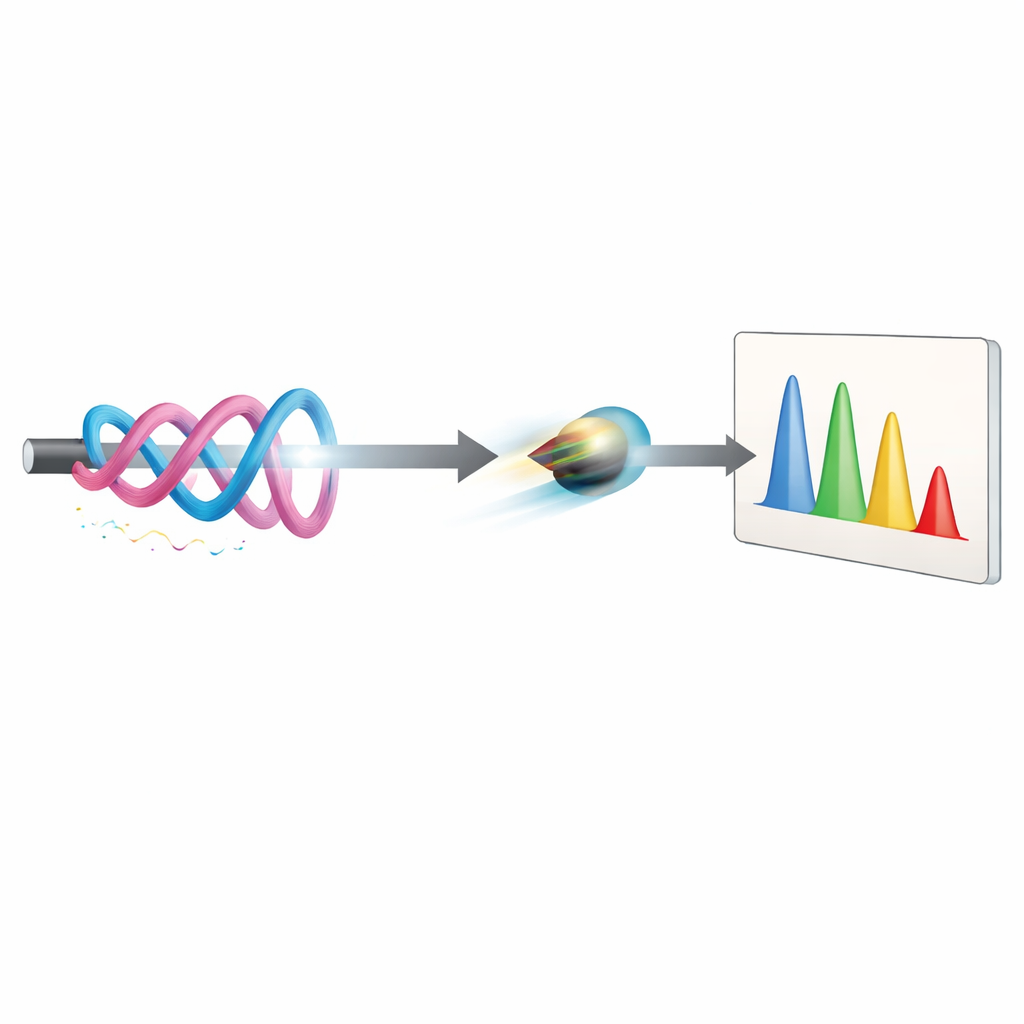
The authors tackle these limits by engineering a new type of light field that carries two intertwined kinds of structure at once. One is polarization order, describing how the direction of polarization varies around the beam. The other is orbital angular momentum, which sets how strongly the wavefront of the beam twists like a spiral staircase. By carefully coupling these properties—a process known as spin–orbit coupling—they create vectorially polarized dual-vortex fields. In simple terms, the beam’s polarization pattern and spiral structure are locked together in a controlled way. When such a beam strikes a moving particle or surface, the motion imprints not just a single Doppler shift, but several, each tied to a different combination of the beam’s internal twists.
Four Signals from One Interaction
When the structured beam reflects from a rotating or translating target and passes through a polarizer into a detector, its intensity wobbles in time. Analyzing this wobble with standard frequency tools reveals four clear signatures at once. One is the familiar Doppler signal linked to the spiral of the light; another comes from the polarization pattern alone. Crucially, two new mixed signals appear that depend on both the polarization order and the spiral order at the same time. Because these mixed signals combine two twists of the light, their frequency shifts are substantially larger than those from either ingredient alone. The team shows that for realistic choices of beam parameters, the mixed signals can increase effective measurement accuracy by more than an order of magnitude compared with traditional schemes.
Sharper Sensing and Clearer Direction
Beyond producing bigger shifts, the new method also clears up directional confusion. The authors demonstrate that by either rotating a polarizer in the detection path or adjusting the initial polarization setting of the emitted beam, they can read out the sign of the Doppler shifts encoded in the polarization-linked signals. That means the setup can tell whether a target is spinning one way or the other, and it continues to work even when the rotational speed changes over time—speeding up, slowing down, or following more complex patterns. In all these cases, the mixed signals maintain their advantage, consistently yielding smaller relative errors than conventional Doppler and polarization-only measurements.
From Laboratory Demo to Real-World Use
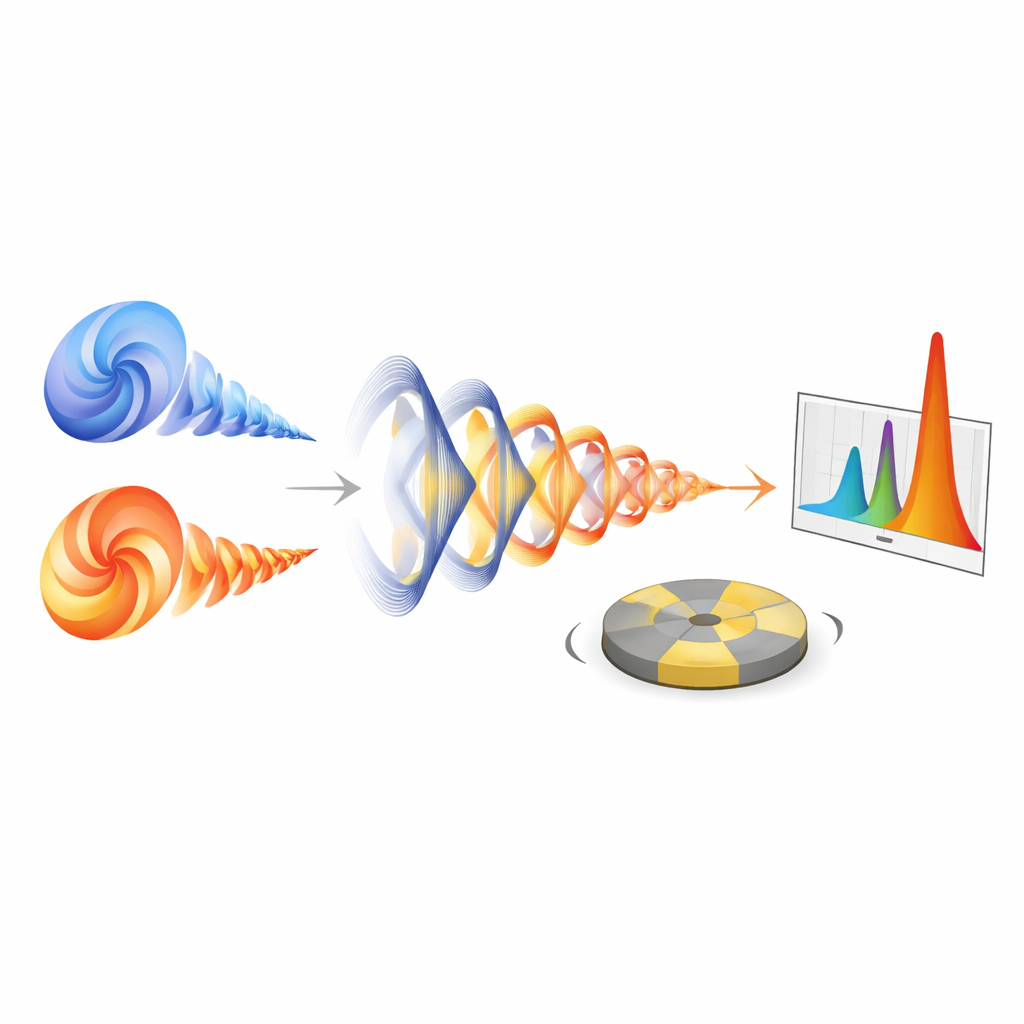
To test practicality, the researchers build an experimental system that shapes the light, directs it onto a tiny mirror "particle" whose motion is programmed by a digital micromirror device, and then analyzes the returning light. They verify that the four distinct Doppler components match theoretical predictions under steady and time-varying motion and that the mixed vector–vortex signals indeed give the most accurate readouts. The authors also discuss how future devices could use mode-selective filters to isolate these valuable mixed signals even when light scatters from rough, diffuse surfaces—a common situation in real-world sensing.
A New Roadmap for Ultra-Precise Motion Measurements
In essence, this work shows that by cleverly structuring light before it meets a moving object, one can coax out multiple Doppler fingerprints from a single measurement, with some of them greatly magnified. For non-specialists, the key idea is that using light with two coordinated "twists" lets instruments see motion more clearly and more accurately than before, while also resolving which way things move. This generalized Doppler framework unifies older approaches and points toward next-generation tools for mapping swirling flows, monitoring blood movement, improving laser-based radar, and exploring other systems where tiny changes in motion matter.
Citation: Zhang, Y., Ba, D., Yang, Y. et al. Generalized Doppler effect for high-accuracy frequency shift measurement. Light Sci Appl 15, 197 (2026). https://doi.org/10.1038/s41377-026-02259-9
Keywords: generalized Doppler effect, structured light, orbital angular momentum, precision velocimetry, vector vortex beams