Clear Sky Science · en
Hollow-core fiber gas lasers [Invited]
Light in a Hollow Thread
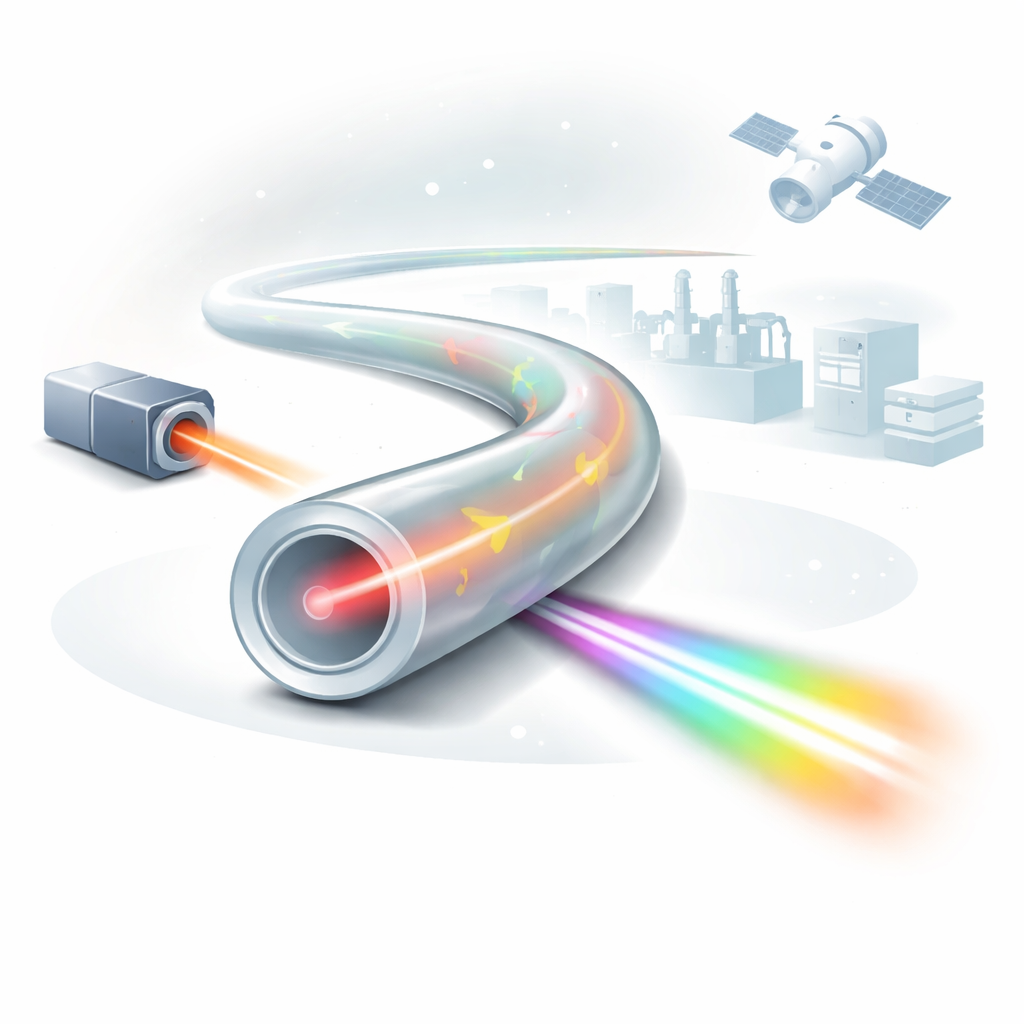
Imagine a hair-thin glass tube whose center is not solid, but empty and filled with gas. Shine the right kind of light into one end and, instead of simply passing through, the gas and light team up to create powerful new colors of laser light, including wavelengths that are very hard to reach with today’s technology. This review article explains how such “hollow-core fiber gas lasers” work, how they are built, and why they could reshape applications from high‑speed communications to pollution sensing and even medical treatments.
Why Hollow Fibers Matter
Conventional fiber lasers guide light through a solid glass core. That works extremely well around the familiar near‑infrared band used in telecom and industrial cutting, but it runs into fundamental limits when we try to push to higher powers or very different colors, especially in the mid‑infrared where many molecules strongly absorb light. Hollow‑core fibers turn this idea inside out: light travels mostly through an empty central channel, while a delicate glass structure around it keeps the beam confined. Because the light barely touches the glass, these fibers can tolerate higher powers, suffer less distortion, and can be filled with gases that act as the laser’s active medium. This combination gives hollow‑core fiber gas lasers the compactness and beam quality of fiber systems with the flexibility of gas lasers.
Two Families of Hollow‑Core Fibers
The article first traces how hollow‑core fibers themselves have evolved. Early designs, called photonic bandgap fibers, used a complex lattice of microscopic air holes to trap specific wavelengths of light, achieving impressive but relatively narrow transmission bands. A newer family, anti‑resonant fibers, relies instead on thin glass walls that act like tiny mirrors for broad bands of wavelengths. Refinements such as negative curvature cores and nested capillaries have steadily cut losses to below 0.1 decibels per kilometer, in some cases beating standard telecom fibers. These advances are crucial: the lower the loss in both the pump band and the laser band, the more efficiently a gas‑filled fiber can amplify or convert light, especially deep into the mid‑infrared.
Two Ways Gases Make New Light
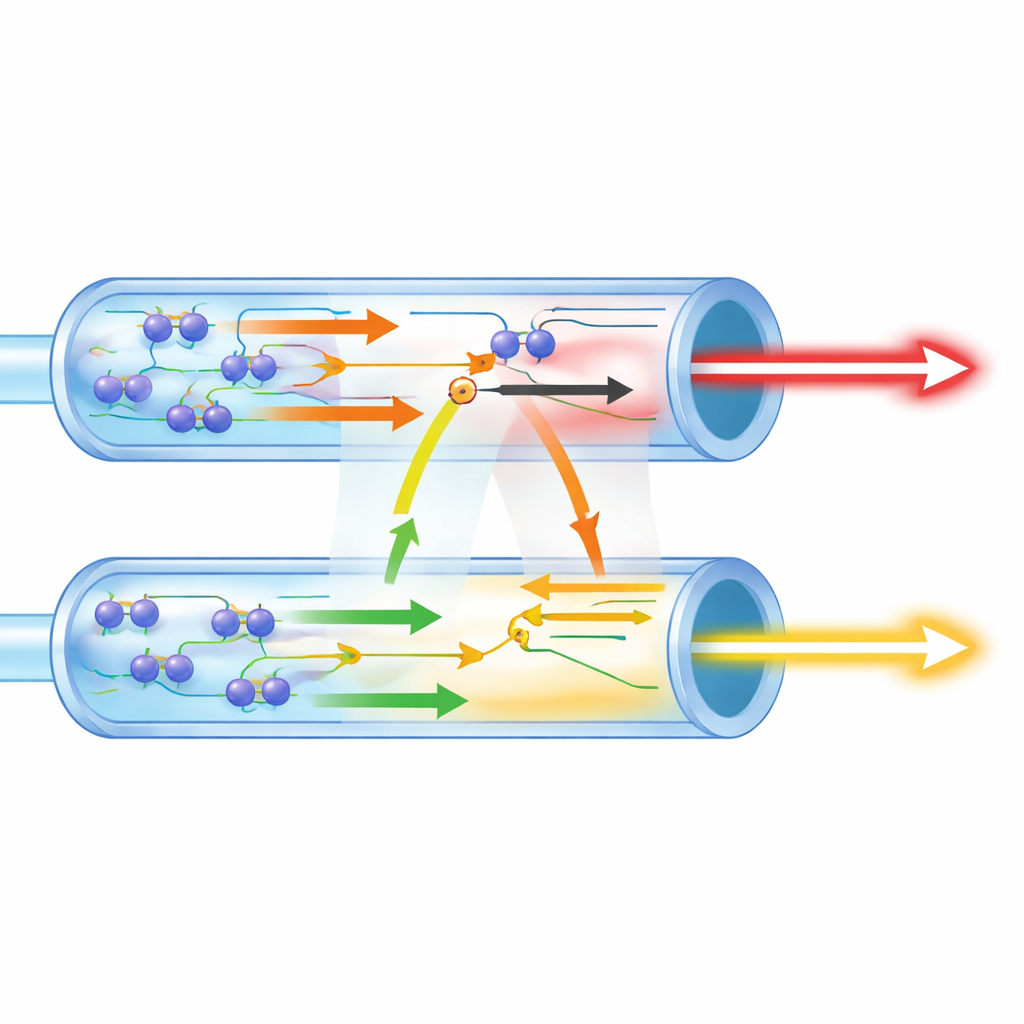
Inside a hollow‑core fiber, the gas can drive lasers through two main mechanisms. In population‑inversion lasers, the pump light lifts gas molecules into higher‑lying vibrational states; when they fall back down, they emit mid‑infrared light at well‑defined wavelengths. Carefully chosen gases such as acetylene, carbon dioxide, hydrogen bromide, and carbon monoxide can produce emissions around 3–5 micrometers, a scientifically and technologically important band that is hard to access with solid‑glass fibers. The second route, stimulated Raman scattering, does not require matching a sharp absorption line. Instead, intense pump light transfers energy to molecular vibrations, shifting the light’s color in steps. With suitable gases like hydrogen, methane, and deuterium, this approach has generated laser lines from the ultraviolet all the way to the mid‑infrared, including a record 110‑watt output around 1.15 micrometers.
Power, Color, and Practical Designs
The review highlights rapid progress in performance and engineering. For population‑inversion systems, acetylene‑filled fibers have reached more than 20 watts around 3.1 micrometers, while carbon dioxide and hydrogen bromide have produced multi‑watt beams near 4 micrometers. Careful thermal management, clever gas‑cell designs, and increasingly low‑loss nested fibers are key to these gains. For Raman‑based systems, researchers have built both free‑space and fully spliced all‑fiber setups, sometimes using fiber Bragg gratings to form compact resonant cavities. Cascaded stages can step the wavelength from standard one‑micrometer pump lasers out to nearly three micrometers or beyond. Alongside experimental work, detailed models now guide choices of gas pressure, fiber length, and pump format to balance threshold, efficiency, and beam quality.
Looking Ahead to Real‑World Use
Although still a young technology, hollow‑core fiber gas lasers are already competing with, and in some niches surpassing, traditional rare‑earth‑doped fibers in challenging spectral regions. The authors foresee further power scaling using advanced pump architectures, mixtures of gases, and even alternative glass types that can transmit far into the mid‑infrared. They also discuss ways to simplify the hardware by directly splicing hollow fibers to standard solid fibers with very low loss and minimal back‑reflection. If current trends continue, these hollow threads of light and gas could become practical sources for remote sensing, long‑distance data links, precision spectroscopy, and industrial processing—delivering bright, clean beams at wavelengths that were once considered out of reach.
Citation: Wang, Z., Pei, W., Zhou, Z. et al. Hollow-core fiber gas lasers [Invited]. Light Sci Appl 15, 208 (2026). https://doi.org/10.1038/s41377-026-02256-y
Keywords: hollow-core fiber, gas lasers, mid-infrared, stimulated Raman scattering, fiber optics