Clear Sky Science · en
Subarray programmable terahertz metasurface for optical logic and high-order amplitude modulation
Smarter Wireless Waves for Everyday Devices
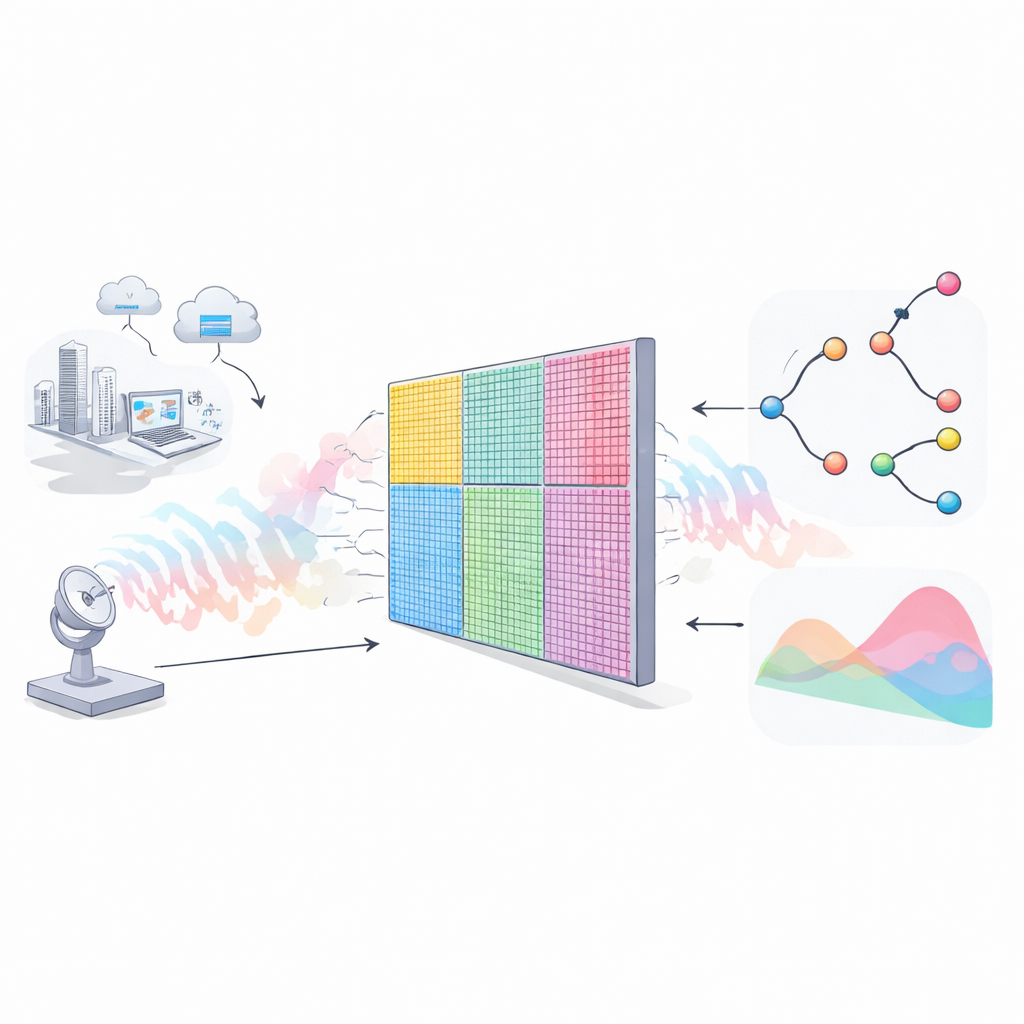
As our phones, cars, and smart gadgets get more connected, the invisible highways that carry their signals are reaching their limits. This paper explores a new kind of tiny, engineered surface that can shape and process terahertz waves—radiation far beyond today’s Wi‑Fi—in real time. By letting the same chip both decide simple logic questions and send data using multiple signal levels, the work points toward future wireless systems that sense, think, and communicate on the fly without bulky separate hardware.
A New Building Block for Future 6G Networks
Designers of next‑generation 6G and beyond networks want wireless links that do more than move bits; they must also sense their surroundings and make split‑second decisions, for example in autonomous driving or robotic factories. The terahertz band is attractive because it can carry huge amounts of data and resolve fine details, but existing materials do not respond strongly or flexibly enough in this range. Conventional programmable surfaces either control each tiny pixel one by one—giving great flexibility but extreme wiring and power complexity—or drive the whole surface uniformly, which is simpler but usually limited to basic on–off patterns and modest speeds. The challenge is to get rich, reconfigurable control of terahertz waves without creating an unmanageable electronic maze.
Controlling Waves One Subarray at a Time
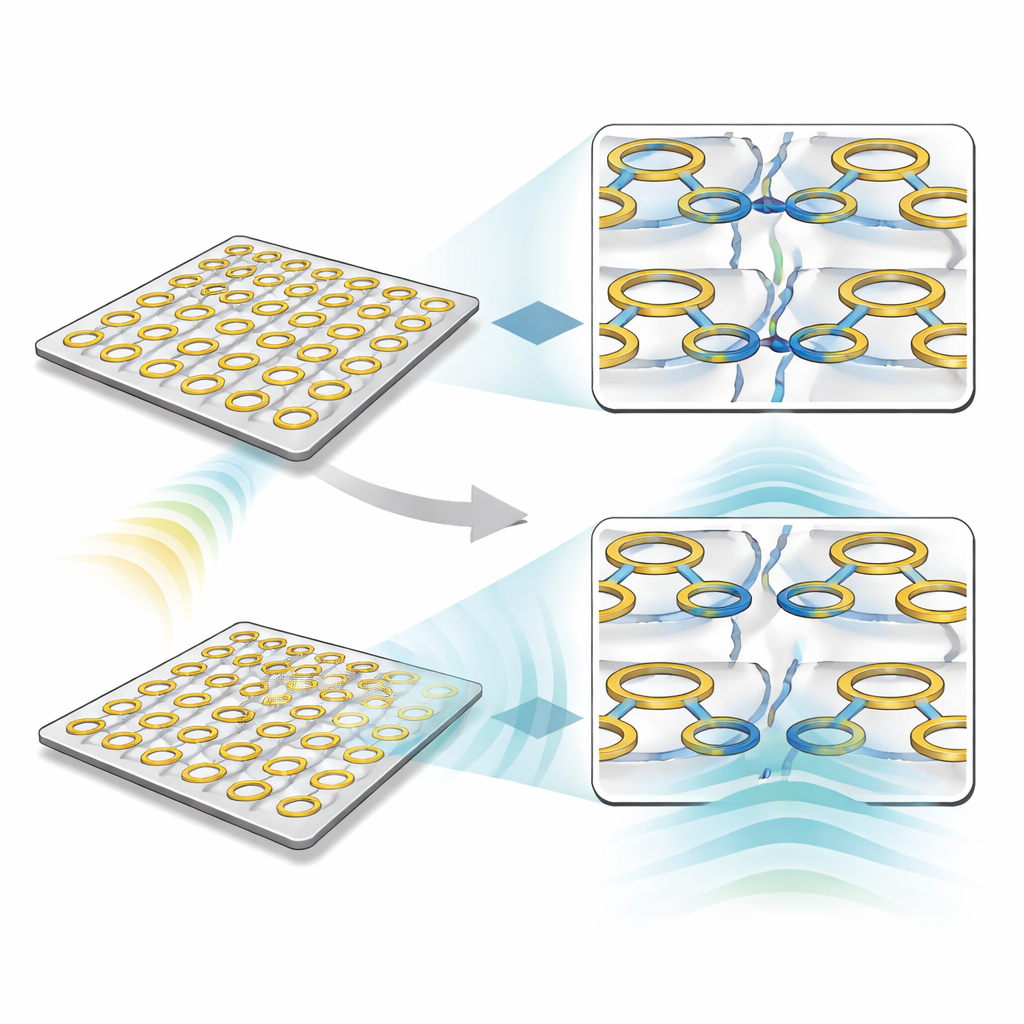
The researchers solve this by introducing a “subarray‑programmable” metasurface. Instead of addressing every microscopic unit separately, the surface is divided into four larger regions, or subarrays, each made of thousands of repeating elements. Inside each element, a special high‑electron‑mobility transistor made from AlGaN/GaN hosts an ultra‑thin sheet of mobile electrons that naturally conducts at terahertz frequencies. By applying a voltage to the gate of a chosen subarray, the device can either preserve a dense sea of electrons, which ties neighboring elements together and strongly blocks transmission, or deplete that sea so currents break apart and more of the wave passes through. Experiments show smooth tuning of transmission across a broad band from about 170 to 260 GHz, with nearly a factor‑of‑two change in transmitted power at certain frequencies—enough to clearly distinguish different electronic states.
Turning Light Into Logic and Multi‑Level Signals
Because each of the four subarrays can be switched independently, their combined on–off patterns create many distinct transmission levels. The team first uses this as an optical logic processor. Two subarrays play the role of logical inputs, assigned “0” or “1” depending on their gate voltage, while the measured terahertz transmission is interpreted as a True or False output. By choosing suitable fixed settings on the other two subarrays and a simple intensity threshold, the same hardware can perform different logic functions such as AND, OR, and XNOR over a wide frequency range. High‑speed tests with radio‑frequency drive signals show these logic operations working dynamically up to hundreds of megahertz. The authors then regroup the subarrays into two pairs and drive each pair with an independent square wave, so their contributions add to produce four distinct intensity levels. This realizes four‑level pulse amplitude modulation (PAM‑4), a popular format in high‑speed fiber‑optic and wireless links, directly in the transmitted wavefront.
Link‑Level Performance and Practical Limits
To show that the concept works in a realistic setting, the metasurface is placed inside a 220 GHz wireless testbed that mimics a short‑range terahertz link. A multiplied local oscillator generates the carrier, horn antennas send and receive the beam, and custom electronics feed modulation waveforms to the chip. Measurements reveal that a simple single‑tone signal can be tracked up to 6 GHz, indicating that the device and its packaging can already handle gigahertz‑class modulation. The PAM‑4 scheme produces four clearly separated amplitude levels at 20 MHz, even though subtle rounding of edges and unequal spacing appear due to electrical coupling and parasitic resistance and capacitance. The authors analyze how, as more subarrays are activated, electromagnetic coupling compresses the spacing between transmission levels; while the underlying coding space is huge, in practice the number of cleanly distinguishable amplitude steps is limited by this nonlinearity, fabrication variations, and noise.
What This Means for Everyday Technology
In simple terms, this work demonstrates a thin, chip‑scale surface that can both “think” and “talk” with terahertz waves using the same hardware, without the complexity of controlling millions of tiny elements individually. By grouping elements into programmable subarrays, the device achieves fast, broadband logic operations and high‑order amplitude modulation in a compact platform, pointing toward intelligent front ends for future 6G‑class systems that can sense, decide, and communicate in real time. With further improvements to the wiring, packaging, and linearity, similar metasurfaces could help enable smaller, more energy‑efficient terahertz links for applications ranging from ultra‑fast indoor networking to advanced sensing and imaging.
Citation: Wang, L., Gong, S., Xia, C. et al. Subarray programmable terahertz metasurface for optical logic and high-order amplitude modulation. Light Sci Appl 15, 222 (2026). https://doi.org/10.1038/s41377-026-02255-z
Keywords: terahertz metasurface, programmable surfaces, optical logic, PAM-4 modulation, 6G communications