Clear Sky Science · en
Scalable optical vortex arrays enabled by the decomposition of Laguerre–Gaussian beams into three Hermite–Gaussian modes and multibeam interference
Light That Twists and Multiplies
Imagine a laser beam not as a straight, steady ray, but as a tiny tornado of light that can twist and move matter on the scale of cells and nanostructures. Now imagine not one such “twister,” but thousands of them, all perfectly ordered and fired at once. This paper shows how to create enormous grids of these swirling light spots—called optical vortices—using a surprisingly simple optical setup, unlocking new possibilities for ultra-parallel manufacturing, biology, and future quantum technologies.
From Single Beams to Swirls of Light
Ordinary laser beams deliver light in a smooth, uniform way. Optical vortices are different: their light intensity forms a ring, dark in the center, while their wavefront spirals like a corkscrew. Each photon in such a beam carries a twist, known as orbital angular momentum. This twist can be harnessed to rotate microscopic particles, sculpt materials into chiral (handed) shapes, or encode extra information in communication systems. While scientists have long known how to make a few of these vortices, turning them into large, powerful arrays—thousands at once—has been difficult. The usual tools, such as programmable spatial light modulators and tiny nanostructured metasurfaces, either can’t handle high power, produce only modest numbers of vortices, or demand complex setups.
Reimagining How Vortex Light Is Built
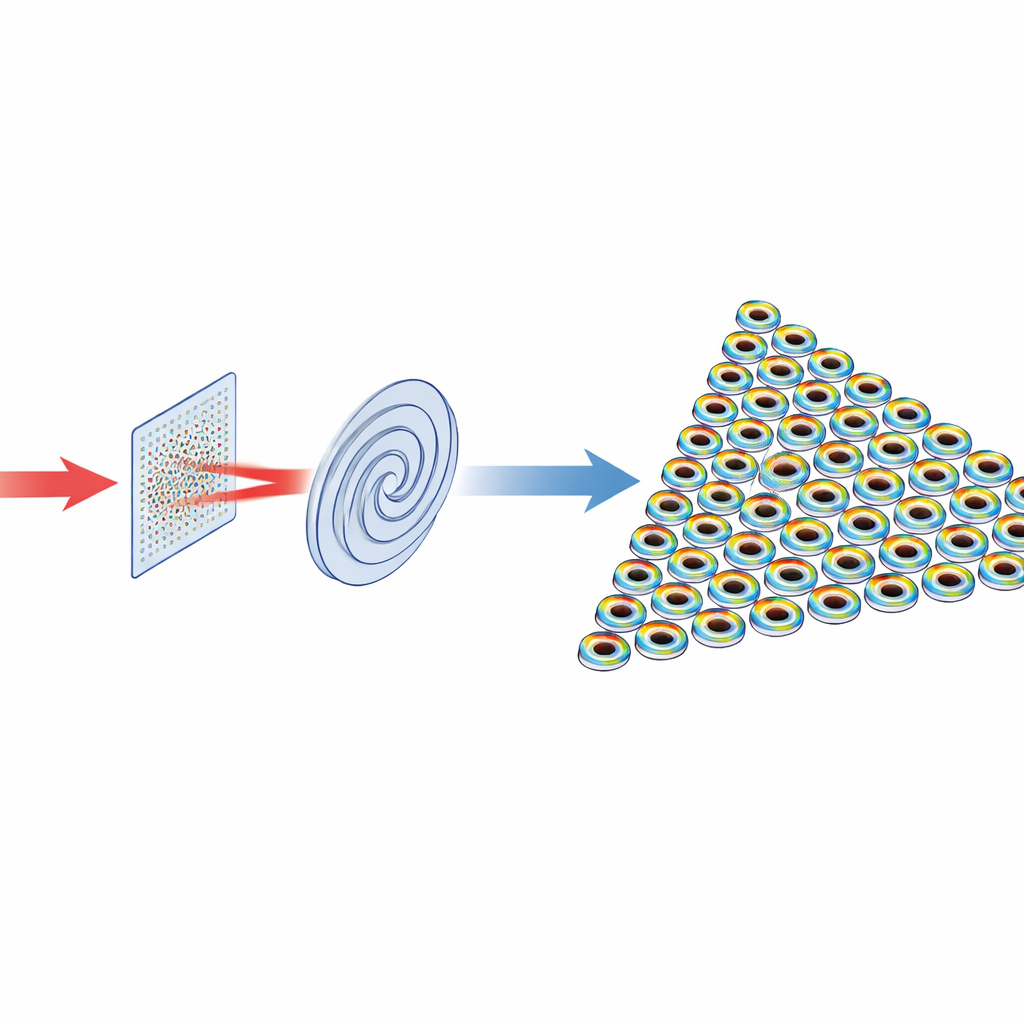
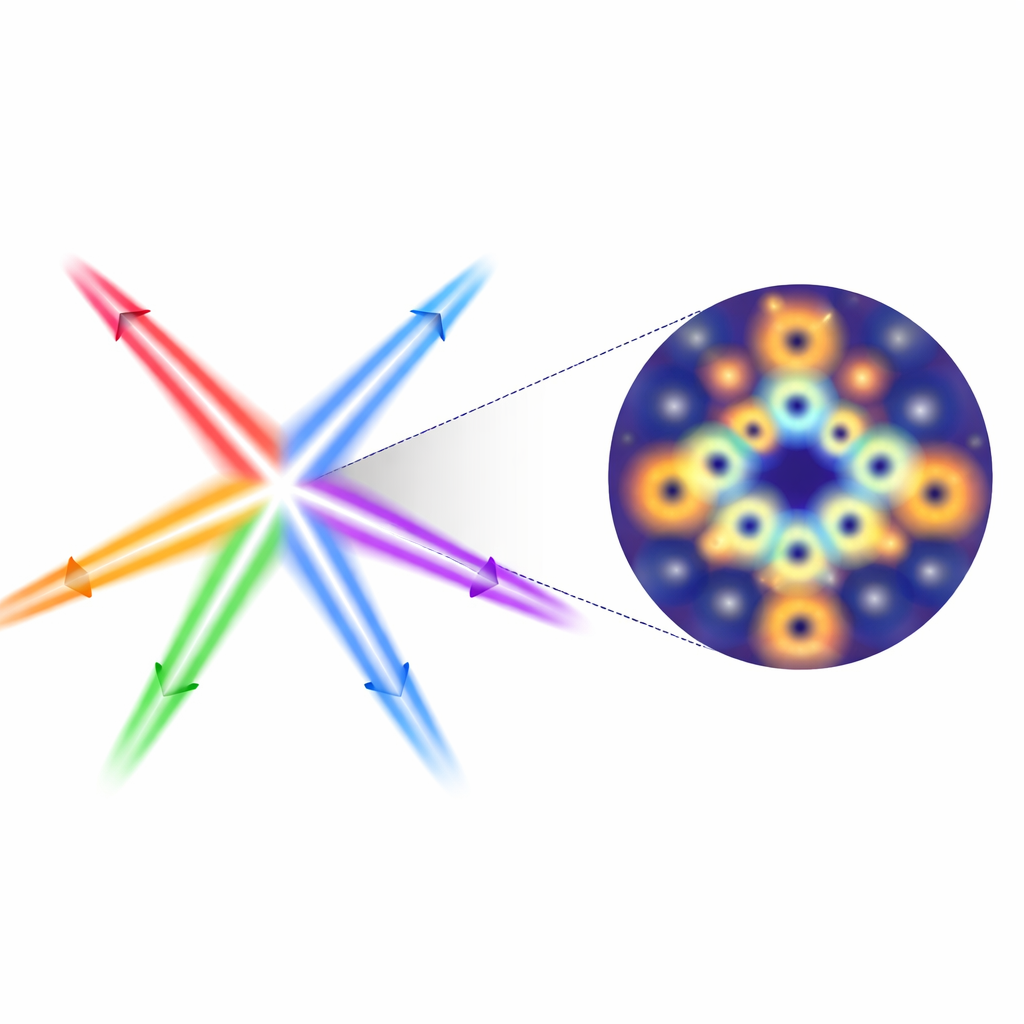
The authors revisit a classic mathematical description of vortex beams and give it a new twist. Traditionally, a vortex beam is built by combining two simple laser patterns at right angles. In this work, the team shows it can instead be represented as the sum of three similar patterns, each rotated by 60 degrees. This seemingly small change has a big payoff: those three rotated patterns can be realized as three pairs of laser beams that interfere with each other. When six beams are arranged symmetrically around a central axis and made to overlap, their interference automatically generates a repeating pattern of donut-shaped light spots with a well-defined twist. In other words, many vortices appear at once, arranged in a triangular lattice, with no intrinsic upper limit on how many can be created across a large area.
Turning Theory into a High-Power Light Engine
To prove the concept, the researchers built a compact “4f” optical system using only two lenses, a patterned diffractive element, and a spiral phase plate. A single input laser beam is first split into six beams that fan out symmetrically. The lenses then refocus these beams so they meet again, where their interference forms a regular triangular pattern. The spiral plate adds the corkscrew phase that endows each spot with a vortex character. With this simple arrangement, the team created an array of about 3,070 coherent optical vortices at a peak power of 58 megawatts—a jump of more than a thousand-fold in both vortex count and power compared with leading programmable and metasurface-based methods. Simulations and careful measurements confirmed that each bright donut hides a central phase singularity, the hallmark of a true vortex.
Writing Tiny Twisted Structures in Metal
High power is not just a bragging right; it is essential for directly shaping materials. Using nanosecond green laser pulses in their array mode, the authors irradiated a copper surface. The result was a regular grid of circular ablation spots matching the vortex lattice, and, at some of the darkest central points, the emergence of tiny needle-like structures with a distinct handedness. Reversing the twist of the light flipped the handedness of these nanoneedles, clear evidence that the orbital angular momentum in the vortex array was being transferred to the material. Remarkably, because the process uses many vortices at once and a favorable wavelength, the energy needed for each tiny twisted feature was about a thousand times lower than that required in earlier single-beam experiments.
What This Breakthrough Means Going Forward
By combining a fresh way of describing vortex beams with a straightforward interference scheme, this work delivers a new kind of optical engine: a scalable, robust source of thousands of high-power optical vortices. The setup is compact, uses standard components, and can in principle be pushed to even finer spacing and higher power. For a non-specialist, the message is simple: we now have a practical way to create vast, orderly “cities” of tiny light tornadoes, each capable of twisting, sorting, or writing structures at the micro- and nanoscale. This opens the door to massively parallel laser processing, advanced chiral photonics, and future experiments where quantum and nonlinear effects are explored not one vortex at a time, but in thousands working together.
Citation: Nakata, Y., Miyanaga, N., Kosaka, Y. et al. Scalable optical vortex arrays enabled by the decomposition of Laguerre–Gaussian beams into three Hermite–Gaussian modes and multibeam interference. Light Sci Appl 15, 193 (2026). https://doi.org/10.1038/s41377-026-02254-0
Keywords: optical vortices, laser interference, orbital angular momentum, vortex arrays, chiral nanostructures