Clear Sky Science · en
Integrated optomechanical ultrasonic sensors with nano-Pascal-level sensitivity
Listening to Faint Sounds
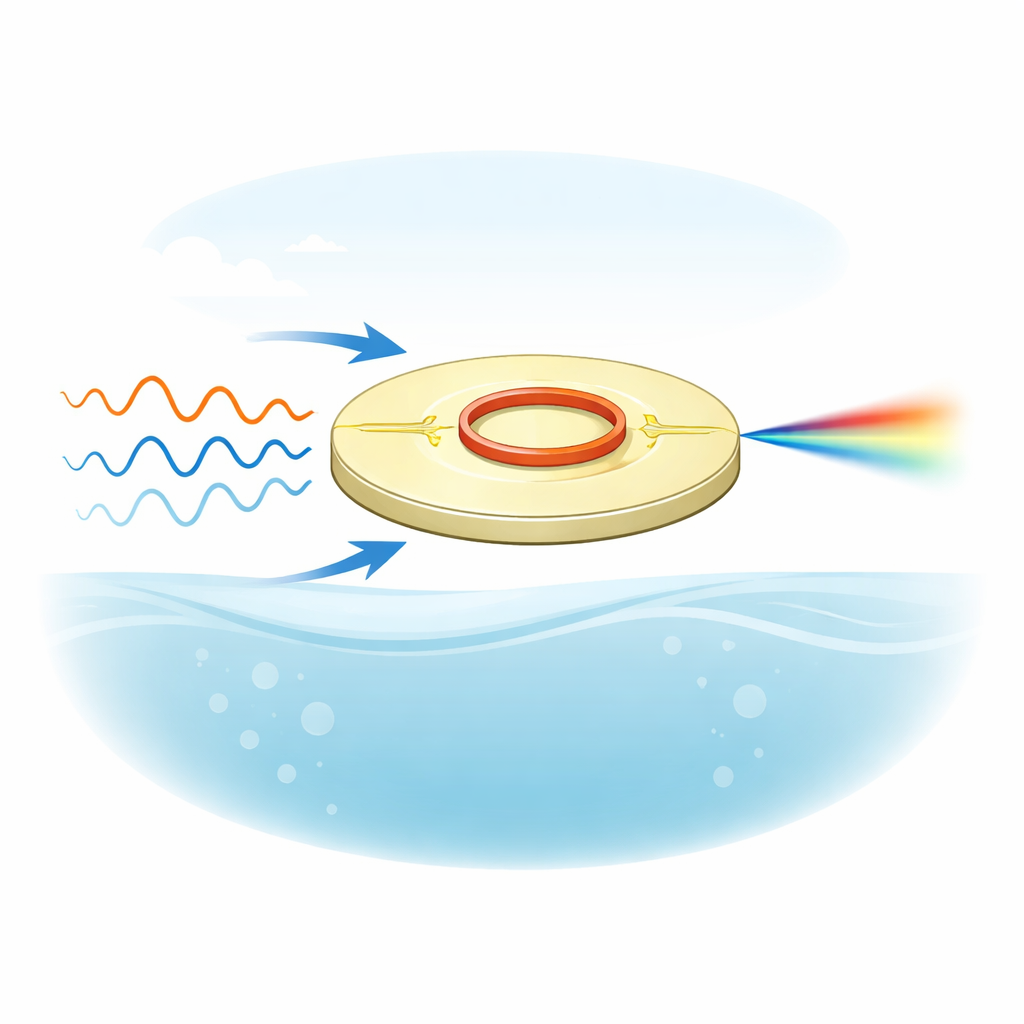
Ultrasound underpins everything from prenatal scans to checking for cracks in airplane wings and listening for signals in the ocean. Yet today’s tiny sensors struggle to pick up very weak sounds, especially when devices must be small, cheap, and packed densely on a chip. This paper introduces a new kind of light-based ultrasonic sensor so sensitive it can detect pressure changes smaller than a billionth of the air pressure around us, opening doors to sharper medical images, better environmental monitoring, and more precise industrial testing.
A New Way to Hear with Light
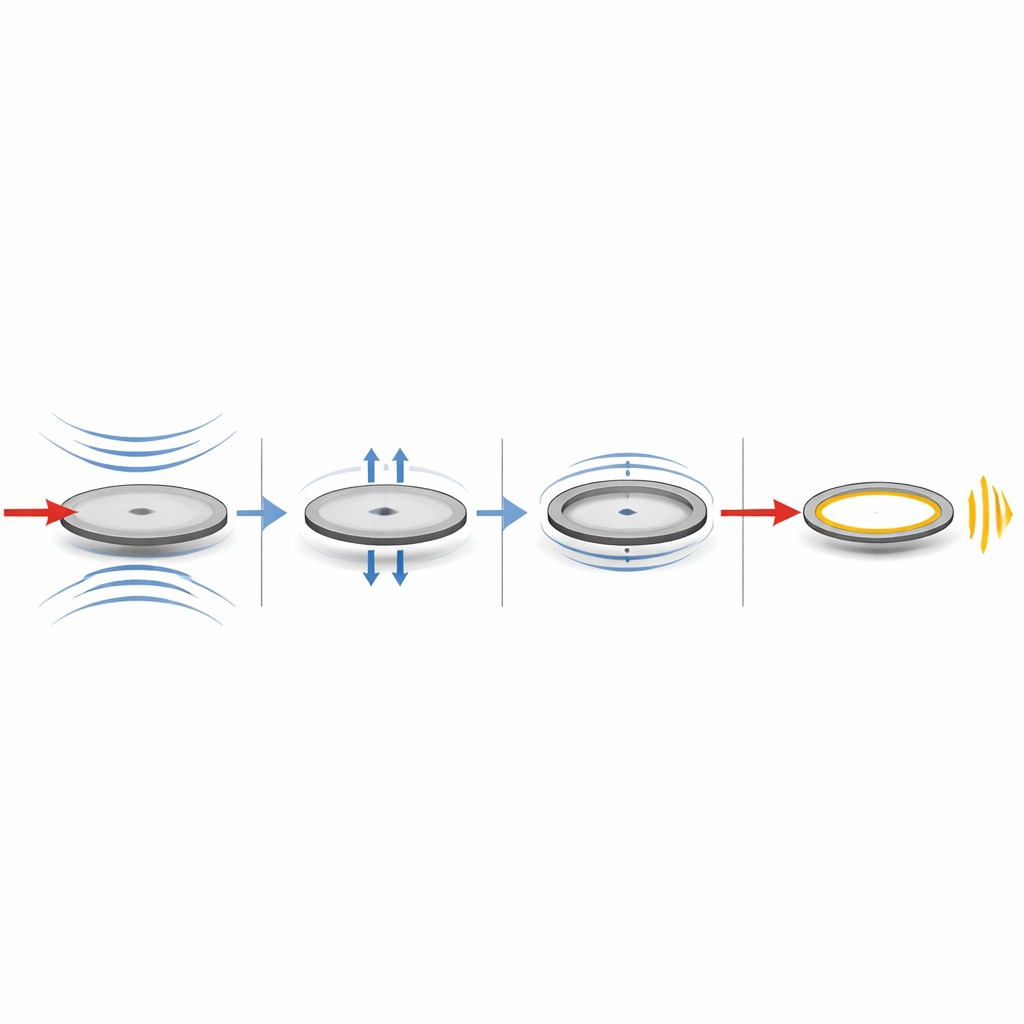
The heart of the device is a thin glass-like membrane that floats above a silicon chip, with a microscopic ring-shaped light guide embedded inside it. When ultrasound waves hit the membrane, they make it flex ever so slightly. That motion changes the size of the tiny ring, which in turn shifts how light circulates inside. By shining a steady laser into the ring and watching how the transmitted light intensity wiggles, the system converts invisible sound vibrations into an optical signal that can be measured with great precision.
Boosting Sensitivity with Gentle Vibrations
To push sensitivity to extremes, the researchers took advantage of resonance, the same effect that makes a playground swing move higher when pushed at just the right rhythm. The suspended membrane has natural vibration modes, and when ultrasound arrives at one of these special frequencies, the membrane’s motion is greatly amplified. At the same time, the light inside the ring circulates many times, making the optical response to tiny changes very sharp. Together, these mechanical and optical resonances dramatically enhance how strongly the device reacts to weak sound waves, both in air and in water.
Record-Breaking Performance in Air and Water
Careful design and wafer-scale fabrication allowed the team to fine-tune the membrane size, ring radius, and layer thicknesses so that the device is both mechanically flexible and optically clean. The resulting sensors, made using standard chip-making tools, achieve record low noise-equivalent pressure levels: about 218 nano-Pascals per square-root Hertz in air and 9.6 nano-Pascals per square-root Hertz in water. Put simply, they can detect minuscule pressure ripples far below what earlier integrated optical sensors could see, while remaining compact, robust, and suitable for mass production.
From Trace Gases to Hidden Shapes Underwater
To show what this sensitivity enables, the authors used the sensor in two very different tasks. First, they placed it in a gas cell and used a modulated laser to heat and cool acetylene molecules, causing them to generate tiny sound waves through the photoacoustic effect. The sensor picked up these weak signals well enough to detect acetylene concentrations down to a few parts per million and to reproduce the gas’s absorption spectrum with high accuracy. Next, they immersed the device in water and used it to image an air-filled groove hidden in an acrylic block. Even when the driving ultrasound pressure was thousands of times weaker than that used for a commercial hydrophone, the new sensor produced clearer contrast and millimeter-scale resolution, revealing the shape of the buried feature.
What This Means for Future Technologies
By combining extreme sensitivity with chip-level integration, this work points toward ultrasound detectors that can be tiled into dense arrays and married with on-chip lasers, detectors, and electronics. Such systems could one day be built into wearable medical patches, compact underwater communication links, or handheld inspection tools that see fine details without needing strong sound pulses. In essence, the study shows that using light to listen allows us to hear much fainter whispers in air and water than ever before, potentially transforming how we sense and image the hidden structures around us.
Citation: Cao, X., Yang, H., Wang, M. et al. Integrated optomechanical ultrasonic sensors with nano-Pascal-level sensitivity. Light Sci Appl 15, 171 (2026). https://doi.org/10.1038/s41377-026-02238-0
Keywords: ultrasound sensing, optomechanics, microring resonator, photoacoustic spectroscopy, underwater imaging