Clear Sky Science · en
Continuous polarization–wavelength mapping with nonlocal metasurfaces
Light that Carries More Information
Modern technologies like secure communication, advanced imaging, and on-chip artificial intelligence all depend on how cleverly we can encode information into light. Two of light’s most useful “dials” are its color (wavelength) and its polarization (the direction in which its electric field wiggles). This paper shows how a specially engineered flat optical surface can link these two dials in a smooth, programmable way, opening paths to ultracompact devices that pack far more information into a single beam of light.
Why Color and Polarization Matter
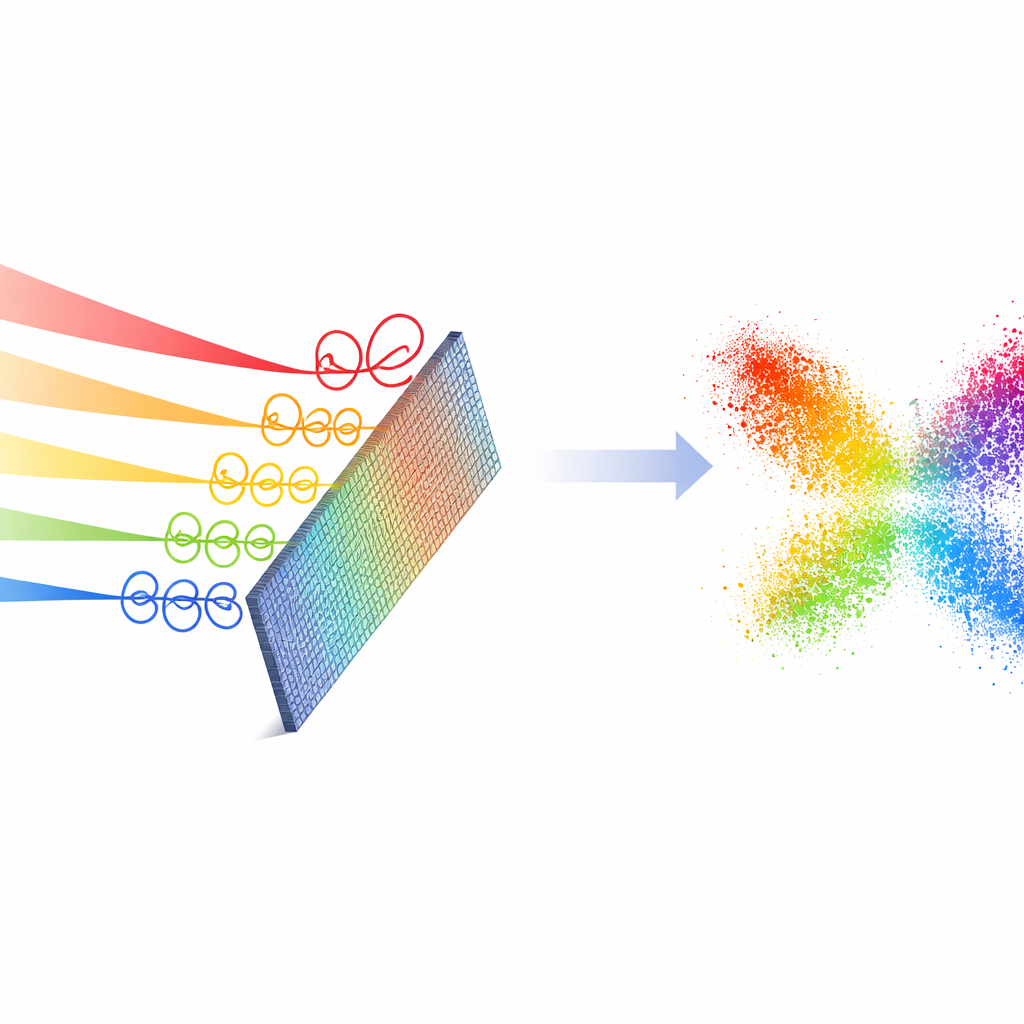
Color and polarization are attractive carriers of information because they are both continuous: in principle, there are infinitely many colors and polarization states to choose from. Used together, they form a huge space for encoding data, useful for tasks from quantum key distribution to imaging that processes information directly on a chip. Yet most current optical devices treat these properties separately, or only allow a few fixed combinations. They often rely on stacked layers, segmented zones, or arrays of different elements, which add bulk, losses, and interference between channels. As a result, light is usually restricted to hopping between a handful of predefined color–polarization combinations instead of moving smoothly through the full space.
A Flat Surface that Thinks Nonlocally
The authors introduce a new kind of “nonlocal” metasurface—a carefully patterned silicon film only a few micrometers thick—that breaks this restriction. Traditional metasurfaces are designed locally: each tiny building block responds mainly to the light that hits it directly. Here, the team instead models how light spreads and diffracts across the entire surface, and how this collective behavior can be tuned so that different colors follow continuously changing paths on a sphere that represents all possible polarizations. Using an equivalent mathematical description, they separate how the structure affects polarization from how it affects color, which lets them prescribe an almost arbitrary, smooth mapping between input color–polarization states and output ones.
Letting a Neural Network Design the Pattern
Designing such a metasurface by hand would be impossibly complex, because each tiny pillar can influence many colors and polarizations at once. To solve this, the authors compress the problem using an analytical model of how each “meta-atom” delays and reshapes polarized light across wavelengths. They then feed this compact description into a specially built neural network that treats the metasurface as a vectorial diffraction system rather than a simple pixel array. This approach shrinks the design space by orders of magnitude, allowing efficient optimization of the pillar shapes and orientations so that the final device reproduces a prescribed continuous relationship between wavelength and polarization.
Turning Theory into Working Devices
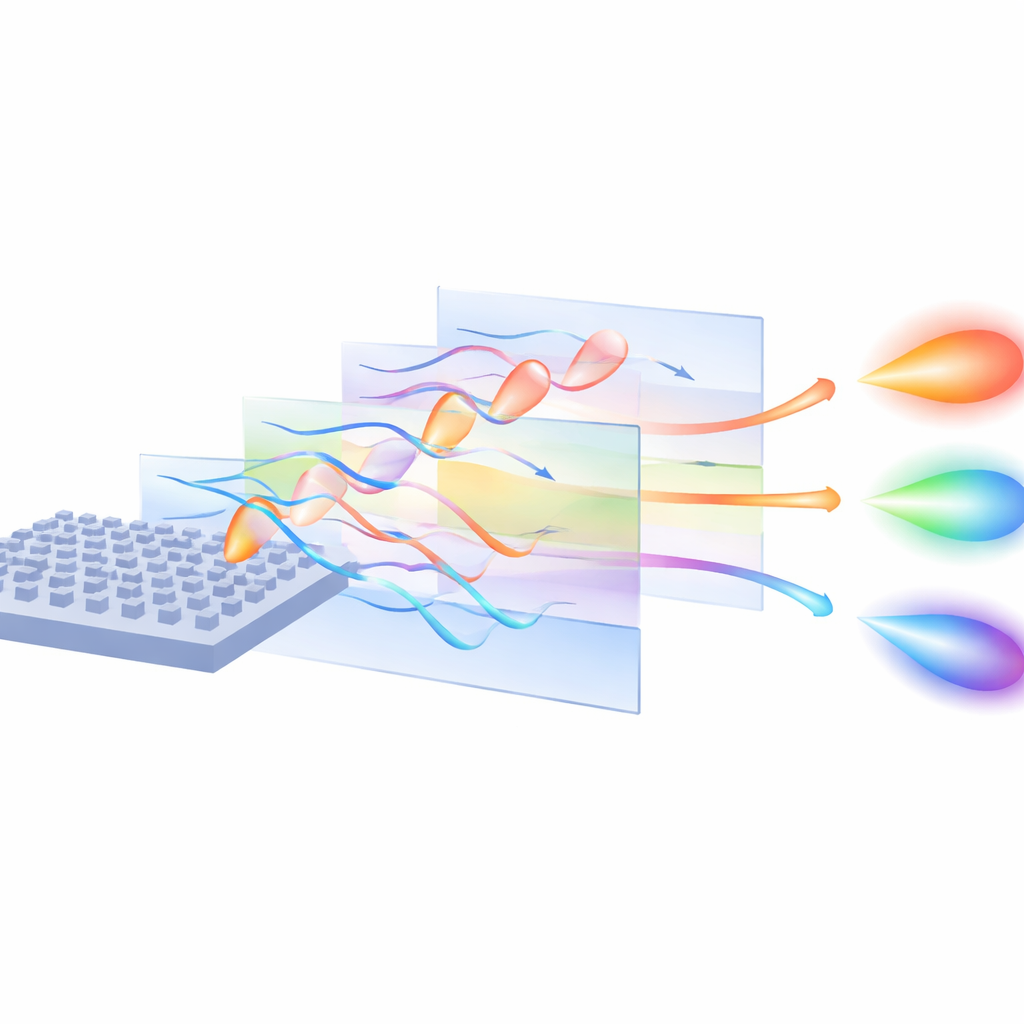
Using deep-etched silicon nanopillars that are compatible with standard nanofabrication, the researchers build mid-infrared metasurfaces about 600 micrometers across, containing over 160,000 elements. Experiments show that a single flat device can produce sharp holographic images at multiple colors while keeping the focus position almost unchanged—a property known as broadband achromatic behavior. At the same time, each color is assigned a distinct, carefully chosen polarization state, and the device can realize both simple, nearly linear polarization paths and fully arbitrary ones scattered over the polarization sphere. Measurements of image fidelity, channel efficiency, and polarization contrast indicate minimal crosstalk and strong agreement with design predictions, even when the channels are closely spaced in wavelength.
New Ways to Pack Information into Light
For non-specialists, the key message is that this work moves beyond devices that switch between a few fixed light states, toward surfaces that can paint a smooth, programmable landscape linking color and polarization. By showing that such continuous mappings can be designed, fabricated, and verified in practice, the authors lay a foundation for compact components that encode data in many intertwined channels of light. This could benefit secure communications, where each color–polarization combination carries separate keys; imaging systems that adjust to different wavelengths without refocusing; and optical processors that exploit high-dimensional light fields for computation, all on a single, ultra-thin chip.
Citation: Wang, J., Wang, J., Yu, F. et al. Continuous polarization–wavelength mapping with nonlocal metasurfaces. Light Sci Appl 15, 170 (2026). https://doi.org/10.1038/s41377-026-02233-5
Keywords: metasurface holography, polarization control, wavelength multiplexing, nonlocal photonics, optical information encoding