Clear Sky Science · en
High-performance thermally-evaporated light-emitting diodes via one-step vapor purification
Why Cleaner Light Matters
From smartphone screens to massive TVs, today’s displays rely on ultra-thin light-emitting layers built inside high-vacuum machines. Yet even in these high-tech chambers, stray molecules of water and oxygen can quietly sabotage performance and lifetime. This paper introduces a simple twist to the manufacturing process that scrubs the air inside these chambers just before devices are made, leading to brighter, more efficient, and far longer‑lasting light-emitting diodes based on both perovskites and organic materials.
The Hidden Problem in High-Tech Vacuums
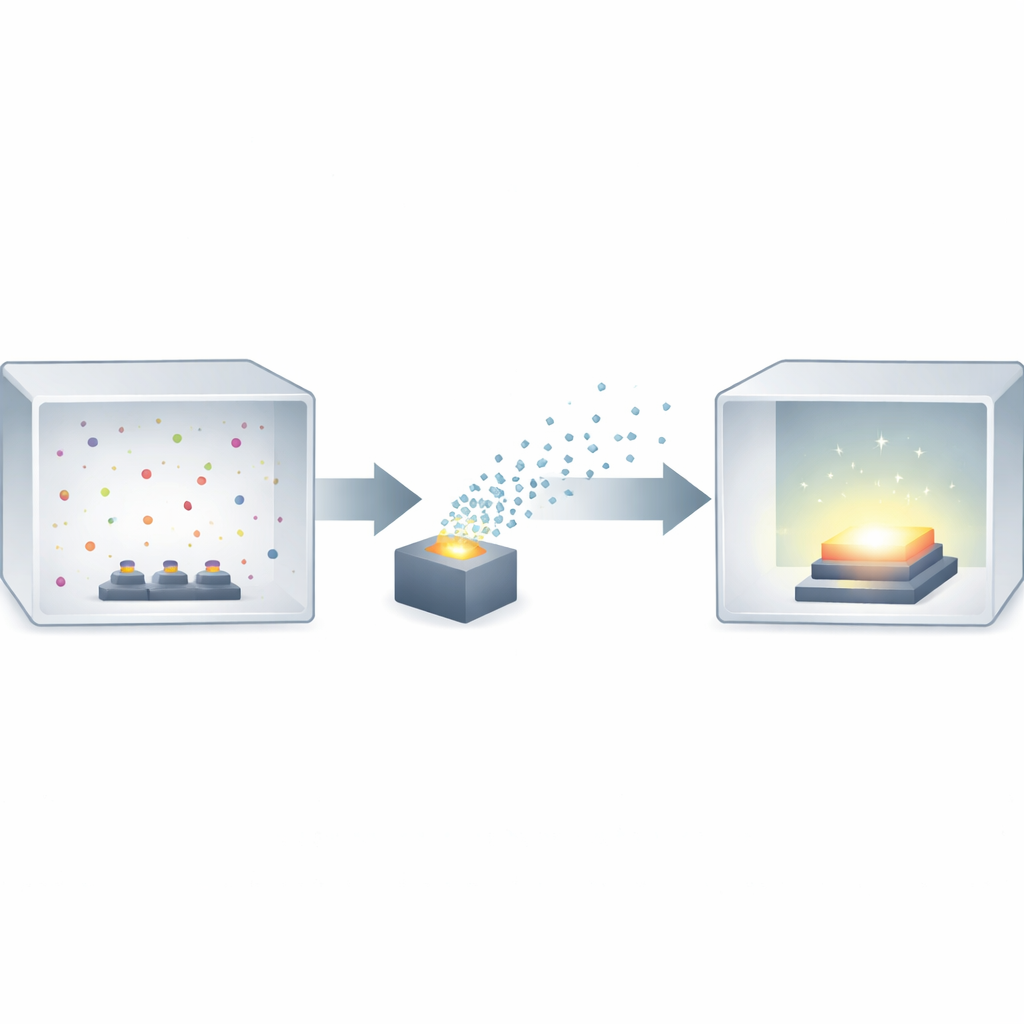
Modern factories already use powerful pumps to empty their coating chambers, but the authors show that at typical operating pressures, tiny but significant amounts of harmful gases like water vapor, oxygen, and halogens remain. For perovskite materials, which are chemically active during film growth, these lingering molecules can react with the ingredients as they condense into a solid, creating defects that sap brightness and speed up decay. Traditional vacuum pumping alone struggles to remove these stubborn gases efficiently, especially without making equipment more complex and slow.
A Simple One-Step Cleaning Trick
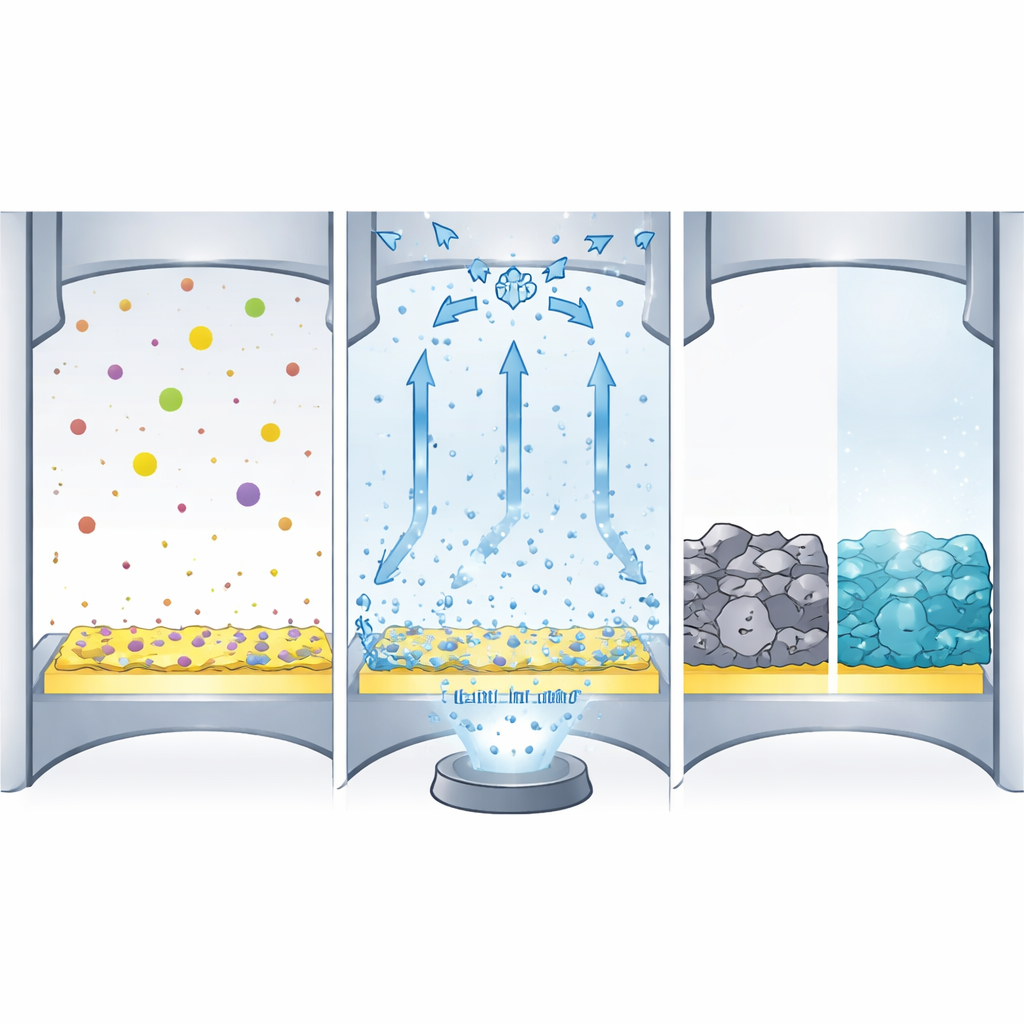
To tackle this, the team proposes a surprisingly straightforward method: before making any devices, they briefly evaporate a thin layer of a reactive metal—aluminum—inside the chamber. In the gas phase, aluminum atoms eagerly bind with the leftover impurity molecules, turning them into harmless solids that coat the chamber walls, plus a few non-harmful gases. Using an in-situ residual gas analyzer, they watch in real time as the levels of detrimental gases drop by orders of magnitude, until these impurities make up less than one percent of the total pressure. This creates a cleaner, more stable atmosphere without extra hardware or long pumping cycles.
Brighter and Longer-Lasting Perovskite LEDs
With this purified environment, the researchers grow perovskite light-emitting layers by thermal evaporation and compare them with films made in untreated chambers. The cleaned-atmosphere films shine more strongly, show longer excited-state lifetimes, and contain fewer electronic traps—signs of fewer internal defects. When built into green perovskite LEDs, these improved films push the external quantum efficiency beyond 20%, a record for thermally evaporated devices, while also delivering vivid, pure color close to the demanding Rec. 2020 display standard. Just as importantly, device lifetime improves dramatically: at a set brightness, operating lifetimes grow by more than a factor of five, and integrated active-matrix display panels show both high brightness uniformity and much slower decay during use and storage.
Extending the Idea to Organic LEDs
Although organic LEDs (OLEDs) are usually considered less sensitive to the chamber atmosphere during fabrication, the authors test whether the same cleaning step can help them too. They build blue OLEDs in both untreated and purified environments using commercial materials and structures. While the basic efficiency numbers remain similar, the devices made after vapor purification emit more spectrally pure light, indicating less unwanted quenching. The most striking effect appears in lifetime measurements: at a fixed driving current, blue OLEDs from the cleaned chamber last more than one hundred times longer before significant dimming. Active-matrix OLED panels also benefit, showing almost no brightness loss over an hour, in contrast to noticeable decay without purification.
What This Means for Future Screens
Overall, the study shows that a brief pre-evaporation of aluminum can transform the working atmosphere of standard vacuum chambers, sharply cutting residual reactive gases with no need for complex new equipment. For perovskite LEDs, this yields record-setting efficiency alongside large gains in operational and storage stability, and for OLEDs it markedly extends the useful lifetime, especially for fragile blue pixels. To a non-specialist, the message is clear: by cleaning not just the materials but the very air around them during fabrication, manufacturers can build brighter, more reliable next-generation displays and light sources using a simple, industry-ready step.
Citation: Zhang, X., Wu, Y., Ou, J. et al. High-performance thermally-evaporated light-emitting diodes via one-step vapor purification. Light Sci Appl 15, 210 (2026). https://doi.org/10.1038/s41377-026-02226-4
Keywords: perovskite LEDs, vapor purification, OLED stability, vacuum deposition, display technology