Clear Sky Science · en
Red OLED with efficiency of 25.6% at 10,000 cd m−2 based on selenium embedding multiple resonance framework
Brighter, Redder Screens Without Precious Metals
Modern phones, TVs, and VR headsets all rely on tiny light sources called OLEDs to create vivid images. Making a deep, pure red that stays bright and efficient at high screen brightness has been a stubborn problem, especially without using expensive precious metals like iridium. This paper describes a new way to design red-emitting materials that stay efficient even at very high brightness, pointing the way toward sharper, more energy‑saving displays that are also cheaper to manufacture.
Why Red Light Is So Hard To Get Right
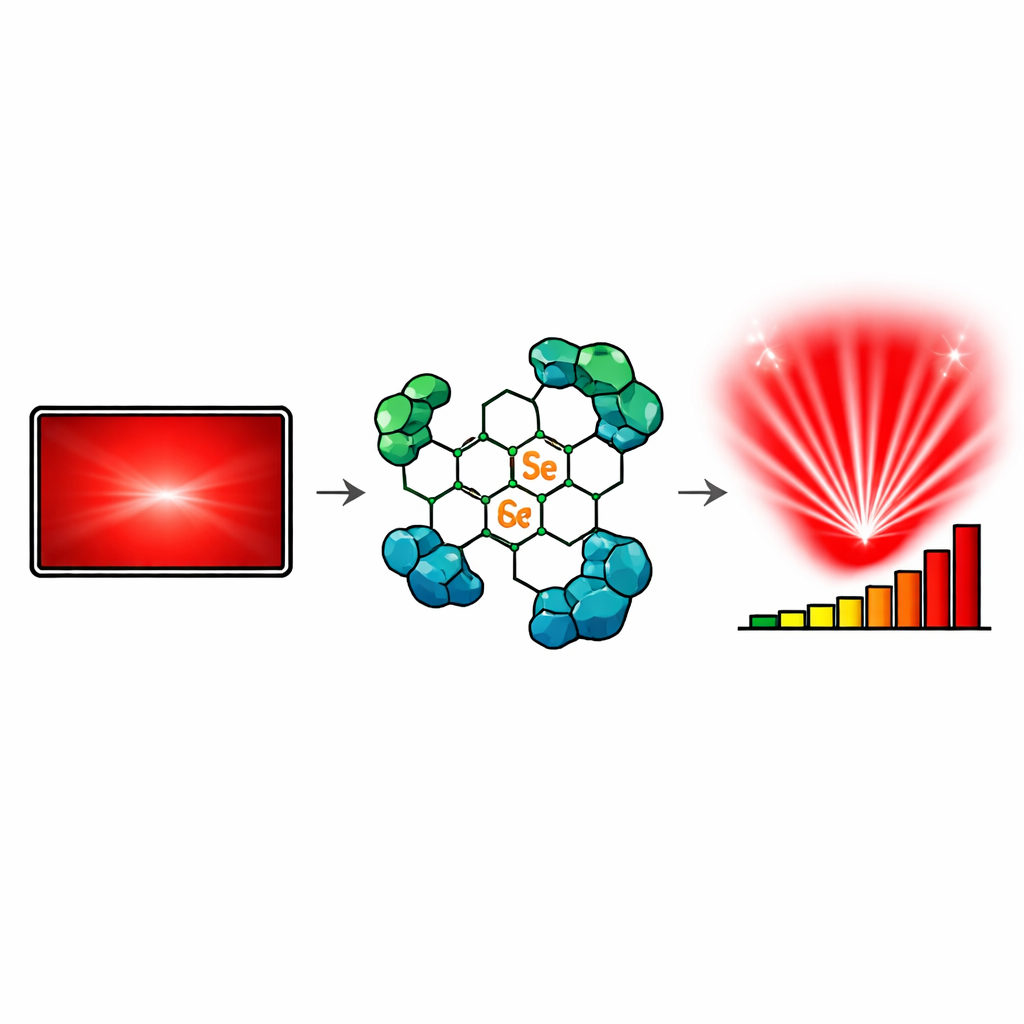
OLEDs work by converting electrical energy into light inside ultra-thin organic layers. To meet the demands of ultra‑high‑definition displays, engineers want light that has both very pure color and very high efficiency. A promising class of materials known as multiple‑resonance TADF emitters can do this for blue and green light, but red versions have lagged behind. At high brightness, these red emitters waste many of their excited states as heat instead of light, a problem known as efficiency roll‑off. The root cause is that they are too slow at recycling a particular kind of excited state, so these states pile up and collide, shutting each other off instead of glowing.
Adding A Single Atom To Change The Game
The researchers tackled this bottleneck by subtly rebuilding the light‑emitting molecule around a single heavier atom, selenium. They started from a known molecular framework that already gives narrow, clean emission, then inserted sulfur or selenium into a key position and locked the structure with bulky side groups to prevent clumping. Computer calculations and X‑ray studies show that swapping in selenium slightly distorts the molecule and strengthens interactions between electronic states that control how quickly dark triplet states can be converted back into bright singlet states. This combination shrinks the energy gap that must be bridged and boosts the internal coupling that enables the conversion, both of which are crucial for speeding up the recycling process.
Turning Faster Recycling Into Better Devices
Measurements in solution and in thin films confirm that the selenium‑based molecule, called tFSeBN, emits a narrow red light around 607 nanometers with almost no loss: about 98 percent of the absorbed energy is turned into light. Time‑resolved experiments show that its delayed light emission is both strong and unusually fast, indicating that triplet states are being harvested efficiently. When placed into a full OLED device, tFSeBN delivers an external quantum efficiency of roughly 35 percent at moderate brightness and still keeps more than a quarter of that efficiency at a very high luminance of 10,000 candelas per square meter. Compared with similar molecules without selenium, its performance at high brightness is dramatically better, confirming that rapid recycling of excitations sharply cuts the usual efficiency roll‑off.
Using The New Molecule As An Energy Middleman
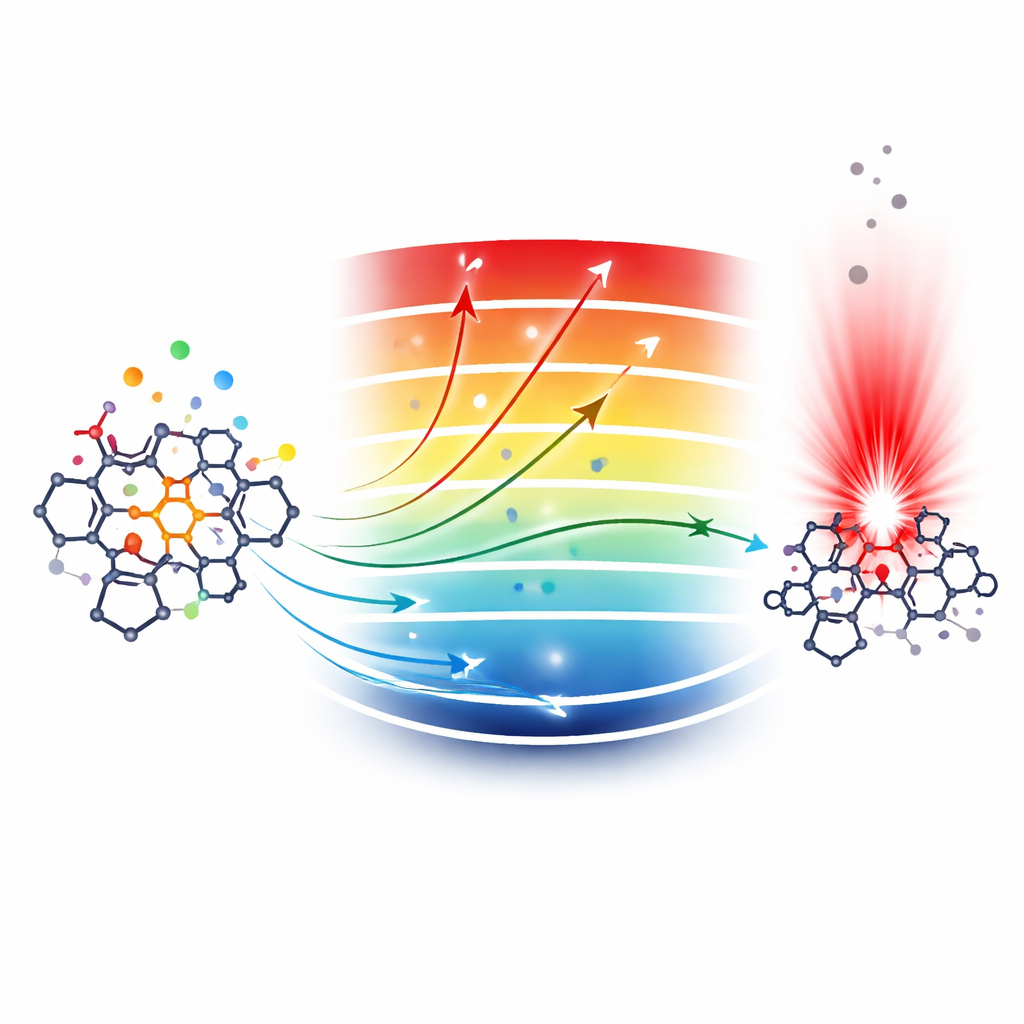
Because tFSeBN is so good at capturing and re‑emitting energy, the team also explored it as a “sensitizer” that hands off its energy to another ultra‑pure red emitter. In this setup, tFSeBN first collects electrical excitations and then passes them, via long‑range energy transfer, to a red molecule called RBNO2 that emits even deeper red light matching industry color targets. Careful molecular design ensures strong long‑range transfer while blocking short‑range pathways that would cause energy loss. Devices built this way achieve pure red emission close to the demanding BT.2020 color standard, while tripling or more the efficiency compared with using RBNO2 alone and maintaining good performance at practical screen brightness levels.
What This Means For Future Displays
To a non‑specialist, the key message is that the authors have shown how changing just one atom inside a light‑emitting molecule can solve a major hurdle for high‑performance red OLEDs. By embedding selenium into a carefully tuned framework, they create a material that glows bright red with very little waste, even when driven hard, and that can also boost the performance of other red emitters. This single‑atom engineering strategy offers a path to efficient, noble‑metal‑free red pixels, helping future displays become more colorful, more energy‑efficient, and potentially less expensive to produce.
Citation: Pu, Y., Cai, X., Li, C. et al. Red OLED with efficiency of 25.6% at 10,000 cd m−2 based on selenium embedding multiple resonance framework. Light Sci Appl 15, 191 (2026). https://doi.org/10.1038/s41377-026-02220-w
Keywords: red OLEDs, TADF materials, multiple resonance emitters, selenium doping, hyperfluorescent displays