Clear Sky Science · en
Photoinduced radical emission from flexible organic crystals
Crystals that bend and glow with light
Imagine a hair thin crystal that you can bend like a spring while it brightly guides light along its length. This study shows how chemists coaxed normally fragile organic crystals to both flex and shine when exposed to ultraviolet light, opening paths toward wearable sensors, soft robots and tiny light based circuits. 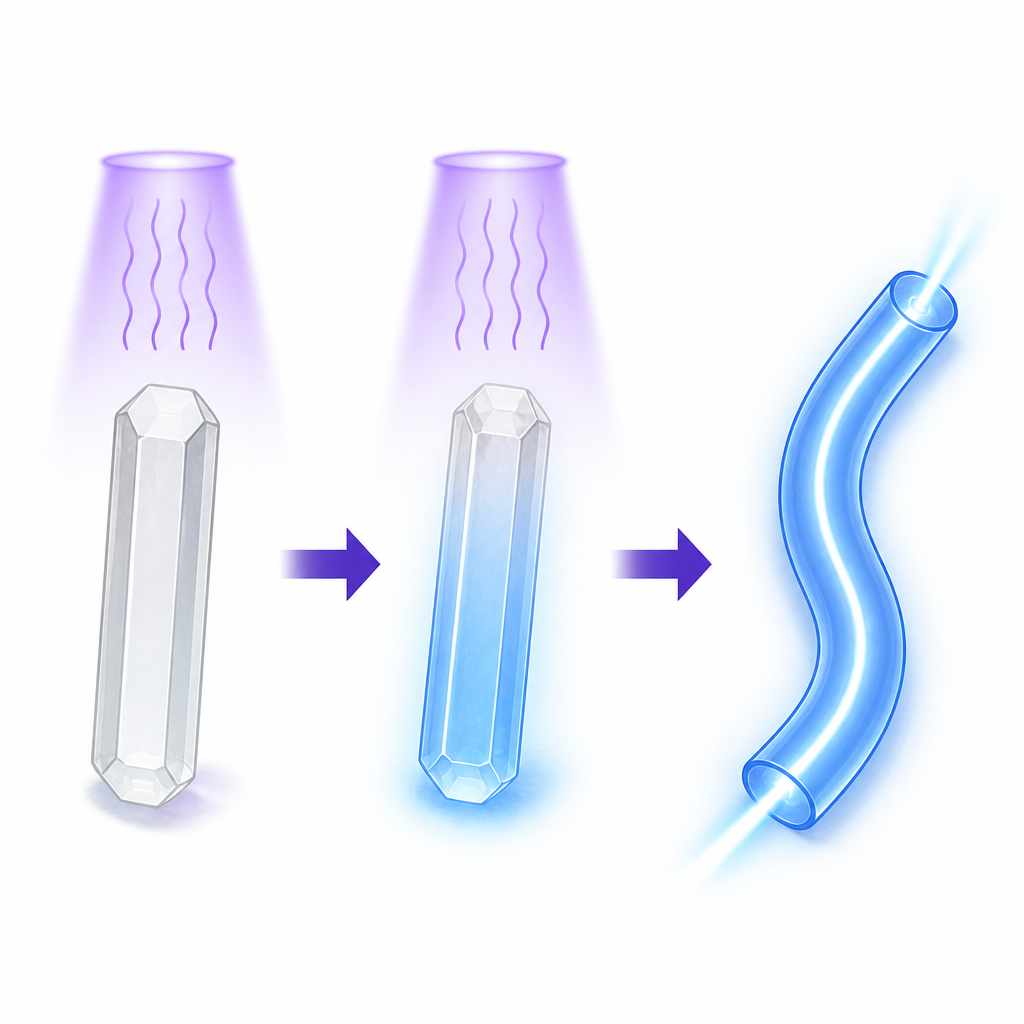
Why flexible glowing crystals matter
Flexible electronics and optics promise bendable displays, skin like health monitors and soft machines that interact gently with people. Organic single crystals are attractive building blocks because they can conduct light and electricity very efficiently. Yet most such crystals snap like glass, and adding glowing radical species to them has been especially difficult, because radicals are usually unstable in air and stop emitting light when packed together.
A light triggered recipe for glow
The researchers designed a small molecule called NPBr that forms long, needle shaped crystals. At first, these colorless crystals barely glow under ultraviolet light. When the team shines UV light on them in air for a few minutes, however, the crystals slowly turn yellow and begin to emit intense blue light, with the brightness increasing by about sixty times. Careful measurements showed a strong new emission near the blue part of the spectrum along with a high efficiency for turning absorbed light into emitted light, similar to or better than many other known radical based emitters.
Hidden radicals locked in place
To find out what changed inside the crystals, the scientists combined nuclear magnetic resonance, chromatography, electron spin measurements and computer calculations. They discovered that UV light gently breaks a small fraction of the NPBr molecules, creating oxygen centered radicals inside the crystal. These radicals are the true light sources, responsible for the bright blue glow. Because they are formed in tiny amounts and held in rigid pockets of the surrounding crystal, they cannot easily move or recombine, so they remain stable and emissive for at least a month at room temperature. This behavior is like a self doping process, where the crystal quietly seeds itself with glowing sites without losing its overall structure.
How the crystal bends without breaking
Equally striking is that these radical filled crystals stay highly flexible. Long NPBr needles can be bent well beyond a half circle and snap back to their straight shape when the force is removed, over and over again. X ray studies reveal why: the molecules stack in orderly one dimensional chains, held together by gentle attractions between flat aromatic units, hydrogen atoms and bromine and oxygen atoms. During bending, distances between these stacks adjust slightly, allowing the outer side of the crystal to stretch and the inner side to compress while the layers remain locked together. This intricate network of weak links distributes stress and prevents cracks.
Light pipes that work even when curved
Because the crystals shine strongly, the team also tested them as miniature light guides. When only one spot along a straight crystal is excited by a UV laser, light travels along the interior and leaks out more brightly at the tip, showing that the crystal works like a tiny optical fiber. The researchers quantified how much light is lost per millimeter and found very low loss for the straight crystal and only a modest increase when the same crystal is held in a strongly bent shape. This means the material can route light around curves with little fading, a key feature for flexible photonic circuits. 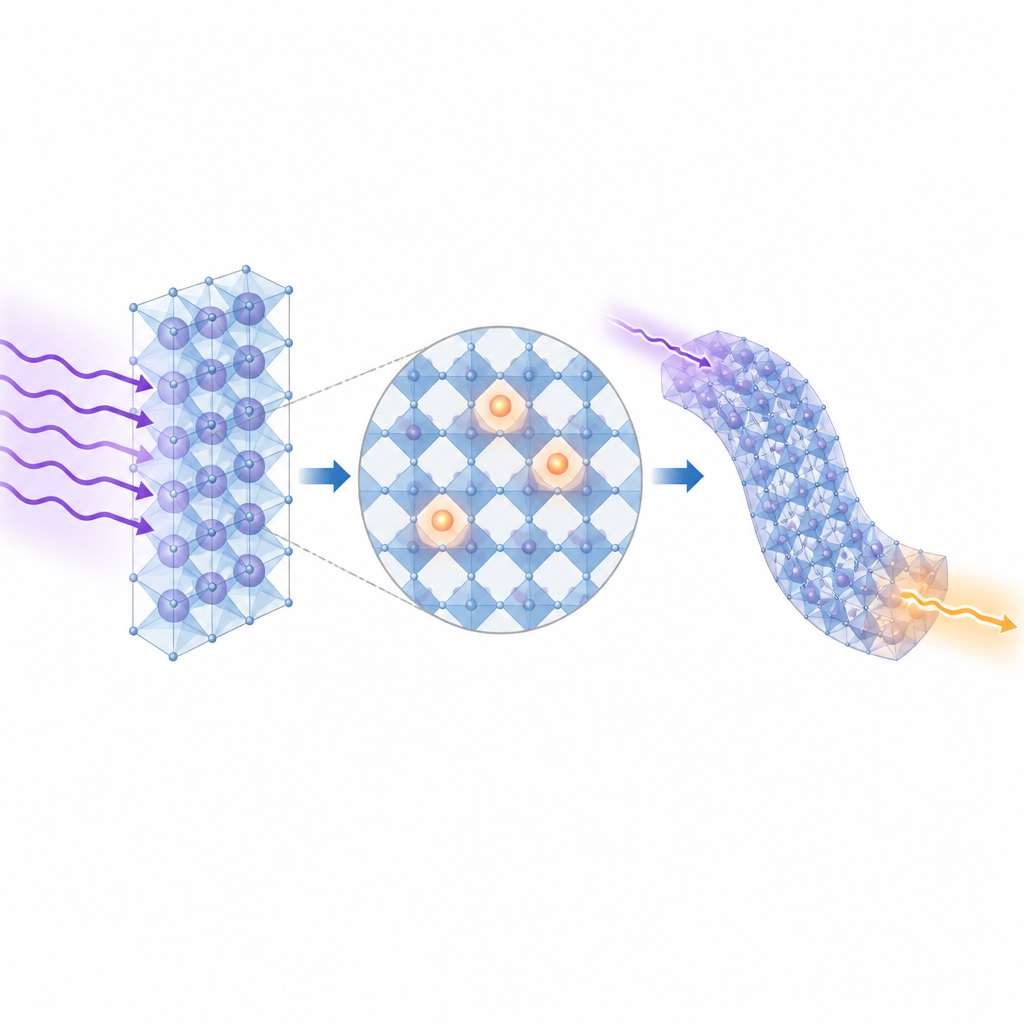
What this work means going forward
By using light to create and trap a few glowing radicals inside a flexible host crystal, this study links mechanical softness with stable radical emission in a simple, one step process. For non specialists, the message is that we can now make tiny, bendable crystals that both light up and steer light, using nothing more exotic than ultraviolet irradiation and clever molecular design. Such materials could become the building blocks for future soft, light based devices that conform to skin, clothing or delicate instruments.
Citation: Zhang, X., Pan, W., Tang, Y. et al. Photoinduced radical emission from flexible organic crystals. Light Sci Appl 15, 240 (2026). https://doi.org/10.1038/s41377-026-02208-6
Keywords: flexible organic crystals, radical luminescence, optical waveguides, photoinduced emission, organic optoelectronics