Clear Sky Science · en
Thouless quantum walks in topological flat bands
Why this quantum walk matters
Random walks are everywhere, from how gas molecules wander in a room to how data packets move across the internet. In the quantum world, similar walks become far richer: a traveler can be in many places at once, and interference can steer where it ends up. This paper shows how to build a particularly controllable kind of quantum walk, using subtle geometric effects in specially designed light-guiding structures, with potential impact on quantum computing and precision control of quantum motion.
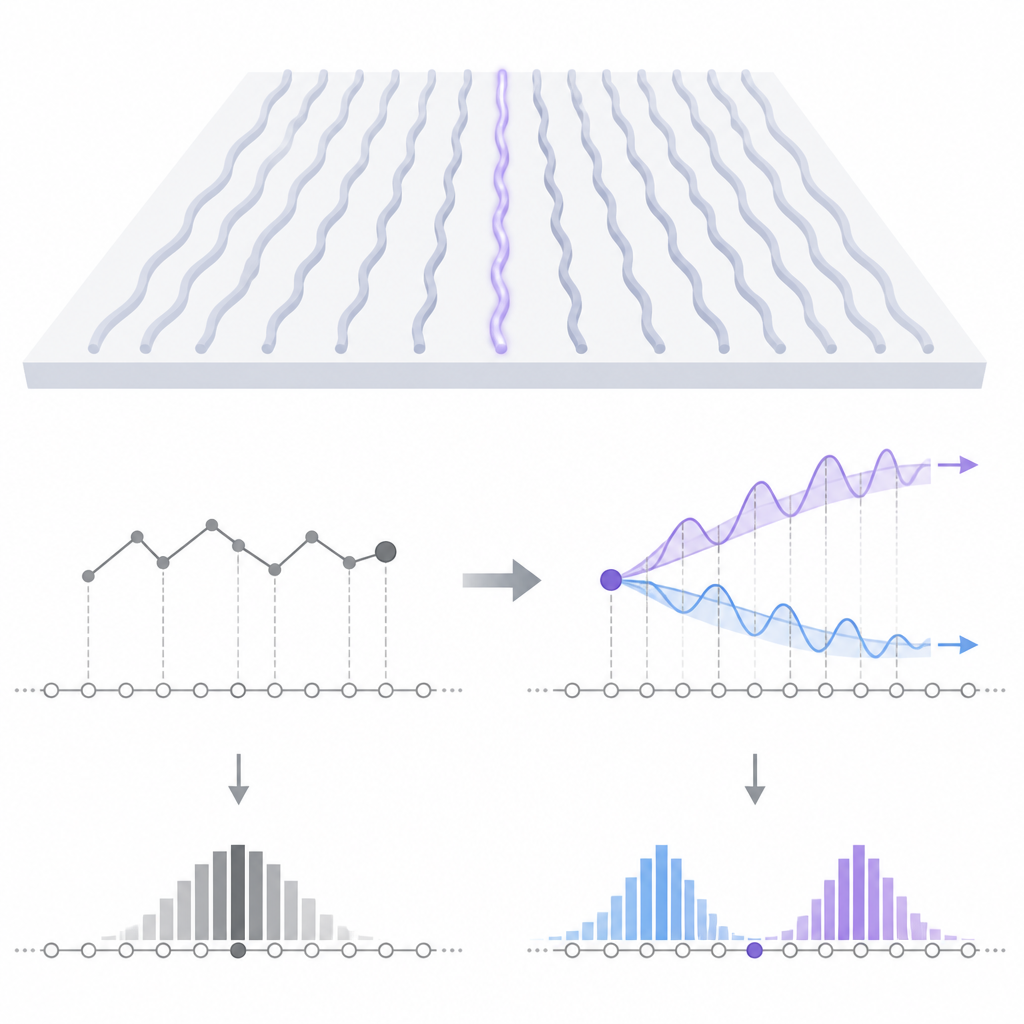
From coin flips to quantum steps
In a standard quantum walk, a particle moves on a line or network while carrying an internal “coin,” such as spin or polarization. Each step consists of flipping this coin and then moving left or right depending on the outcome. Because the rules are quantum, the walker spreads faster than in an ordinary random walk, and its final position reflects interference between many possible paths. Such walks are not just curiosities: with the right design, they can reproduce any quantum circuit and therefore serve as a universal model for quantum computation.
Using quiet bands to hold a quantum coin
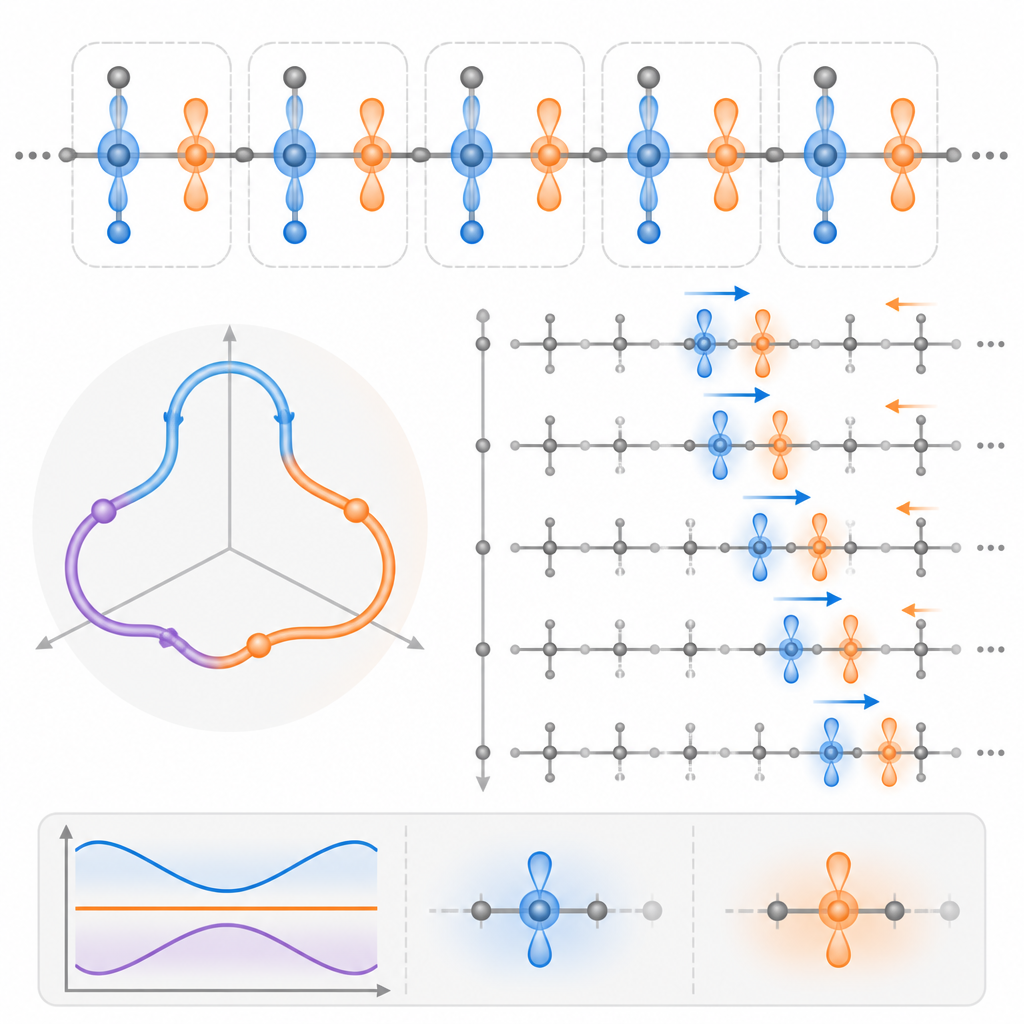
The authors base their new walks on “flat bands,” energy levels in a lattice where a particle’s energy does not depend on its momentum. In such bands, destructive interference pins quantum states to small regions of space called compactly localized states. By engineering a one-dimensional version of a Lieb lattice with two flat bands, the team obtains two such localized modes in each repeating cell. These two modes act as the two sides of a quantum coin, while the row of cells provides the positions the walker can occupy.
Geometric cycles that move and mix
To advance the walk in time, the authors slowly and periodically change the couplings between sites along the lattice. This controlled “pumping” traces a closed loop in a space of device parameters and exploits a non-Abelian gauge structure, a geometric feature that appears when several quantum states are exactly degenerate. One family of pumping cycles produces a clean, quantized shift of the walker from one cell to the next, with the direction set by the orientation of the loop. Another family mixes the two coin states without net motion, acting as a tunable coin flip. By combining these two kinds of cycles, they define Thouless holonomic quantum walks, in which each time step is a precisely engineered geometric operation.
Chiral motion and hidden symmetries
A key outcome is that these walks naturally break mirror symmetry: the evolution can favor motion to the left or to the right depending on how the cycles are drawn. In a continuous description, the resulting dynamics resemble those of a Weyl particle, a relativistic object that comes in right- and left-handed versions. The authors show how adjusting the geometric coin angle controls how quickly the walk spreads, and how composing different steps can either preserve or restore parity, or create more complex patterns. Because the transport is tied to topological quantities, such as a Chern number associated with the displacement per cycle, parts of the motion are protected against small imperfections.
Light-based platforms and future uses
The proposed scheme can be realized in arrays of photonic waveguides, where light follows paths etched into glass or silicon. In this setting, the distance traveled by light plays the role of time, while the spacing and strength of couplings between waveguides can be modulated to implement the required pumping cycles. The authors analyze practical constraints such as fabrication errors, disorder, and photon loss, and argue that the topological nature of the shift steps offers robustness, while the mixing steps require finer control. Similar ideas could be adapted to cold atoms in optical lattices or superconducting circuits, and extended to more than two coin states or higher-dimensional networks.
What the study shows in simple terms
Put simply, this work describes a recipe for making a quantum walker whose steps are guided by the geometry of the device rather than by rapid external kicks. By harnessing flat bands and carefully choreographed parameter loops, the authors show how to move and mix a quantum particle in a way that is both flexible and, in part, protected by topology. This offers a new tool for building quantum walks that can encode symmetry, directionality, and entanglement by design, potentially aiding future quantum computers and simulators that rely on precise control of how quantum information flows.
Citation: Danieli, C., Conti, C., Pilozzi, L. et al. Thouless quantum walks in topological flat bands. Light Sci Appl 15, 244 (2026). https://doi.org/10.1038/s41377-025-02140-1
Keywords: quantum walks, topological photonics, flat bands, non-Abelian pumping, quantum transport