Clear Sky Science · en
Graphene-integrated microtube whispering-gallery mode resonators for polarization-sensitive optical modulation and photodetection
Light and Electronics Working Together
Modern technologies like data centers, 5G networks, and artificial intelligence all need to move vast amounts of information quickly and efficiently. Light is excellent for carrying data over long distances, while electronics are better at processing it. This paper explores a new kind of tiny device that lets light and electrical signals interact more tightly on a chip, promising faster, smaller, and more energy‑efficient communication hardware for future computers and networks.
Tiny Tubes That Trap Light
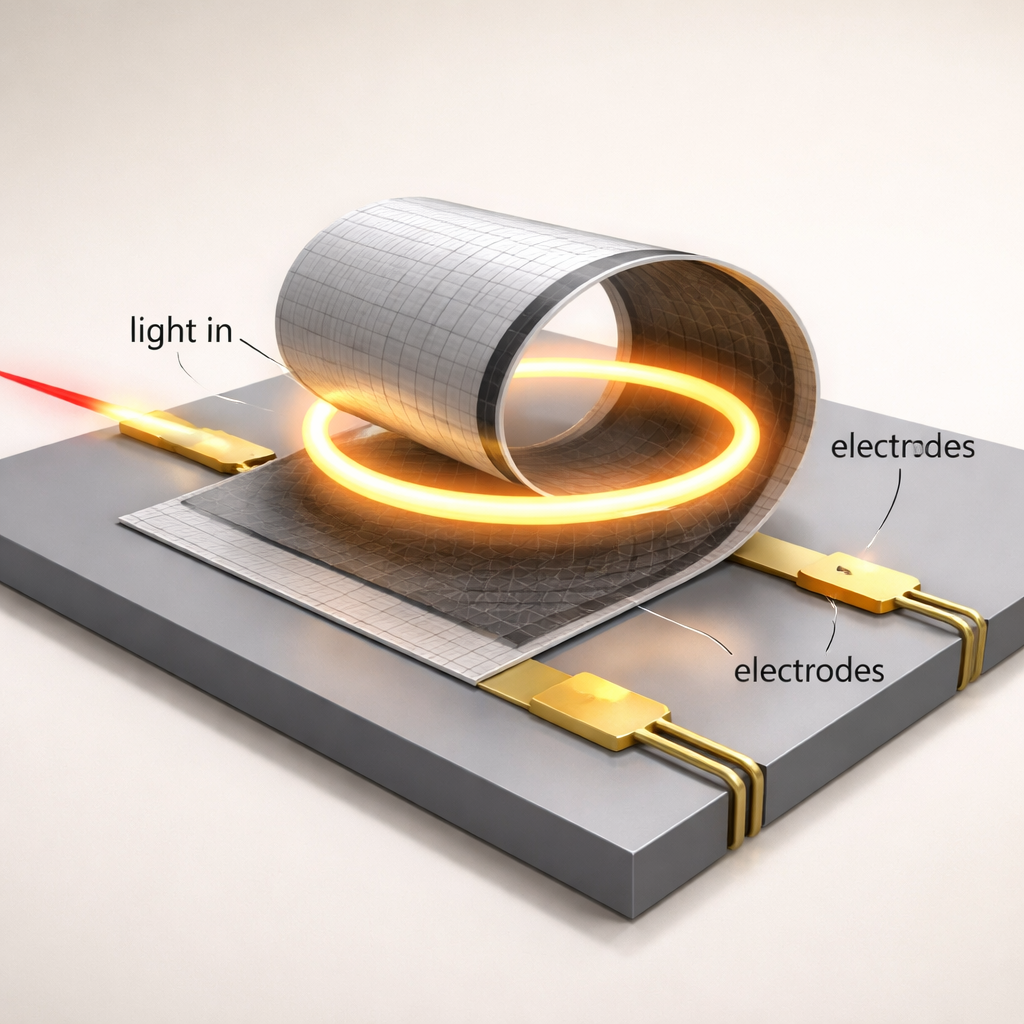
Instead of using flat rings or straight channels carved into a chip to guide light, the researchers build hollow microtubes from ultra‑thin films of silicon nitride, a material already widely used in photonics. These tubes act like miniature “whispering galleries” for light: once light enters, it circulates many times around the tube wall, greatly strengthening its interaction with the material. Uniquely, the tubes are not built by stacking and etching, but by a self‑rolling process. Carefully engineered internal strains cause flat nanomembranes to curl up by themselves into uniform tubes across an entire wafer, allowing thousands of identical devices to be made at once with a very small footprint.
Shaping the Tube to Hold Light Better
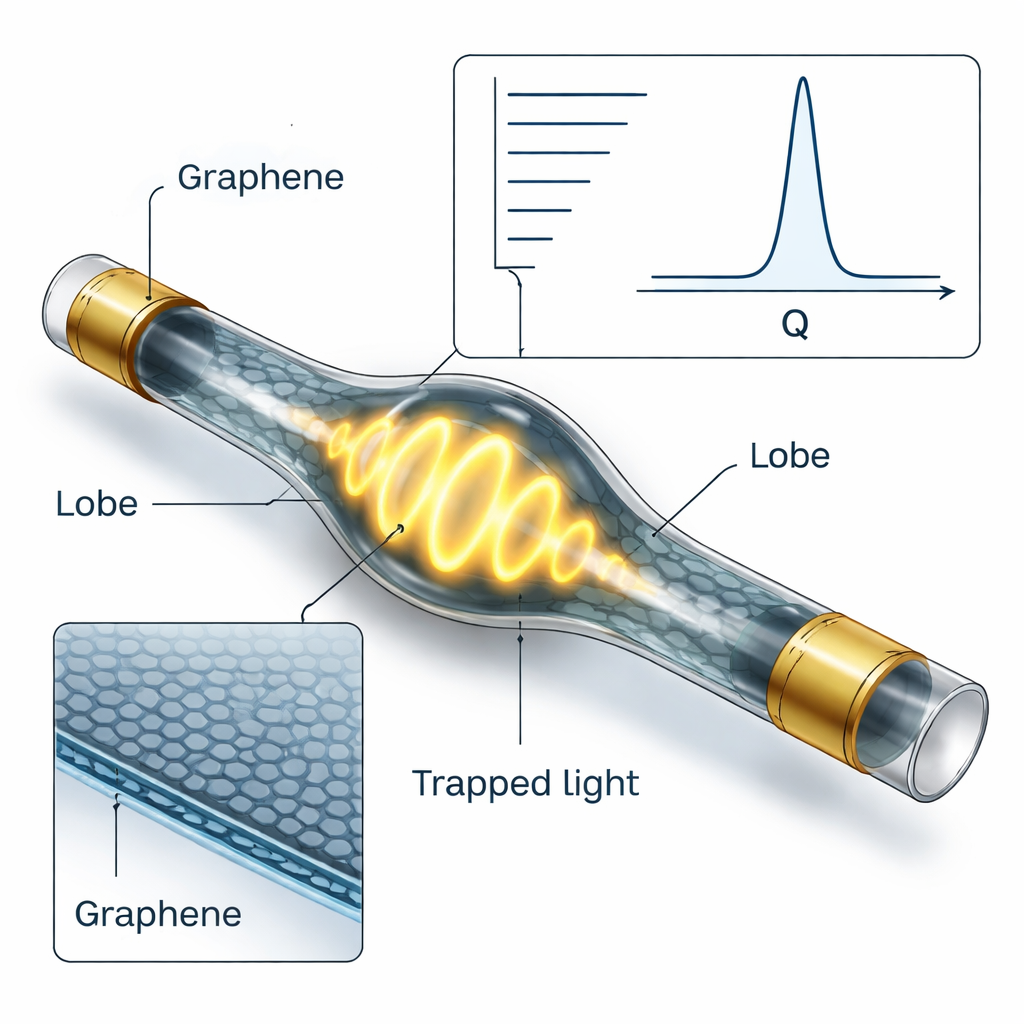
A key innovation is that the tubes are not perfectly uniform along their length. The team deliberately adds a gentle “lobe” or bulge into the tube shape. This subtle change varies how strongly light sees the material along the tube, acting like a curved potential landscape for the light waves. As a result, the light cannot freely leak along the tube’s axis and instead settles into a set of discrete standing patterns, much like the quantized energy levels of electrons in an atom. This design sharply reduces energy loss and boosts the resonator’s quality factor, a measure of how long light is stored. Experiments show that lobed tubes can reach quality factors above 3000, far higher than similar microtubes without this structure.
Graphene as a Sensitive Electrical Probe
To turn trapped light into an electrical signal, the researchers line the inside of the silicon nitride tube with an atom‑thin layer of graphene, then connect it to metal electrodes. Graphene absorbs only a small fraction of the circulating light, so it does not destroy the resonance, but it is extremely good at turning that absorbed light into mobile charge carriers. By adjusting how long the graphene section is along the tube, they can tune the trade‑off between maintaining sharp optical resonances and collecting a strong electrical signal. With an optimized length, the device achieves both a respectable quality factor around 2000 and high photoresponsivity of about 2.8 amperes per watt, meaning a small amount of light can generate a relatively large current.
Picking Out the Direction of Light
The rolled‑up geometry breaks the simple symmetry of a flat film, making the tube respond differently to light depending on its polarization—the direction in which its electric field oscillates. Light whose electric field runs along the tube axis couples strongly into the whispering‑gallery modes and interacts efficiently with graphene, producing strong optical peaks and large currents. Light polarized across the tube, in contrast, couples poorly and generates a much weaker signal. Measurements and simulations show polarization ratios of several times between these cases, and the effect can become even stronger when the incoming beam is tightly focused. This built‑in polarization sensitivity could allow the same device to detect not only how bright light is but also how it is oriented.
A Platform for Future Light‑Based Chips
Overall, the work demonstrates that self‑rolled microtube resonators made from standard chip materials, combined with graphene, can simultaneously trap light efficiently, convert it into electrical signals, and distinguish its polarization, all within a compact three‑dimensional structure. For non‑specialists, the takeaway is that this is a powerful new building block for optical circuits on a chip, potentially enabling faster data links, smarter sensors, and more compact photonic‑electronic systems that use less energy while handling ever‑growing information flows.
Citation: Cai, T., Zhang, Z., Wu, B. et al. Graphene-integrated microtube whispering-gallery mode resonators for polarization-sensitive optical modulation and photodetection. Light Sci Appl 15, 130 (2026). https://doi.org/10.1038/s41377-025-02097-1
Keywords: graphene photodetector, whispering gallery resonator, silicon nitride microtube, polarization sensitive optics, photonic electronic integration