Clear Sky Science · en
Analysis of 18 mercapturic acids in urine samples from the German Environmental Specimen Bank—tackling the data gap in the human biomonitoring of VOCs in Europe
Why everyday air pollution ends up in our bodies
Most of us think about air pollution as something “out there” in the streets or around factories, but a large part of it quietly passes through our lungs, food, and homes and ends up inside our bodies. This study followed chemical traces left in urine by a group of common air pollutants and smoke-related substances in young adults in Germany over more than two decades, revealing how our daily exposure has changed and why it still matters.
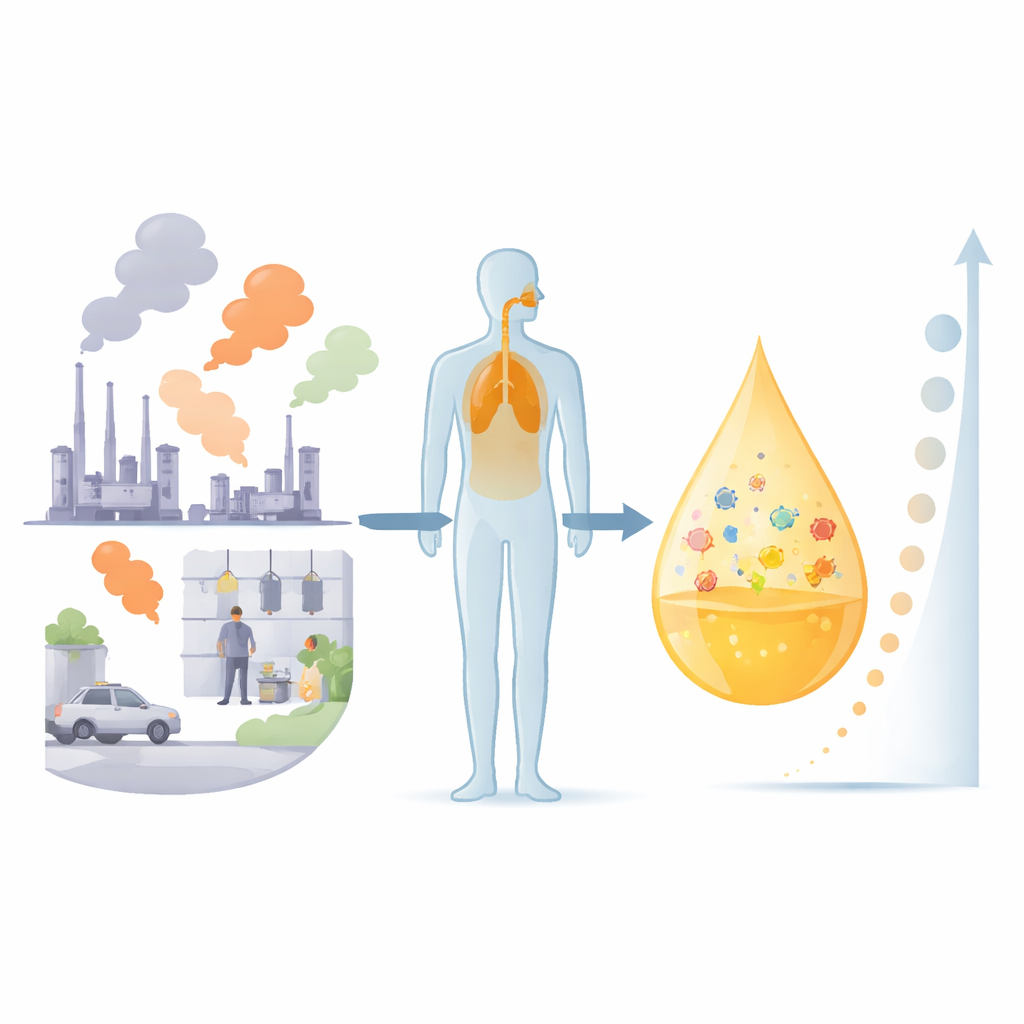
Following invisible pollutants through the body
The researchers focused on volatile organic compounds, a broad group of chemicals that easily evaporate into the air from traffic, industry, tobacco smoke, and even some foods. Many of these compounds, such as benzene or 1,3-butadiene, are known to damage DNA or cause other harmful effects. When they enter the body, the liver works to make them safer, converting them into small, water-soluble molecules called mercapturic acids that are flushed out in urine. By measuring these mercapturic acids, scientists can reconstruct how much of the original pollutants people have been exposed to without having to track each gas or vapor in the environment.
What the German specimen bank can tell us
Germany’s Environmental Specimen Bank stores deep-frozen urine samples from carefully selected volunteers together with detailed information such as sex, age, and daily urine volume. This long-term biobank allowed the team to go back in time, analyzing 360 full-day urine samples collected from 20 to 29 year old adults between 2000 and 2021. They looked for 18 different mercapturic acids linked to 14 parent pollutants, using sensitive mass spectrometry methods and strict quality controls to ensure that even tiny amounts were measured reliably.
Who is exposed and how that has changed
The results showed that 14 of the 18 mercapturic acids appeared in almost every sample, confirming that exposure to a mix of volatile pollutants is widespread even in people without special workplace risks. At the same time, the levels were far from constant. For eight of the markers, including those linked to acrylonitrile, benzene, and 1,3-butadiene, the average amounts dropped by roughly one fifth to one half between 2000 and 2021. Much of the decline happened between 2010 and 2015, and then flattened out, suggesting that cleaner air regulations and reduced secondhand smoke may have had a strong impact but further improvements are slower.
Differences between men, women, and smokers
The study also uncovered clear differences between groups. Men generally excreted higher amounts of most mercapturic acids than women, even when total urine volume was taken into account, pointing to contrasts in lifestyle, workplace environments, and how male and female bodies handle chemicals. Smokers had noticeably higher levels for several markers related to tobacco smoke, especially for a compound tied to acrylonitrile. Body weight, summarized as body mass index, also played a role: people with higher values tended to show higher levels of many of the markers, hinting at links between diet, metabolism, and exposure.

What these findings mean for public health
Because many of the parent chemicals behind these urine markers are suspected or known cancer-causing or reproduction-harming agents, even small exposures matter over a lifetime. The encouraging news is that overall levels of several key markers have gone down in young adults in Germany, likely reflecting cleaner air and less secondhand smoke. However, the universal presence of mercapturic acids, frequent exceedance of health-based reference points for some markers, and clear differences by sex, smoking, and body weight show that important risks remain. The authors argue that broader, regularly repeated biomonitoring in representative national surveys is needed to track these invisible pollutants, set realistic reference values, and better guide policies aimed at reducing everyday exposure for everyone.
Citation: Pluym, N., Burkhardt, T., Weber, T. et al. Analysis of 18 mercapturic acids in urine samples from the German Environmental Specimen Bank—tackling the data gap in the human biomonitoring of VOCs in Europe. J Expo Sci Environ Epidemiol 36, 490–503 (2026). https://doi.org/10.1038/s41370-026-00838-x
Keywords: volatile organic compounds, human biomonitoring, urine metabolites, environmental exposure, secondhand smoke