Clear Sky Science · en
Osteoblast-derived CAR3 synergizing with collagen and bone sialoprotein enhances bone formation
Why this matters for bones
Broken or fragile bones are a major health problem, especially as people age. This study uncovers how a little-known protein made by bone-building cells helps pack minerals into the bone’s collagen framework, keeping our skeleton strong and even speeding repair after injury. Understanding this hidden helper could guide safer, more natural ways to boost bone healing and combat bone loss.
How bones quietly build themselves
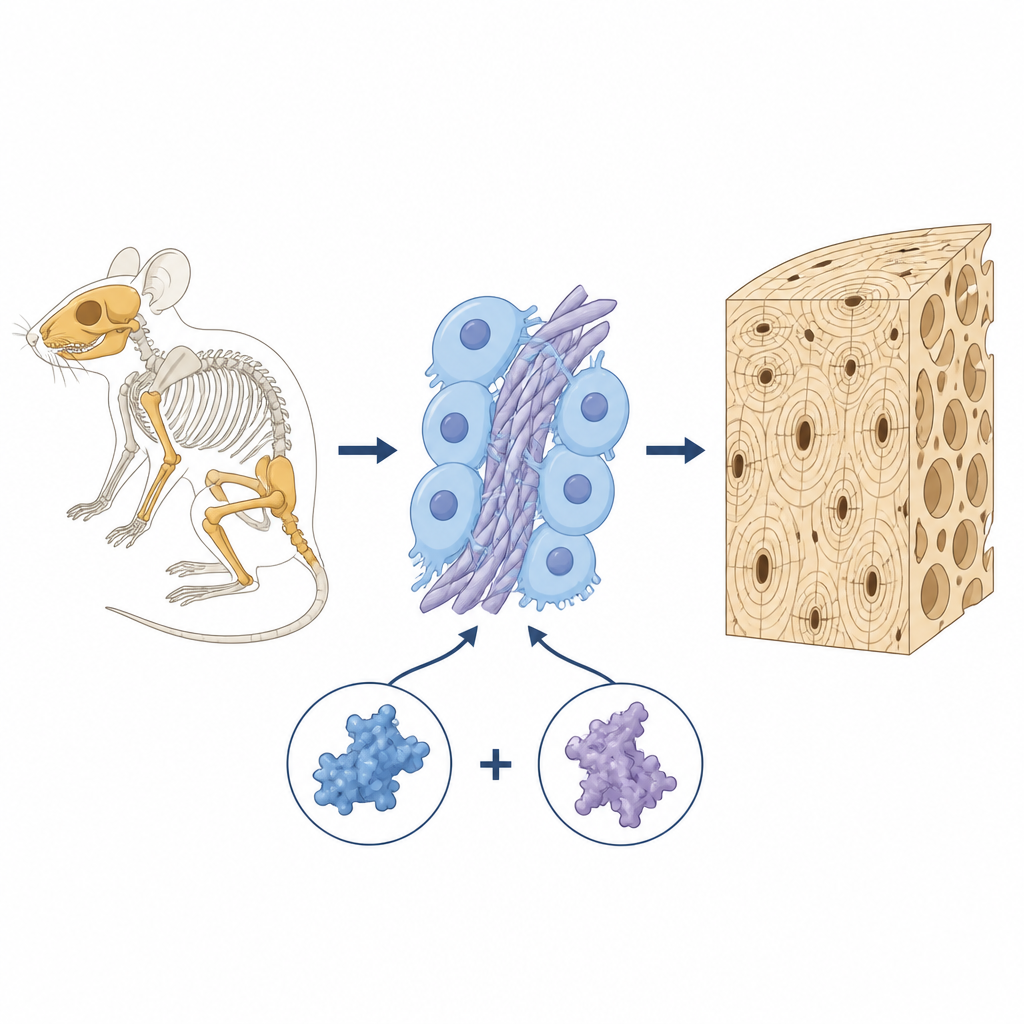
Bone may look solid, but it is a living material built from a soft collagen scaffold that gradually fills with tiny mineral crystals. Cells called osteoblasts organize this process, guiding mineral-rich precursors into the narrow spaces inside collagen fibers and turning them into hardened bone. The authors used single-cell gene reading techniques in mouse skulls and leg bones and noticed that one gene, Car3, was especially active in mature osteoblasts. Its product, the protein CAR3, was already known from muscle, but its role in bone had not been explored.
A key switch in bone-forming cells
To find out what CAR3 does, the team followed its activity as bone cells developed. They showed that CAR3 levels rise as stem-like cells commit to becoming osteoblasts and begin to mineralize their surrounding matrix. The master bone regulator RUNX2 was found to directly control the Car3 gene, turning it on at the right time and place during skeletal growth. When the researchers removed Car3 in limb mesenchymal cells in mice, the animals developed thinner, less dense bones as adults, even though their early skeletal shape looked normal. Measurements of bone growth surfaces revealed that the activity of osteoblasts was dampened, pointing to CAR3 as an important supporter of ongoing bone formation.
The hidden work of CAR3 in bone material
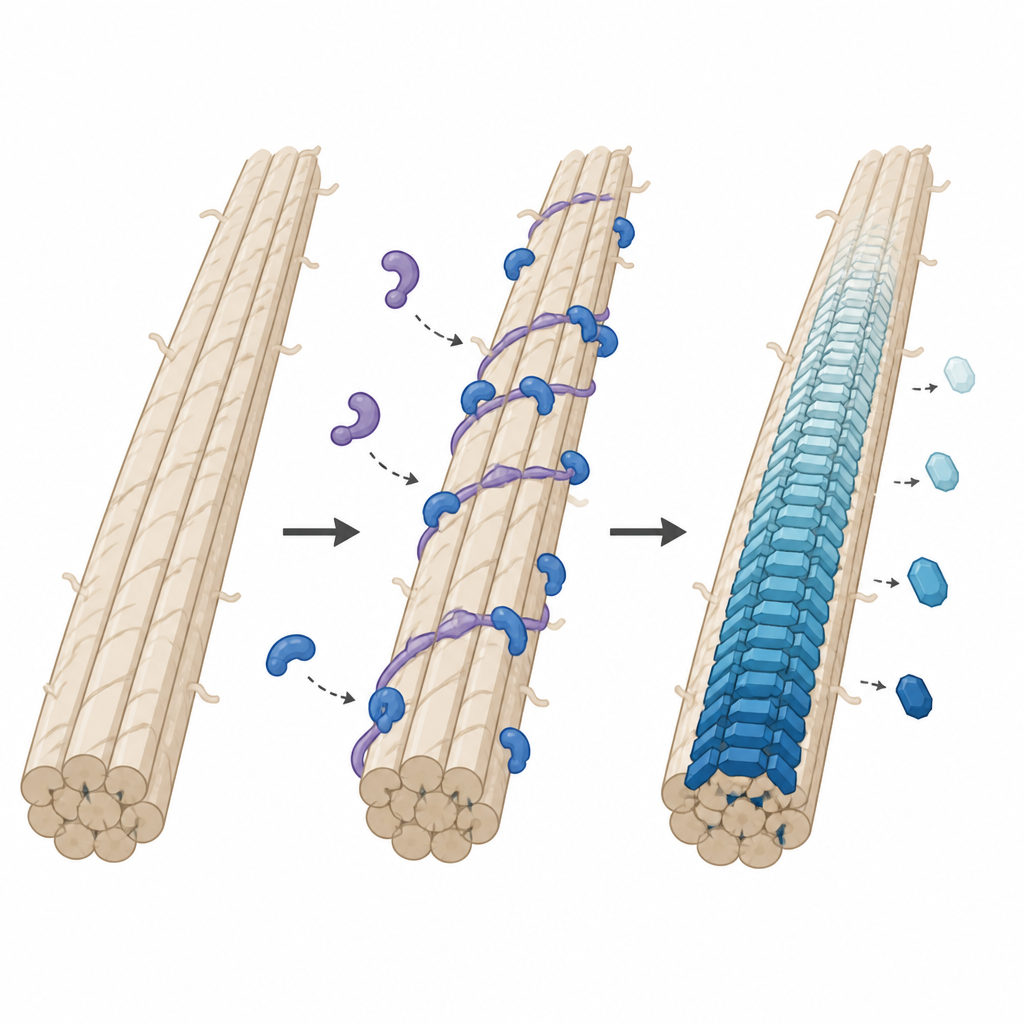
Beyond acting inside cells, CAR3 was detected in tiny vesicles secreted by osteoblasts and on the outside of collagen fibers themselves. In carefully controlled lab systems that mimic how minerals flow into collagen, the protein bound directly to type I collagen and altered how mineral crystals filled the internal spaces of the fibers. The study showed that CAR3 forms a three-part complex with collagen and another bone protein called bone sialoprotein. In this arrangement, CAR3 attaches to the collagen scaffold and helps recruit bone sialoprotein, which in turn encourages mineral precursors to enter the fibers and line up as orderly crystals. Without CAR3, stem cells formed less mineral, and with extra CAR3, they formed more, underscoring its role as a mineralization assistant.
Turning basic insights into healing tools
Armed with this understanding, the researchers created a collagen-based membrane coated with CAR3 and tested it in small skull defects in mice. Compared with plain collagen, the CAR3-treated scaffold led to more new bone volume and denser mineral deposits after several weeks. It also attracted more early-stage bone and cartilage progenitor cells into the defect. This suggests that CAR3 does double duty: it not only helps minerals organize inside collagen but also helps draw in the right repair cells, improving both the quantity and quality of regenerated bone.
What this means for future bone care
In simple terms, the study identifies CAR3 as a natural helper that links the soft collagen framework of bone to the hard mineral that gives it strength. By working with collagen and bone sialoprotein, CAR3 guides minerals into place and supports active bone-building cells. While more work is needed to map its exact structure and timing in humans, CAR3-coated collagen implants, or ways to gently boost CAR3 in bone tissue, could one day become a targeted strategy to enhance bone repair and help maintain a sturdy skeleton through aging.
Citation: Ma, X., He, Q., Ye, C. et al. Osteoblast-derived CAR3 synergizing with collagen and bone sialoprotein enhances bone formation. Int J Oral Sci 18, 42 (2026). https://doi.org/10.1038/s41368-026-00443-6
Keywords: bone mineralization, osteoblasts, collagen, bone regeneration, carbonic anhydrase III