Clear Sky Science · en
Mapping the spatiotemporal evolution and driving mechanisms of intangible cultural heritage in Southeast Coastal China
Why coastal traditions matter today
Along China’s southeastern shore, everyday practices like boat festivals, local opera, and centuries-old crafts are more than charming customs—they are living records of how people have adapted to the sea, rivers, and trade over thousands of years. This paper looks at that living heritage in Fujian, Guangdong, and Guangxi, asking where these traditions are found, how they have spread or faded through history, and what natural and social forces now shape their survival. Understanding these patterns helps communities and policymakers decide how to protect these fragile cultural treasures in a rapidly modernizing world. 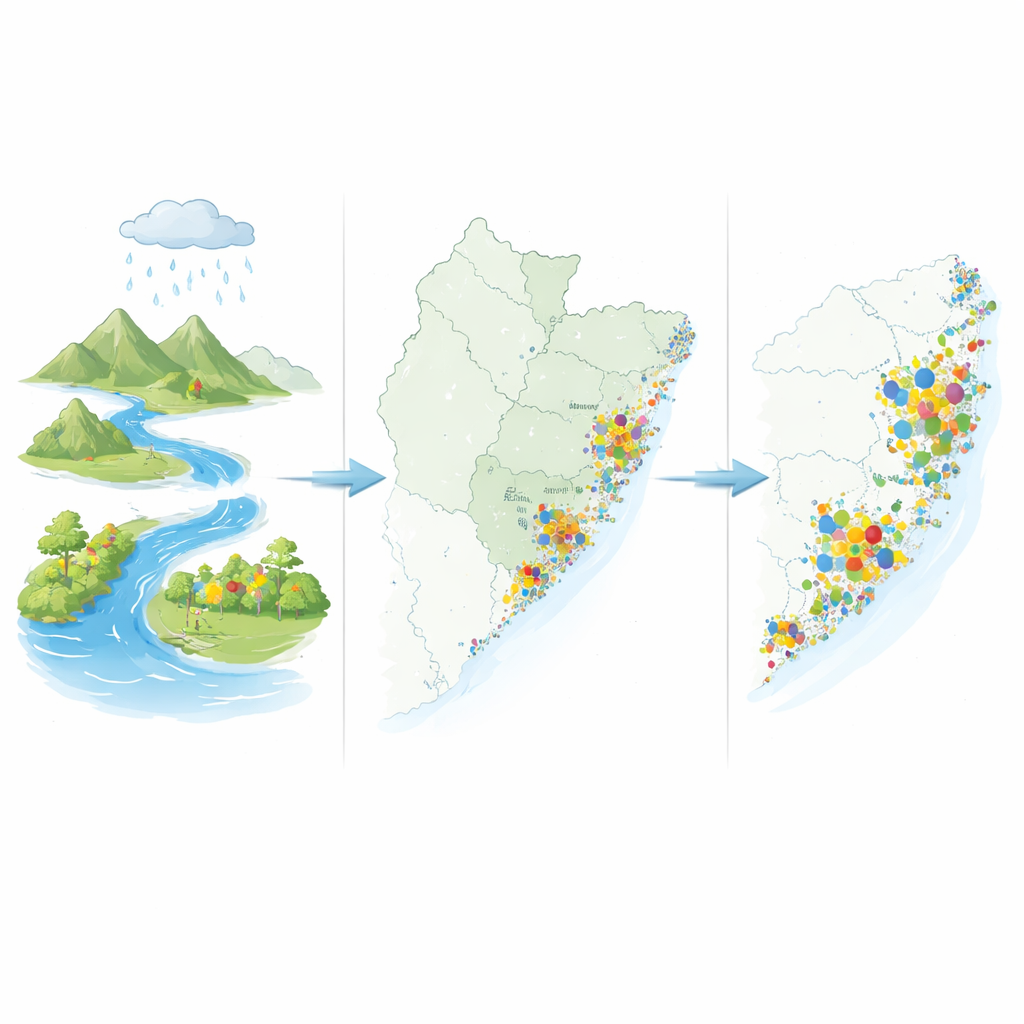
Following traditions through time
The authors assembled a large dataset of 2,372 officially recognized items of intangible cultural heritage—things like folk songs, rituals, handicrafts, and traditional drama—and traced when they originated, from the Pre-Qin era to modern times. They found three broad stages. In the earliest “origin and development” stage, most traditions were tied to handicrafts and local customs controlled by elite families, which limited how widely they spread. A “prosperity” stage during the Sui-Tang and Song-Yuan periods brought a surge of new traditions, especially folk customs and crafts, fueled by booming agriculture, maritime trade, and new technologies such as papermaking and printing. A later “maturity” stage in the Ming and Qing dynasties saw a second peak, with flourishing opera, music, and literature as the region became a key storehouse of Chinese civilization. In contrast, the modern era, marked by war and upheaval, produced far fewer new traditions.
Shifting centers and coastal clusters
To see how the “center of gravity” of heritage moved, the team used spatial statistics that summarize where items cluster and how their focus shifts over time. At the regional scale, the overall center of heritage first drifted eastward toward the coast, then swung southwest, and finally edged east again in modern times, mirroring waves of southward migration from northern China and the rise of maritime trade. Within each province, the heritage centers marched steadily southward, but with different patterns: relatively stable in mountainous Guangxi, oscillating east–west in trade-oriented Guangdong, and sliding north–south in coastal Fujian. Across all periods, traditions tended to line up in a northeast–southwest band, expanding and contracting in response to political stability, economic strength, and external contact.
Where culture gathers—and why
Looking at present-day patterns, the study shows that intangible heritage is far from evenly spread. Instead, items are strongly clustered, especially handicrafts and folk customs, which form dense “multi-core” belts around places like the Pearl River Delta, Fuzhou, Xiamen, Quanzhou, Nanning, and key river basins. Some traditions—such as crafts dependent on local clays, or rituals tied to specific dialects—are tightly bound to particular landscapes and speech communities, making them vulnerable but also distinctive. Others, like traveling performance troupes, are more mobile and diffuse, spreading along trade routes and rivers. Overall, coastal port cities and rich river networks act as cultural magnets, linking inland basins to the sea and helping heritage flow across provincial borders rather than stopping at administrative lines. 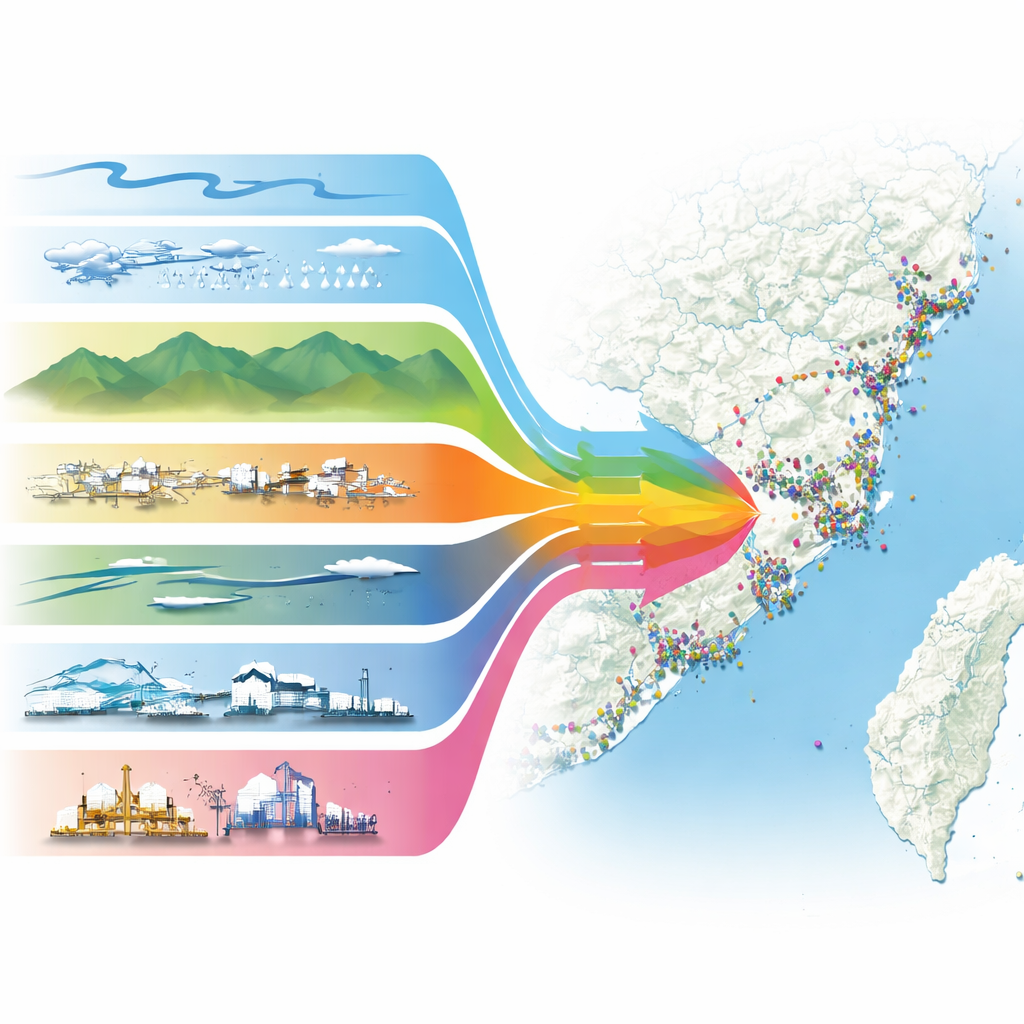
Hidden drivers beneath the map
To move beyond simple maps, the authors used a tool called Geodetector, which asks how strongly different factors explain the observed patterns. They fed in 16 variables, from elevation, rainfall, and vegetation to population density, transport networks, language zones, and economic indicators. Water systems emerged as the single most powerful influence, followed closely by how many people live in an area and how much it rains. Rivers and abundant moisture support dense farming, easy travel, and shared festival spaces; together with warm climates, they encourage practices like dragon boat races, terrace-building know-how, and river-based rituals. Human factors mattered slightly more overall: crowded, well-connected places with active local dialects tended to host more and richer heritage. Crucially, the study shows that combinations of factors matter even more than any one alone—for example, the mix of strong river networks and high local income almost perfectly predicts the biggest cultural hotspots.
What this means for saving living heritage
For non-specialists, the key message is that intangible cultural heritage in Southeast Coastal China is not randomly scattered; it is shaped by long histories of migration, rivers and coastlines, local speech, and modern development. Traditions cluster where people, waterways, and economic opportunity meet—and where dialects and local identities have remained strong. The authors argue that protection efforts should follow these cultural “basins” and river–sea corridors instead of rigid provincial borders, for example by building cross-provincial heritage corridors along the Maritime Silk Road and safeguarding dialect regions as cultural ecosystems. By showing exactly where and why traditions thrive or weaken, the study offers a scientific roadmap for keeping this living heritage alive in the face of globalization and rapid change.
Citation: Wei, YX., Zheng, H., Chen, YZ. et al. Mapping the spatiotemporal evolution and driving mechanisms of intangible cultural heritage in Southeast Coastal China. npj Herit. Sci. 14, 297 (2026). https://doi.org/10.1038/s40494-026-02580-x
Keywords: intangible cultural heritage, Southeast China coast, cultural geography, river and coastal cultures, heritage conservation