Clear Sky Science · en
Dual-function Na₂B₈O₁₃·4H₂O for integrated pest management and acidification mitigation in paper-based cultural heritage
Guarding Fragile Pages from Tiny Invaders
Old books, archives, and artworks on paper are far more vulnerable than they look. Tiny beetles can quietly tunnel through them, leaving holes and dust, while acidic pollution slowly eats away their fibers. This study explores a new material that can be built directly into storage boxes and papers to both kill and repel insects and slow down acid damage, offering a safer way to protect irreplaceable documents and artworks for future generations.
Why Bugs and Acid Threaten Our History
Paper-based treasures in libraries, archives, and museums face a double threat. Insects chew on cellulose, glues, and fabrics, riddling pages with tunnels and holes that weaken their structure and mar their appearance. Their droppings and enzymes stain and further degrade the paper. At the same time, acidic gases from the environment or from the objects themselves lower the pH of paper, making it brittle and yellow. Existing pest control methods often force a trade-off: physical treatments like freezing or oxygen removal are gentle on artifacts but slow and logistically demanding, while chemical fumigants work quickly but can leave toxic residues that endanger both staff and collections. Safer, more durable solutions that also help prevent acid damage are urgently needed.
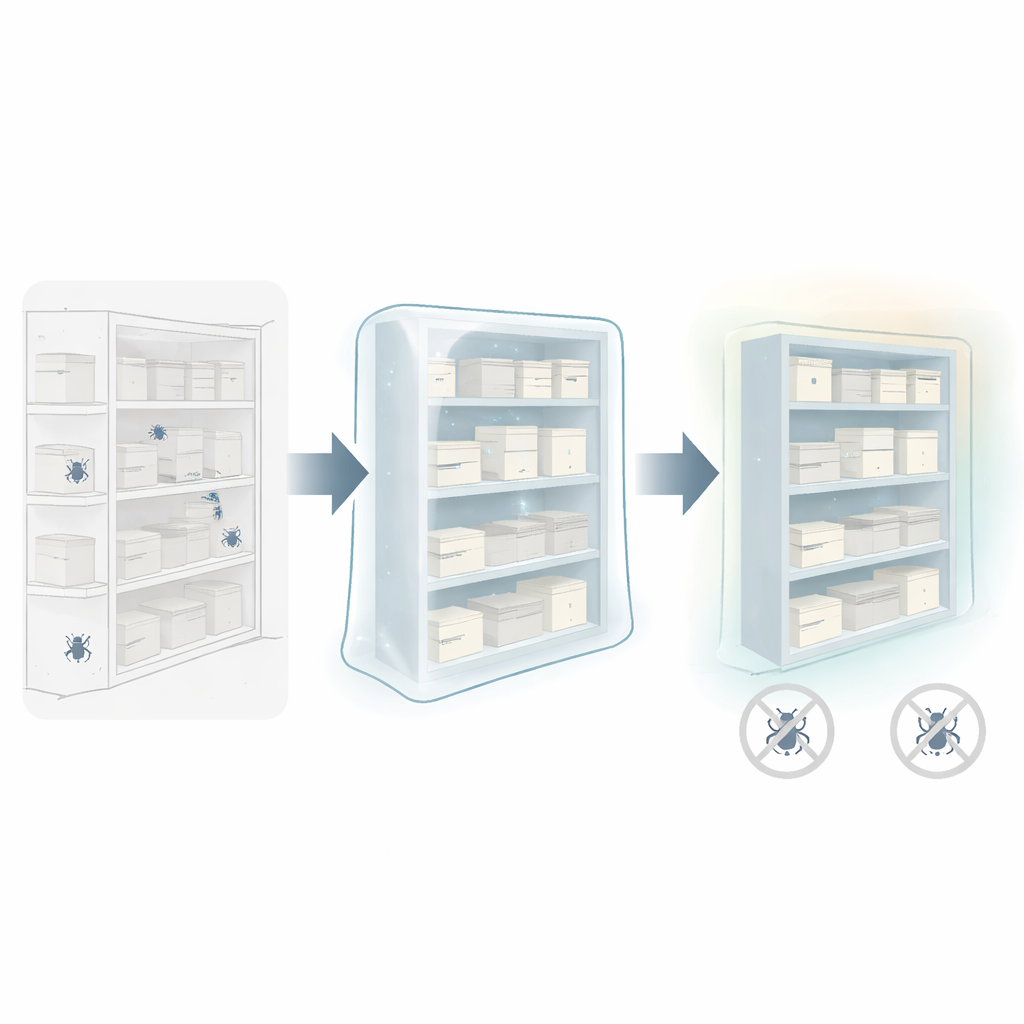
A Dual-Action Salt Built into Storage Materials
The researchers focused on sodium octaborate tetrahydrate, a borate salt already used in agriculture and known for low toxicity to humans. They introduced this salt into paper by soaking thin Xuan paper in a solution and drying it, then using the treated sheets to make archival boxes and test papers. They also mixed the salt with flour used to rear three common archive pests: the cigarette beetle, the red flour beetle, and the sawtoothed grain beetle. To mimic real-world pest treatments, they combined the chemical with low-oxygen conditions inside a vacuum chamber, testing both steady (continuous) vacuum and an on–off "intermittent" vacuum that repeatedly cycles between low pressure and normal air.
Fast Pest Control and Strong Repellent Power
When different inorganic powders were tested under vacuum, all killed insects better than vacuum alone, but the borate salt stood out. It achieved complete mortality of mixed insect populations faster than zinc oxide, silver, or other references. Under low vacuum, insects in untreated conditions only slowly died from lack of oxygen, whereas those exposed to the borate reached 100% mortality within a week. Under higher vacuum, control mortality rose, but the combination with the borate still worked quickest. The most striking result came from the intermittent vacuum: when the chamber cycled between low pressure and normal air while insects contacted the borate, all four tested pest species died within 24 hours. The pressure swings likely damage insect bodies and breathing tubes, while the borate interferes with their biology, producing a powerful one–two punch.
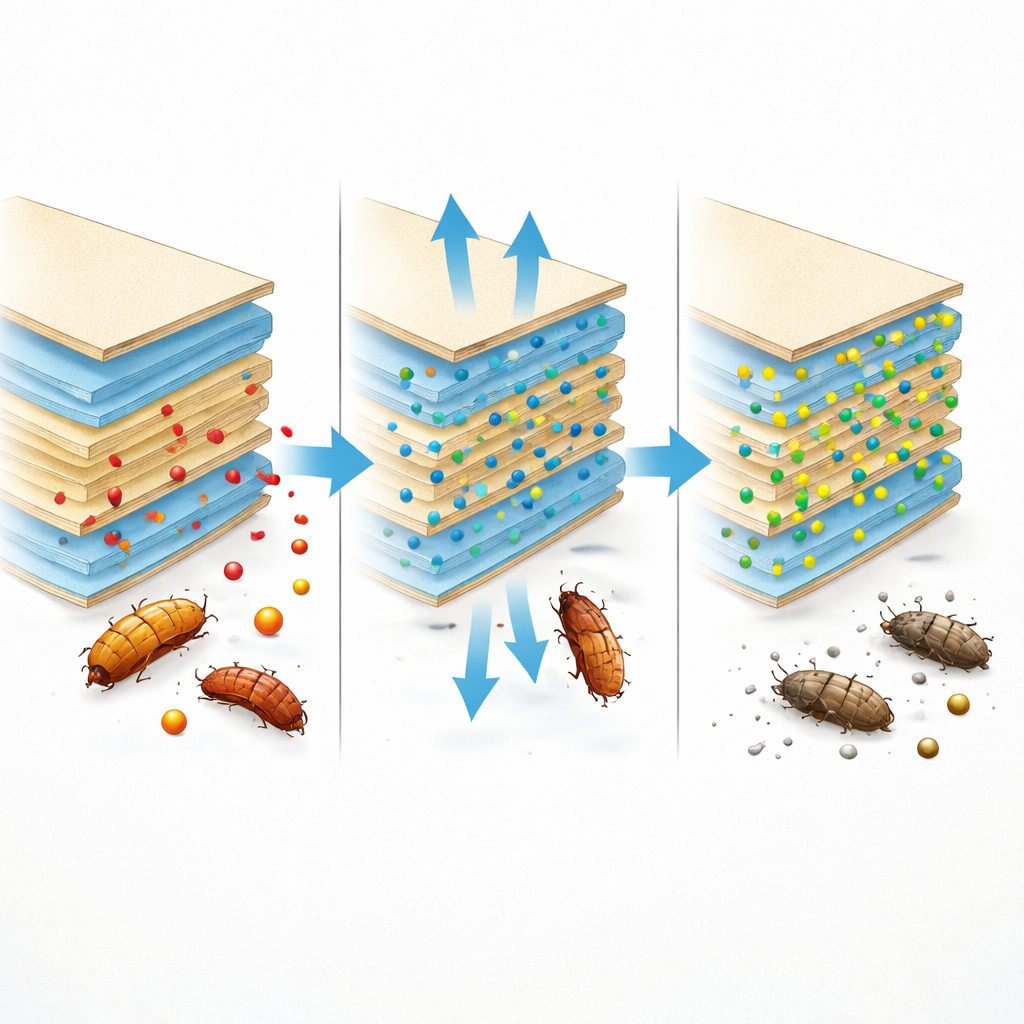
How the Material Harms Insects but Helps Paper
To see what happens inside the pests, the team analyzed gene activity in cigarette beetle larvae exposed to the borate under intermittent vacuum. They found changes in genes tied to building the insect’s outer shell, transporting sugars for energy, and making key hormones that control growth and molting. Pathways involved in breaking down amino acids and fats, producing energy, and maintaining cell membranes were all disturbed. Together, these shifts point to a broad metabolic crisis: weakened protective coatings, disrupted energy supply, and faulty development signals that ultimately lead to death. Meanwhile, when the borate-treated paper was used to make archive boxes and test sheets, it showed a very different behavior. Insects strongly avoided the treated surfaces, clustering instead on untreated paper, and a portion of those forced into contact died over a day. In an artificial acidic atmosphere, paper stored inside treated boxes kept a higher, more stable pH than paper in normal boxes, indicating that the borate acts as a built-in buffer that neutralizes incoming acidic gases.
A Safer Shield for Books and Documents
Viewed in everyday terms, this material turns archival boxes and papers into active shields. The borate-laced packaging pushes insects away, slowly poisons any that stay, and works even better when paired with short intermittent vacuum treatments that can clear infestations in a day. At the same time, it soaks up acidic pollutants before they can embrittle the paper inside. While more work is needed to confirm long-term safety for people and materials, this dual-function approach points toward a future where storing a fragile book in the right kind of box could quietly and continuously defend it from both bugs and acid.
Citation: Cao, J., Liu, X., Zhang, R. et al. Dual-function Na₂B₈O₁₃·4H₂O for integrated pest management and acidification mitigation in paper-based cultural heritage. npj Herit. Sci. 14, 283 (2026). https://doi.org/10.1038/s40494-026-02571-y
Keywords: paper conservation, heritage pests, archival storage, borate treatments, acidification control