Clear Sky Science · en
Study on the dynamics of cultural routes and adaptability of folk beliefs: a case of the Great Tea Road and Guan Yu worship
Why Trade Routes and Local Gods Still Matter Today
The paper explores how an old trade road in China, known as the Great Tea Road, helped spread devotion to a popular folk hero, the warrior Guan Yu. By combining maps, network analysis, and historical records, the authors show that commerce and belief travel together, shaping which temples survive, where communities form, and how cultural heritage should be protected today. Their findings matter not just for historians, but for anyone interested in how ideas and identities move across regions and generations. 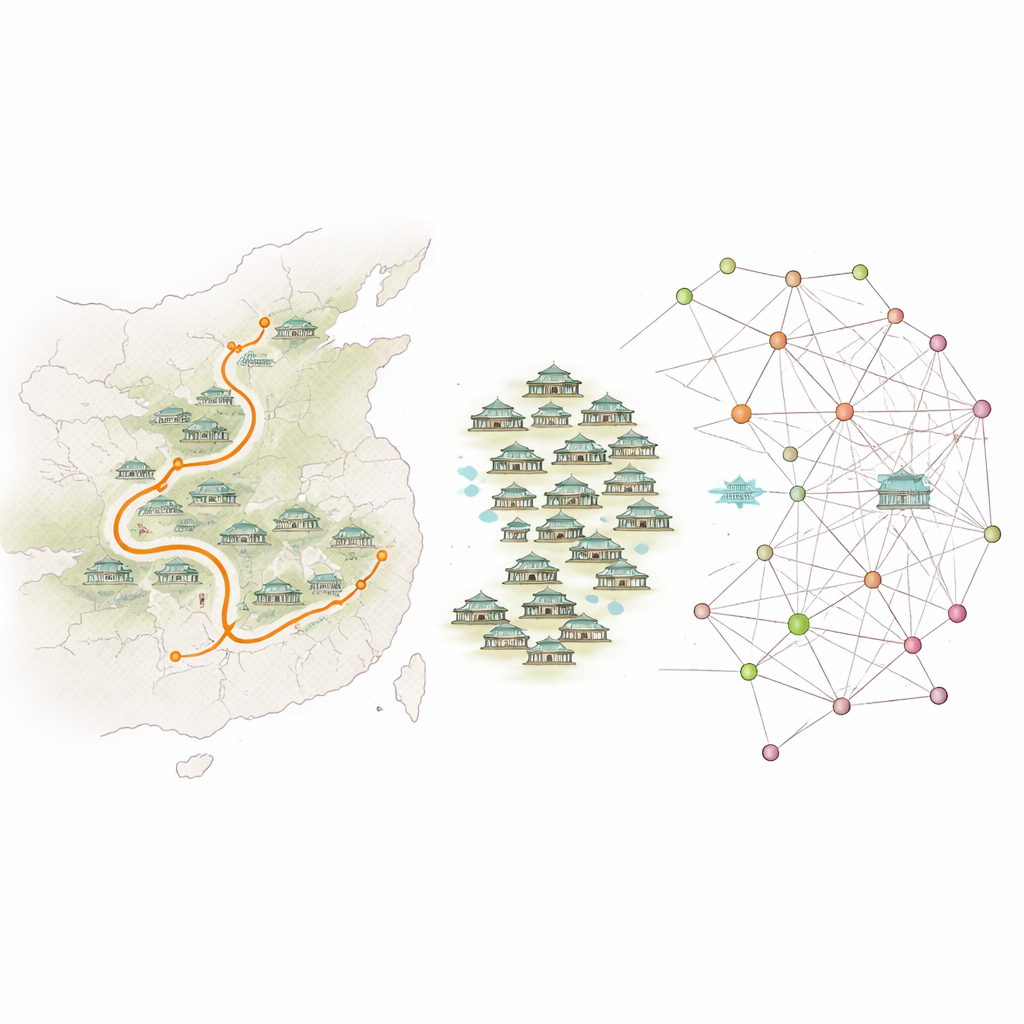
A Road of Tea, Merchants, and Shared Stories
The Great Tea Road linked tea-growing regions in southern China with Mongolia and Russia from the seventeenth century onward. Along this route, merchants from Shanxi province set up guild halls that also housed temples honoring Guan Yu, a historical general later worshipped as a symbol of loyalty and righteousness. These halls doubled as business clubs and sacred spaces: traders met, negotiated, swore oaths, and sought protection there. Over time, this constant movement of people, goods, and rituals turned the road into a living corridor where economic exchanges and spiritual practices reinforced one another.
From Distant Temples to a Web of Belief
To understand how this devotion actually spread, the authors focused on a 400-kilometer circle around the city of Hankou, a crucial mid-point on the Great Tea Road. They painstakingly assembled data on 112 Guan Yu cult sites and 133 transportation nodes—river ports, road crossings, and other strategic points—using modern mapping tools, old gazetteers, stone inscriptions, and field visits. With geographic information systems, they could see where temples clustered along the route and how closely their patterns followed the changing paths of trade. With network software, they treated temples and transport hubs as nodes in a web, measuring how strongly each place connected to the others and which ones acted as bridges between regions. 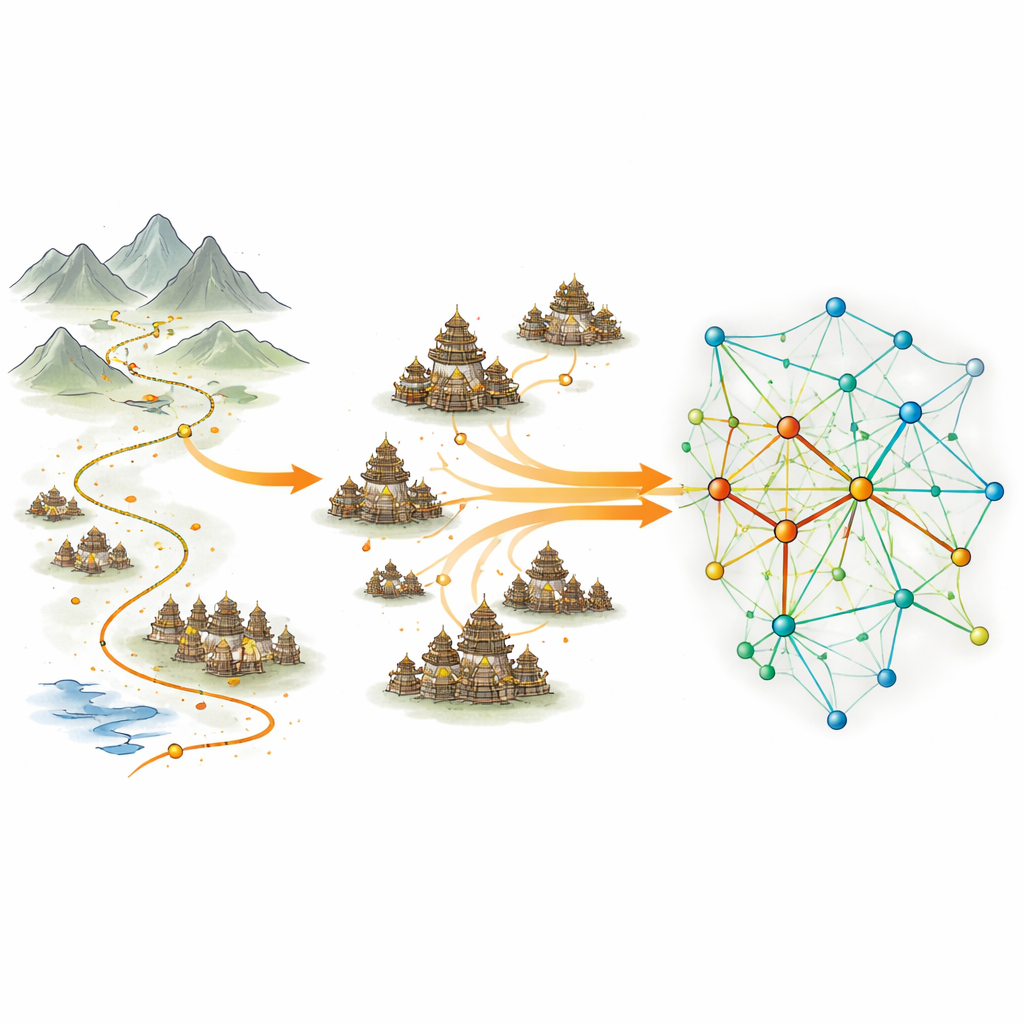
Different Regions, Different Ways Belief Travels
The results show that the spread of Guan Yu worship did not simply mirror a fixed line on a map. In Henan and Hubei provinces, where the main trade route was stable and where older sacred sites already existed, the road and major temples worked together as twin engines. Transport hubs along the Great Tea Road there had many links and high influence in the network, helping rituals and stories circulate widely. In northeastern Hunan, by contrast, the road was less central, and dense clusters of temples grew more from local communities—such as boatmen and clans—who organized their own worship traditions. Northern Jiangxi, served by secondary branches of the route, hosted temples that often sat at the edges of the network, acting as endpoints rather than powerful sources of further spread. In short, the same god traveled in different ways depending on how trade, geography, and community life lined up.
Digital Tools for Living Heritage
By visualizing the data as overlapping maps and networks, the study moves beyond scattered anecdotes toward a quantitative picture of how folk belief and trade routes intertwine. Measures such as clustering, direction of spread, and the importance of “in-between” nodes reveal which ports and towns quietly held the network together, and where belief spread most efficiently. The authors argue that this framework—combining spatial analysis with social network concepts—can be reused for other cultural routes, from the Silk Road and canal systems to maritime paths that carried sea-goddess worship across East and Southeast Asia. It offers a way to see not just where heritage sites are, but how they cooperate to sustain a living tradition.
Rethinking How We Protect Cultural Routes
The study concludes that the Great Tea Road and Guan Yu worship form a single dynamic system: trade flows give temples reasons to exist, while shared rituals and values tighten the bonds among merchants and communities. Treating roads only as physical relics and temples only as isolated monuments misses this interplay. The authors call for protection plans that follow the actual corridors of movement, prioritize key hubs where commerce and worship once met, and adapt to regional differences instead of imposing one uniform model. Unlike major institutional religions with fixed centers and doctrines, folk beliefs such as Guan Yu worship survive through flexibility and local creativity. Recognizing and preserving that flexible logic, they argue, is essential if cultural routes are to remain more than lines on a map.
Citation: Yuan, Y., Shen, Y., Cheng, S. et al. Study on the dynamics of cultural routes and adaptability of folk beliefs: a case of the Great Tea Road and Guan Yu worship. npj Herit. Sci. 14, 276 (2026). https://doi.org/10.1038/s40494-026-02567-8
Keywords: Great Tea Road, Guan Yu worship, cultural routes, folk religion, heritage conservation