Clear Sky Science · en
Evaluation and prediction of dominance degree for brick and stone cultural relics resources
Why Old Bricks and Stones Still Matter
Across China’s Hunan Province, thousands of temples, tombs, cliff carvings, and historic towns made from brick and stone quietly record more than two thousand years of history. Yet many of these treasures sit in the path of rapid urban growth, heavy tourism, and harsher weather. This study asks a simple but pressing question: can we use modern data and algorithms to see where these relics are thriving, where they are in danger, and where undiscovered sites are most likely hiding, before they are lost for good?
What the Study Looked At
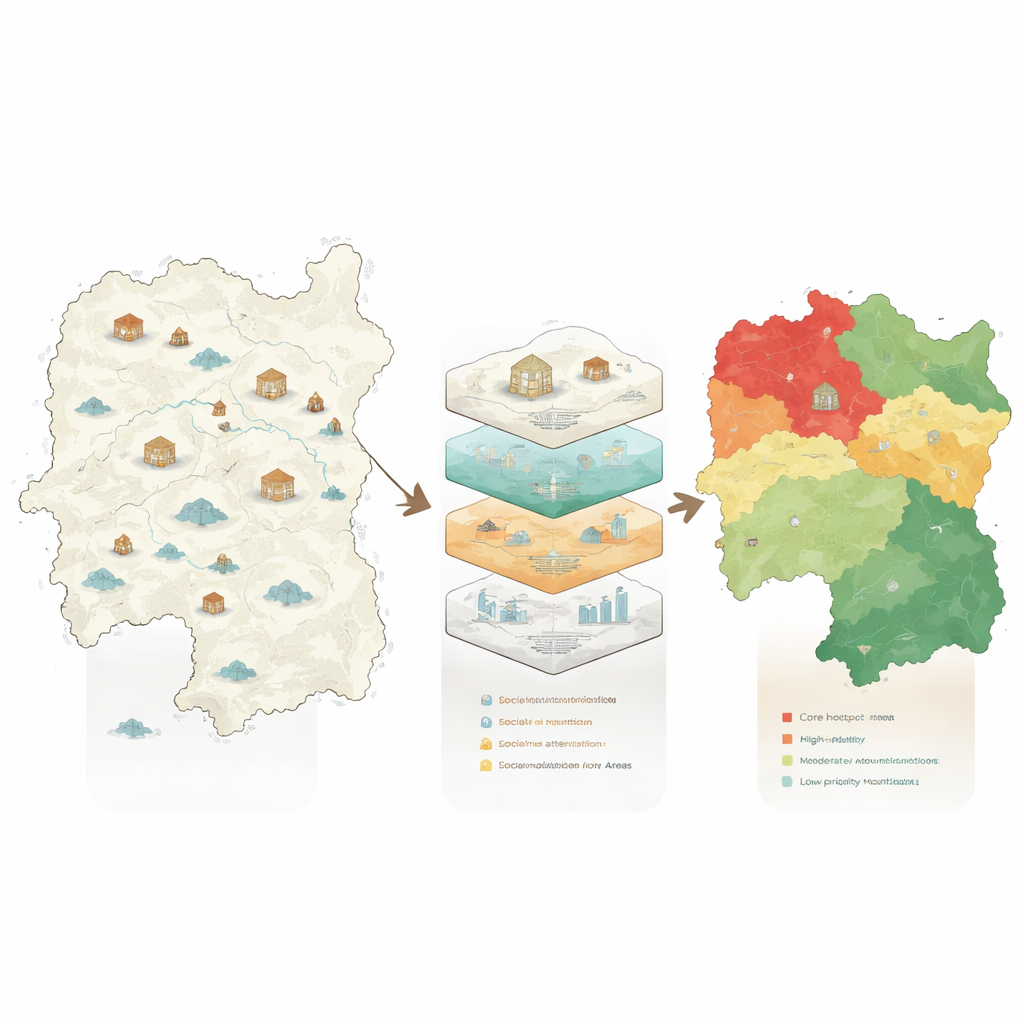
The researchers focused on 1,448 officially registered brick and stone relics in Hunan, ranging from ancient bridges and grotto temples to modern revolutionary sites. They combined traditional maps with satellite images, population statistics, land use maps, traffic networks, rainfall patterns, and even social media check-ins from platforms like Weibo. Together, these sources describe three things: how rich an area is in heritage sites (“resource ontology”), how harsh the surroundings are for their survival (“environmental stress”), and how much people care about or visit them today (“social value”).
Patterns Hidden in the Landscape
When the team mapped all of these sites, clear patterns emerged. The relics are not scattered at random; they cluster strongly along major rivers, trade routes, and in long-settled basins such as the Changsha–Zhuzhou–Xiangtan urban region and around Dongting Lake. Nearly half of all sites lie within 10 kilometers of a large river. Different types of relics favor different terrains: religious grottoes and defensive structures often occupy steeper, higher ground, while tombs and ancient villages hug lower, flatter valleys. Over time, from early dynasties to the modern era, heritage steadily expanded from low river plains into surrounding hills, reflecting shifting politics, population growth, and changing military needs.
Stresses from Cities, Roads, and Rain
The study also examined how modern pressures and natural forces threaten these places. Urban and industrial land uses turn out to be the strongest single stress factor, followed by dense road networks and intense rainfall that slowly wears away stone. Some parts of Hunan, notably in the south and around Dongting Lake, combine high humidity, acid rain, flooding, and heavy salt and biological activity—a recipe for steady, often invisible erosion of brick and stone. At the same time, social media and tourism data show that many of the most visited sites sit exactly where urban expansion and traffic are greatest, creating a tension between showcasing heritage and preserving it.
Using Machines to Predict Hidden Sites
To move beyond describing what is already known, the researchers trained a machine learning model to learn where relics are most likely to occur based on their surroundings. The model compares known sites with randomly chosen non-site locations, while considering elevation, slope, distance to rivers and roads, land use, lights at night, and population. It then estimates, for each small patch of land, how likely it is to host brick or stone relics. The results suggest that many valleys and river basins—especially along the Xiang, Zi, Yuan, and Li Rivers—have environmental “fingerprints” similar to areas rich in known sites, yet currently show few recorded relics. The model performs better than chance and is good enough to highlight promising search zones, though it is far from perfect and still misses many real sites.

Turning Insights into Protection Zones
Combining heritage richness, environmental stress, and social attention, the team grouped counties into four broad categories. Some areas, such as parts of Changsha and Yiyang, contain dense, famous relics but face strong urban and climatic pressure; these “priority protection” zones need strict building limits, close monitoring, and careful water and pollution control. Others have strong heritage but low visitor numbers, suggesting opportunities for gentle, carefully managed tourism. Mountain regions with few relics and fragile ecosystems are flagged as places where big new developments should be avoided, even if a small number of important sites still deserve tailored care.
What This Means for the Future
For non-specialists, the main message is that old walls and carvings do not simply survive or vanish at random. They respond to the lay of the land, to centuries of human choices, and to present-day pressures from cities, roads, and climate. By fusing maps, environmental data, and digital traces of human interest, this study shows how we can move from reacting after damage occurs to planning ahead—pinpointing where to search for hidden relics and where to focus limited conservation funds. The authors stress that their predictions are guidance, not guarantees, but they argue that such intelligent, map-based approaches will be essential if countries hope to safeguard their brick and stone heritage in a rapidly changing world.
Citation: Hou, J., Zhou, J., He, Y. et al. Evaluation and prediction of dominance degree for brick and stone cultural relics resources. npj Herit. Sci. 14, 278 (2026). https://doi.org/10.1038/s40494-026-02561-0
Keywords: cultural heritage mapping, brick and stone relics, spatial prediction, heritage conservation planning, Hunan Province