Clear Sky Science · en
A crystallographic approach to the orb of the New York Salvator Mundi
Mystery in a Famous Painting
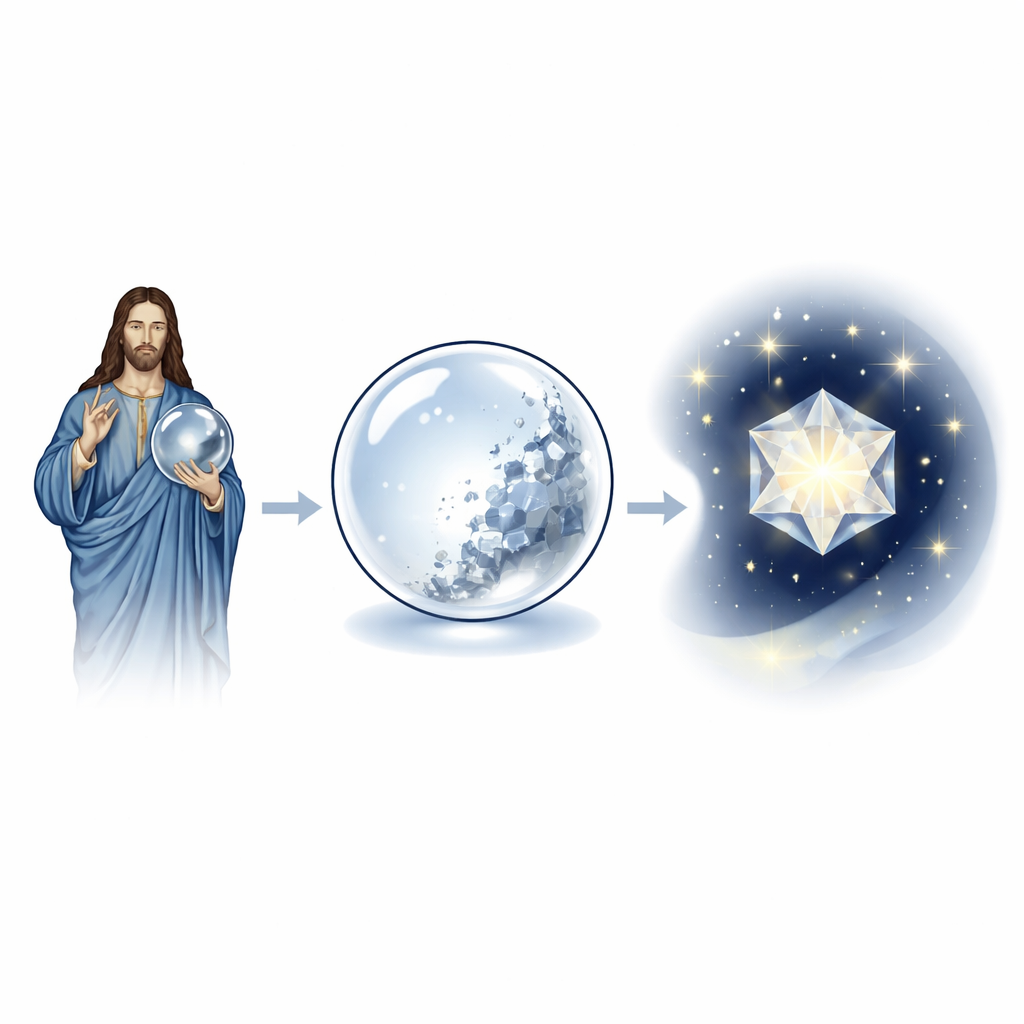
At first glance, the New York version of Salvator Mundi shows a familiar sacred scene: Christ blessing the viewer while holding a clear globe that stands for the world. Yet this painting, rediscovered in 2005 and controversially linked to Leonardo da Vinci, hides a scientific puzzle inside that globe. Scattered across one side of the orb are tiny pale specks, like grains of light trapped in glass. Why would an artist risk “spoiling” a symbol of perfect divine order with visible imperfections? This paper uses tools from crystallography and mineral science to argue that these specks were a deliberate, highly informed choice—and that the orb is meant to be carved rock crystal, not ordinary glass.
Old Ideas about Frozen Water Stones
The story begins long before the Renaissance. Ancient Greek and Roman writers believed that clear quartz crystals were water frozen so deeply it could never melt. Poets like Claudius Claudianus described crystals that trapped droplets of water, and scholars such as Pliny the Elder wrote about tiny bubbles locked inside these “eternal icicles.” We now call these trapped pockets fluid inclusions: microscopic amounts of liquid or gas sealed as a crystal grows. Medieval and Islamic scholars also described such inclusions and understood them as remnants of the original watery “mother” from which crystals formed. By Leonardo’s time, educated people were steeped in this tradition, so the idea of a crystal sphere sprinkled with inner droplets would have been entirely natural, not strange.
How Crystal Spheres Were Made
The authors then ask a practical question: could someone in antiquity or the Renaissance actually carve a large, flawless mineral sphere? Historical texts and surviving objects show that craftspeople had long shaped transparent minerals into balls and vessels. Minerals like salt, gypsum, and calcite were known, but they were too soft, brittle, or prone to splitting to remain clear when worked into spheres. Quartz—hard and tough, with a shell‑like fracture—was the best candidate for a durable, transparent ball. By the Renaissance, Venice was also producing very clear glass, so a globe like the one in Salvator Mundi could in principle be either rock crystal or glass. However, the painted orb is about 18 centimeters across, larger than any known crystal or glass spheres from Leonardo’s circle, suggesting the artist did not simply copy an existing object but imagined a perfected one informed by real materials.
Light Tricks and Painted Specks
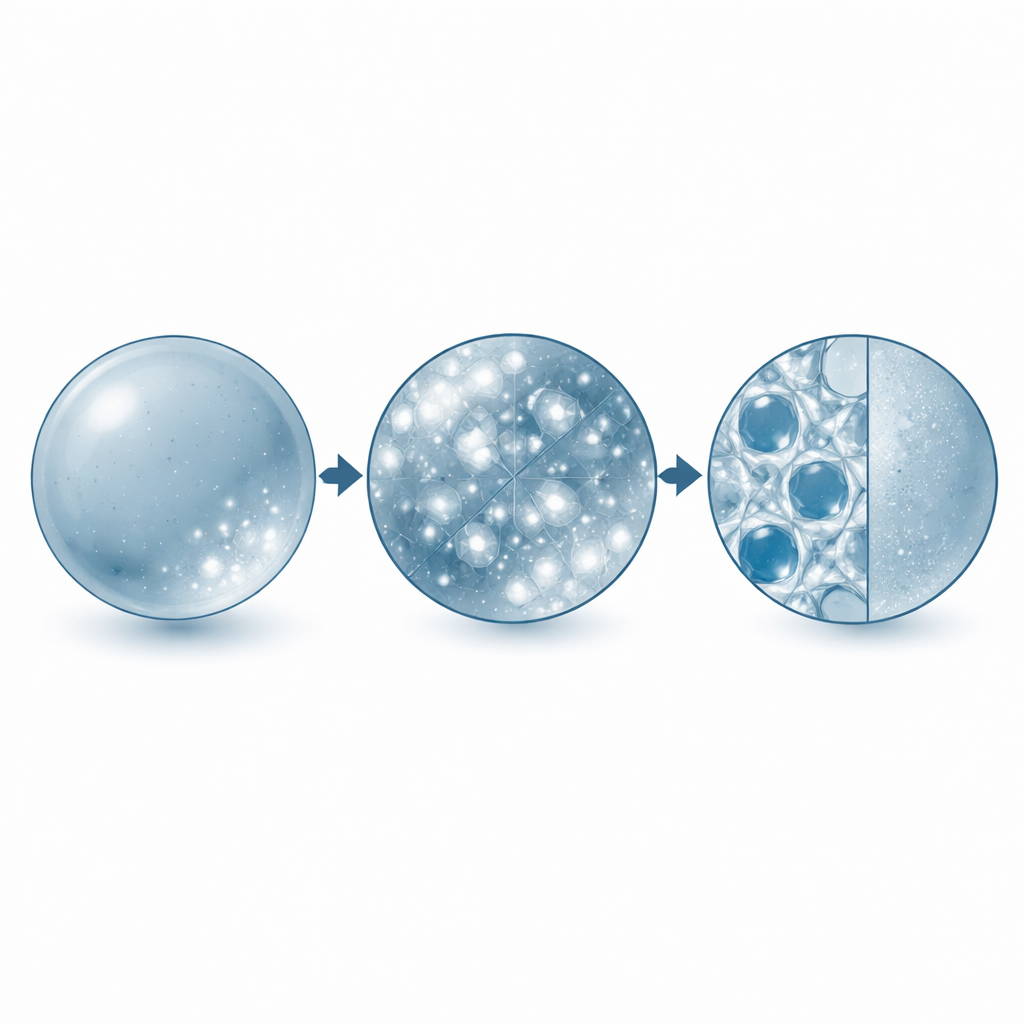
Another debate around the painting centers on whether the globe shows correct optical effects. A solid sphere bends light strongly, stretching and inverting images seen through it. Critics claimed the painting “gets the physics wrong.” By analyzing how the folds of Christ’s robe and his hand appear through the orb, and by comparing the image with photographs of a real sphere under lighting similar to what Leonardo recommended, the authors argue that the picture does not contain major scientific errors. Subtle distortions that critics expected in the upper part of the orb may have been lost during harsh past cleanings. The real clue lies in the tiny specks on one side of the orb. Using image‑analysis software, the researchers measured their shapes and orientations. The specks are not round dots like air bubbles in glass; instead, they are built from several careful brushstrokes that suggest little facets and elongation, as if to echo the angular outlines of inclusions inside a crystal. Even the direction of the white highlights on them lines up with the painting’s overall light source.
Crystals, Faith, and the Structure of the World
Why would an artist, possibly Leonardo himself, take the risk of dotting a holy orb with flaws? Throughout religious history, transparent crystals have symbolized purity, divine light, and spiritual knowledge. Medieval writers linked crystal clarity to heaven and to the soul’s journey toward God. During the Renaissance, thinkers like Leonardo were also fascinated by geometry and polyhedra—ideal shapes that seemed to underlie nature’s design. Crystals are the only common natural solids that naturally form such polyhedral shapes, and their internal order hints at a hidden mathematical structure in the world. By painting the orb not as perfect glass but as rock crystal with fluid inclusions, the artist could be suggesting that the universe itself is built from ordered, crystalline geometry: a world both physical and spiritual, held effortlessly in Christ’s hand.
What the Study Reveals
In the end, this research concludes that the Salvator Mundi orb is best understood as a visionary rock‑crystal sphere, not a flawed glass bubble. The specks on its surface match the look and behavior of fluid inclusions in real crystals, and their placement and lighting show deliberate design rather than accident. The painting therefore stands as the earliest known artistic depiction of mineral fluid inclusions, predating scientific studies of them by centuries. Far from being a mistake, the “marred” orb reveals an artist deeply engaged with the science and symbolism of his age—using the language of crystals to suggest that divine order works through the hidden geometry of the material world.
Citation: García-Ruiz, J.M., Modestini, D. A crystallographic approach to the orb of the New York Salvator Mundi. npj Herit. Sci. 14, 287 (2026). https://doi.org/10.1038/s40494-026-02558-9
Keywords: Salvator Mundi, rock crystal, fluid inclusions, Leonardo da Vinci, Renaissance art science