Clear Sky Science · en
Integrated digital casting: a new method for simulating piece-mold techniques of ancient bronzes
Bringing Ancient Bronze Secrets into the Digital Age
Ancient Chinese bronze ritual vessels are some of the most striking objects in museums, but the techniques used to make them have long remained partly mysterious. Traditional reconstructions of their casting methods are slow, expensive, and heavily dependent on master craftsmen. This study introduces a faster, more accessible way to "rehearse" those ancient techniques using digital 3D modeling, 3D printing, and substitute materials—offering both researchers and the public a safer, clearer window into how these masterpieces were created.
Why Old Bronze Pots Still Matter Today
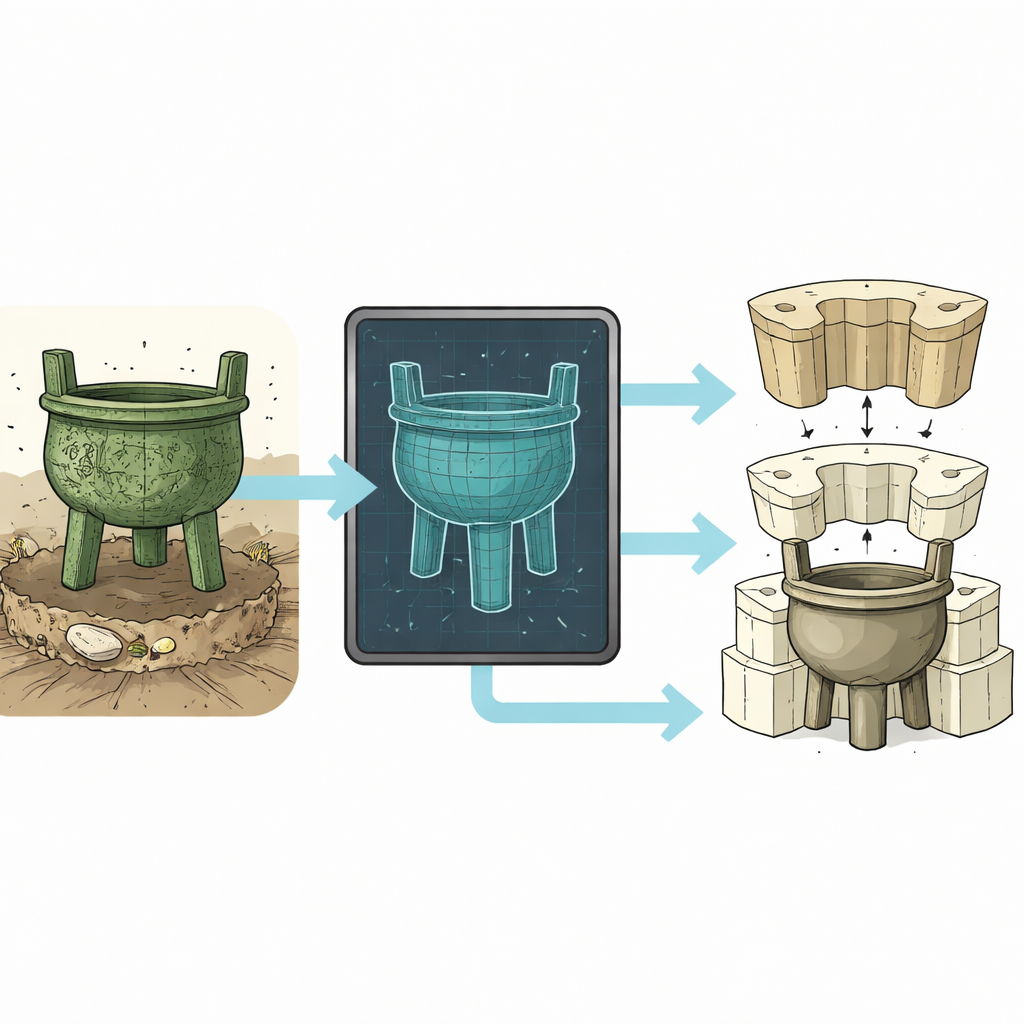
Ritual bronzes from China’s Shang and Zhou dynasties were more than cooking pots: they were status symbols, ceremonial tools, and records of technological ingenuity. Many of these vessels, such as the three-legged ding, were made using a distinctive "piece-mold" method. Craftsmen shaped a model of the vessel, pressed clay around it to form an outer shell, divided that shell into sections, and prepared a separate inner core. When reassembled with a gap between outer mold and core, this space became the cavity for molten metal. The fine lines and seams visible on surviving bronzes are often the only clues modern scholars have for reconstructing how those molds were divided and assembled.
Limits of Recreating the Ancient Workshop
Archaeologists have tried three main approaches to understand piece-mold casting: close visual study of existing bronzes, analysis of excavated clay molds and cores, and full-scale experimental casting with clay and high-temperature bronze. Each strategy has drawbacks. Surface seams can be faint or polished away, complete ancient molds are rare, and traditional casting experiments are difficult to standardize. Making a single clay mold set can take more than a month, requires high firing temperatures and careful pouring near 1000 °C, and depends strongly on the experience of specialized artisans. Even when a replica succeeds, multiple mold layouts could explain the same artifact, making results suggestive rather than definitive.
A New Digital Route from Model to Metal
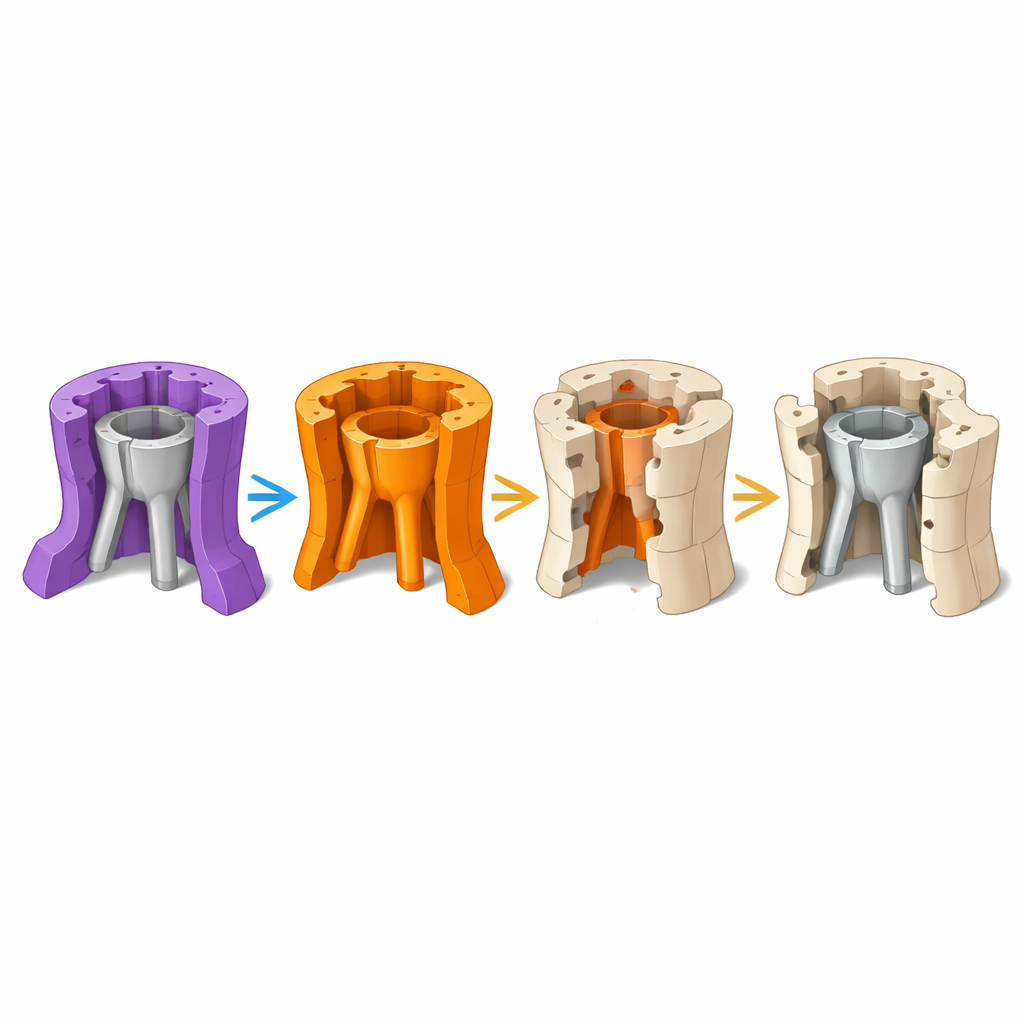
The authors propose an "integrated digital casting" workflow that keeps the core logic of piece-mold casting but replaces its most demanding steps with controllable modern tools. First, they build a precise 3D model of a Shang dynasty ding using free modeling software. With mathematical operations, they slice this digital vessel into fan-shaped outer sections and a core, adding interlocking features so the parts align reliably. These designs are then exported to a 3D printer, which produces rigid plastic negatives—the "molds of the molds"—with smooth curved joints that distribute pressure more evenly than traditional sharp-edged sections. Into these negatives, the team pours a carefully mixed slurry of low-density gypsum, which hardens into detailed, porous molds that mimic the form and function of clay without needing long air-drying or high-temperature firing.
From Gypsum Molds to Shiny Castings
To avoid the risks and equipment demands of molten bronze, the researchers replace it with a low-melting alloy that liquefies at around household-oven temperatures. Once the gypsum outer molds and inner core are assembled, sealed, and supported with sand, this alloy is poured in, allowed to cool, and the brittle gypsum is broken away—preserving the historical rule of "one mold for one vessel." Tests with different gypsum mixtures show that a one-to-one ratio of water to powder gives the best balance of strength, surface smoothness, and easy removal. The resulting metal dings reproduce fine patterns, crisp edges, and realistic mold marks while achieving more uniform wall thickness and neater rims than traditional replica attempts. Crucially, the entire cycle shrinks from about 50 days to under 40 hours.
Making Bronze Heritage Easier to Study and Share
This digitally guided method does not claim to copy every nuance of ancient materials or furnace practice. Instead, it offers a practical laboratory tool for rapidly testing different ways of dividing and assembling molds before committing to costly clay-and-bronze experiments. Because it relies on standardized digital files, modest equipment, and low-temperature casting, it can also be used in classrooms and museums to help people physically explore how sectional molds work. In doing so, integrated digital casting opens a repeatable, measurable path to investigate—and teach—the craft logic behind some of the most iconic bronzes in Chinese history.
Citation: Song, X., Dong, Z. & Fan, A. Integrated digital casting: a new method for simulating piece-mold techniques of ancient bronzes. npj Herit. Sci. 14, 273 (2026). https://doi.org/10.1038/s40494-026-02551-2
Keywords: ancient Chinese bronzes, piece-mold casting, 3D printing, digital archaeology, cultural heritage education