Clear Sky Science · en
Functionalization and application expansion of nano-Ca(OH)2 realized via three-phase AC33-Ca(O)2/Bi4Ti3O12 functional composite materials
Saving Fading Murals
Across the world, ancient wall paintings are quietly crumbling under the combined assault of shifting temperatures, moisture, air pollution, and invading microbes. Conservators walk a tightrope: any treatment must strengthen fragile plaster and paint without sealing the wall so tightly that trapped moisture causes new damage. This study introduces a new kind of smart "nanocomposite" coating designed to reinforce murals, let them breathe, and actively fight bacteria and fungi that nibble away at precious art.
Why Traditional Fixes Fall Short
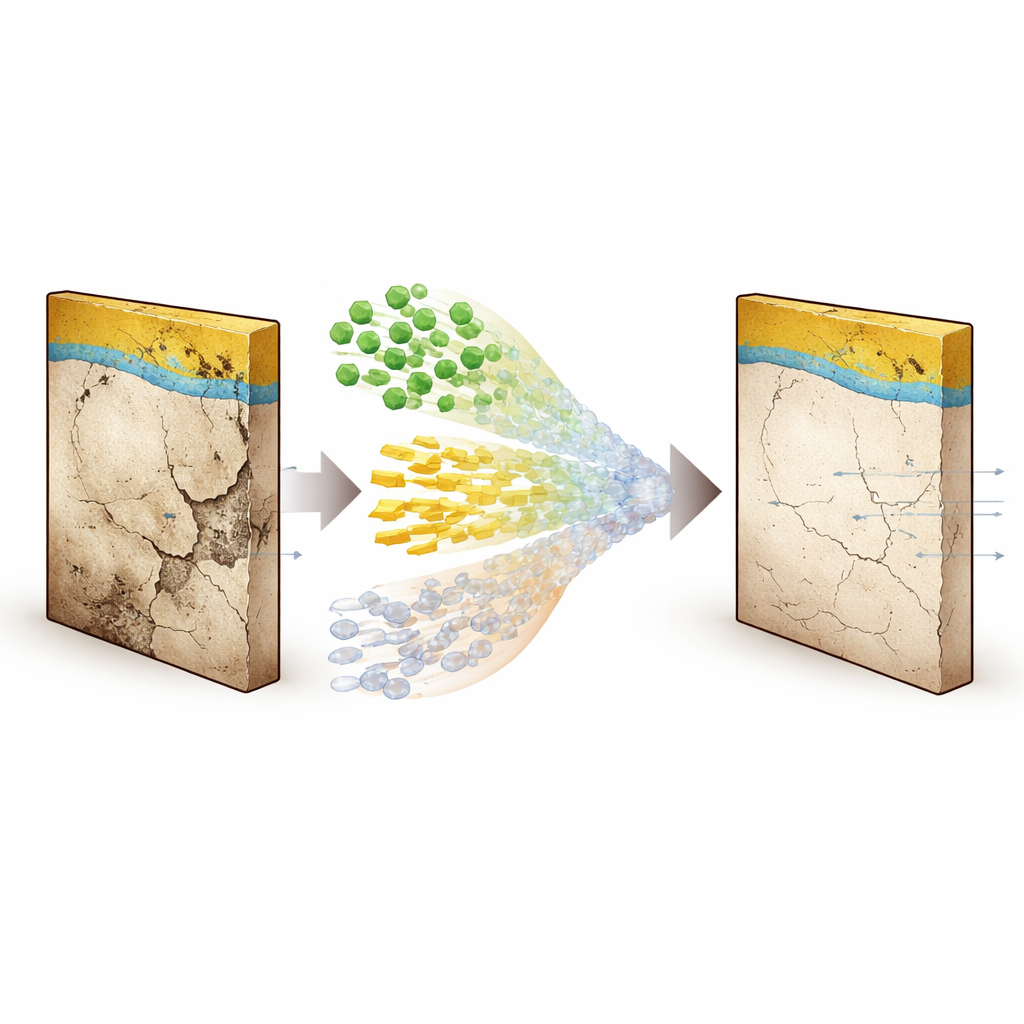
For years, conservators have relied on two main helpers. One is nanolime, tiny particles of calcium hydroxide that chemically blend with the plaster and turn into calcium carbonate, much like the original wall. The other is an acrylic product known as AC33, which forms a strong, clear film that quickly locks loose paint in place. Each has drawbacks: ordinary nanolime can clump, penetrate unevenly, and does little against microbes, while AC33 alone can create a nearly waterproof skin that blocks water vapor from moving in and out of the wall. Over time, that trapped moisture can cause swelling, salt damage, and fresh cracking, undermining the very murals it was meant to save.
Building Smarter Nanobricks
The researchers tackled these problems from the ground up by redesigning the mineral building blocks. They first produced high-quality nano-calcium hydroxide with a controlled hexagonal plate shape around 100 nanometers across. Compared with commercial lime powders, these particles dispersed far better in alcohol, stayed stable in suspension for at least a day, and slipped more easily into the fine pores of plaster. This improved contact with the wall translated into higher bending strength and minimal loss of surface material, all while leaving the color and water-vapor flow of test murals essentially unchanged.
Adding a Light-Driven Shield
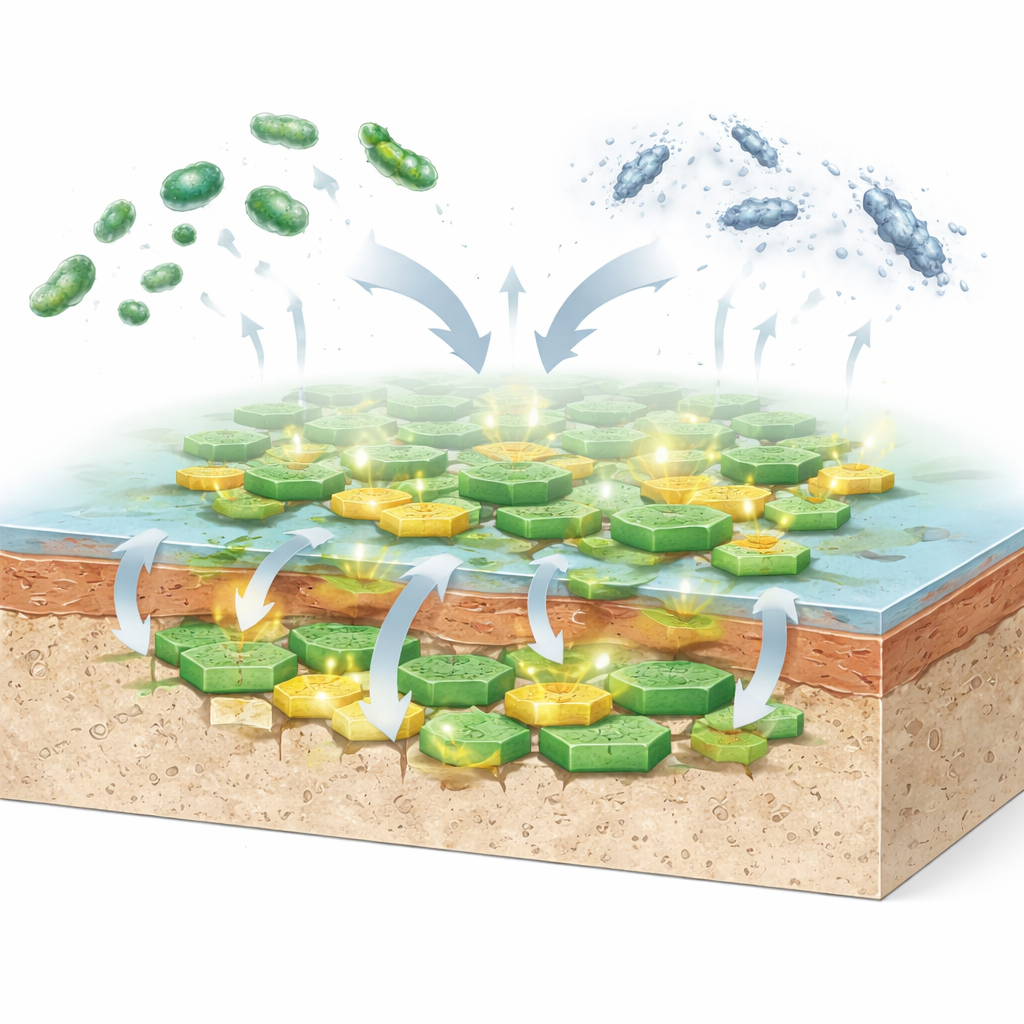
Next, the team introduced a second ingredient: bismuth titanate (Bi4Ti3O12), engineered as tiny plate-like particles using a molten-salt method. These particles absorb nearly all incoming ultraviolet light yet remain relatively transparent to visible light, an ideal combination for protecting pigments without clouding them. Crucially, under light they act as photocatalysts, generating highly reactive oxygen species that can tear apart organic molecules and microbes. By growing the nanolime and bismuth titanate together, the scientists created a close-contact "heterojunction" in which electric charges generated by light are efficiently separated rather than wasted. In tests with a dye pollutant and with common mural invaders—Escherichia coli and the fungus Aspergillus niger—these mixed particles degraded the dye and wiped out up to 99% of microbes at certain mixing ratios.
Blending Mineral Strength with Gentle Glue
To translate these nanoscale tricks into a real-world consolidant, the authors embedded the mineral heterojunction inside the familiar AC33 acrylic, aided by a silicone-based component (PDMS) that makes surfaces more water-repellent and chemically robust. The result is a three-phase gradient material: an outer organic film that grips loose paint, a network of nanolime and bismuth titanate that infiltrates the plaster below, and open pathways that still allow some water vapor to escape. Careful tuning of the mixing ratios was crucial. At an AC33 to mineral ratio of 20:1, simulated murals gained about two-and-a-half times the bending strength of samples treated with nanolime alone, lost almost no material in peel tests, and yet showed only tiny color shifts that fall below what the human eye easily notices. Although the acrylic still reduces breathability compared with bare plaster, adding the mineral particles keeps it significantly more permeable than pure AC33 films.
What This Means for Real Murals
From a conservator’s perspective, the most promising formula behaved like a multifunctional safety net. It strengthened weakened plaster, held powdering paint in place, blocked harmful UV light, and maintained strong antibacterial and antifungal activity, all while keeping color change and moisture blockage within acceptable bounds. After six months of natural aging in the lab, treated test murals remained intact and showed no obvious new cracking or pigment loss. In practical terms, the study points toward a new generation of "smart" consolidation materials that do more than simply glue old walls together: they actively help murals withstand light, microbes, and time, offering a more balanced, long-term approach to safeguarding painted heritage.
Citation: Qin, Y., Shi, LK., Kou, YT. et al. Functionalization and application expansion of nano-Ca(OH)2 realized via three-phase AC33-Ca(O)2/Bi4Ti3O12 functional composite materials. npj Herit. Sci. 14, 289 (2026). https://doi.org/10.1038/s40494-026-02541-4
Keywords: mural conservation, nanolime, antimicrobial coating, cultural heritage, photocatalytic materials